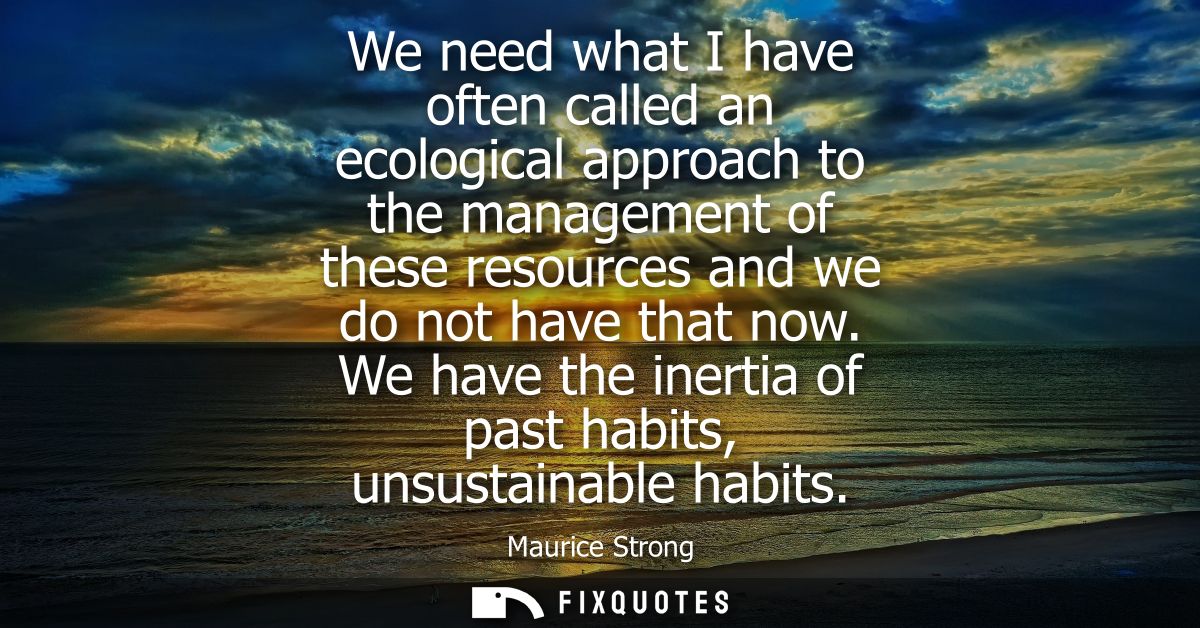
"We need what I have often called an ecological approach to the management of these resources and we do not have that now. We have the inertia of past habits, unsustainable habits"
About this Quote
“Ecological approach” is doing double duty here: it’s a policy prescription and a rebuke. Maurice Strong, the businessman-turned-global-environmental power broker (best known for helping shape the modern UN sustainability agenda), frames environmental management as a systems problem, not a moral scold. That’s strategic. “Management of these resources” speaks the language of boardrooms and ministries; it reassures listeners that this isn’t anti-growth romanticism, it’s operational competence. Then he tightens the screw: we don’t have it now.
The key move is the villain he names: “inertia.” Not greed, not ignorance, but habit. That’s a sharper accusation because it implicates everyone who benefits from the status quo without needing to announce themselves as villains. Inertia is also the perfect alibi for institutions: no one “chooses” it, it just happens. Strong is calling that bluff. By labeling past habits “unsustainable,” he collapses nostalgia into liability. What worked yesterday is reframed as a deferred cost structure that’s now coming due.
Context matters: Strong’s career sits at the hinge between postwar industrial optimism and the era when climate, biodiversity loss, and pollution became governance issues, not just scientific ones. His phrasing signals a transition from conservation as a niche concern to ecology as the operating system for economies. The subtext is political: if you wait for voluntary change, the machine will keep running. An “ecological approach” isn’t just greener management; it’s an attempt to rewrite the default settings that inertia protects.
The key move is the villain he names: “inertia.” Not greed, not ignorance, but habit. That’s a sharper accusation because it implicates everyone who benefits from the status quo without needing to announce themselves as villains. Inertia is also the perfect alibi for institutions: no one “chooses” it, it just happens. Strong is calling that bluff. By labeling past habits “unsustainable,” he collapses nostalgia into liability. What worked yesterday is reframed as a deferred cost structure that’s now coming due.
Context matters: Strong’s career sits at the hinge between postwar industrial optimism and the era when climate, biodiversity loss, and pollution became governance issues, not just scientific ones. His phrasing signals a transition from conservation as a niche concern to ecology as the operating system for economies. The subtext is political: if you wait for voluntary change, the machine will keep running. An “ecological approach” isn’t just greener management; it’s an attempt to rewrite the default settings that inertia protects.
Quote Details
| Topic | Nature |
|---|
More Quotes by Maurice
Add to List