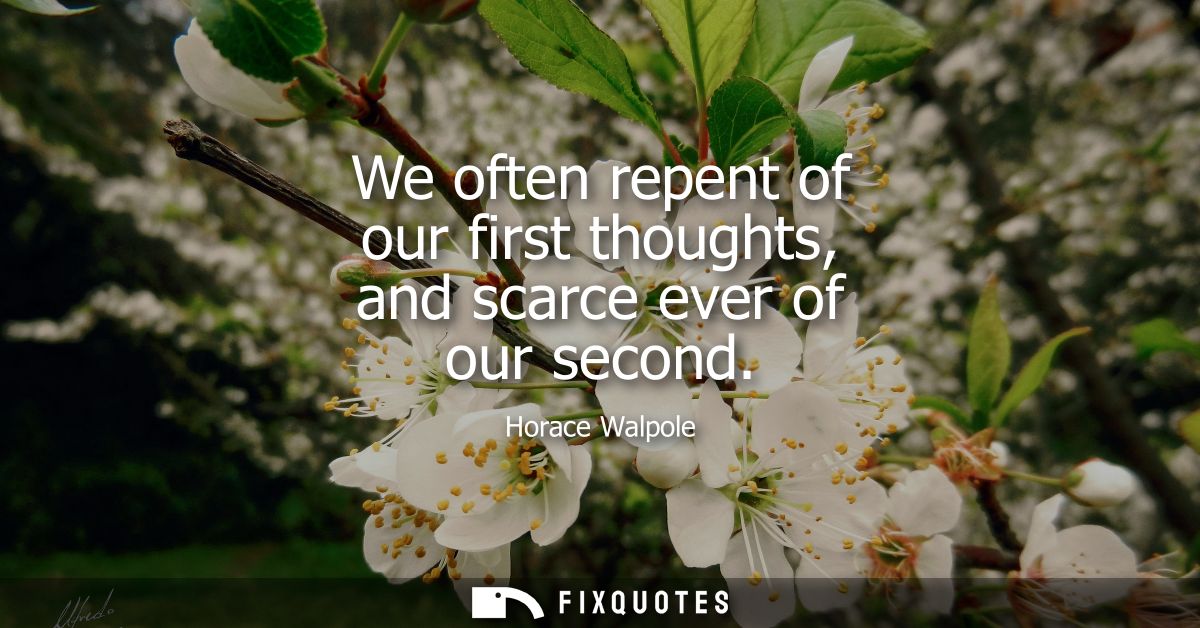
"We often repent of our first thoughts, and scarce ever of our second"
About this Quote
Walpole is flattering the second thought while quietly disciplining the first. The line lands with the neat authority of a maxim, but its real work is social: it trains the reader in an 18th-century virtue prized by polite society and precarious politics alike, self-command. “First thoughts” are impulse, appetite, the raw emotional draft you don’t send. “Second” are the revised version shaped by manners, strategy, and the awareness that other people are watching.
The bite is in “often” versus “scarce ever.” Walpole isn’t claiming second thoughts are always morally purer; he’s claiming they’re safer. Regret is framed less as ethical failure than as reputational cost. In a world of salons, letters, and court intrigue, your unfiltered reaction could harden into a public position before you’ve decided what you actually mean. A second thought is not simply reflection; it’s triage.
There’s also a subtle admission of duplicity that makes the aphorism feel modern. The second thought can be wisdom, but it can also be calculation: the story you choose to tell after your first instinct reveals too much. Walpole, a novelist of atmospheres and hidden corridors, understands that human beings are not transparent to themselves, let alone to others. The quote works because it makes prudence sound like conscience, turning restraint into a moral upgrade, and leaving the reader to wonder how often their “better” self is just their more edited one.
The bite is in “often” versus “scarce ever.” Walpole isn’t claiming second thoughts are always morally purer; he’s claiming they’re safer. Regret is framed less as ethical failure than as reputational cost. In a world of salons, letters, and court intrigue, your unfiltered reaction could harden into a public position before you’ve decided what you actually mean. A second thought is not simply reflection; it’s triage.
There’s also a subtle admission of duplicity that makes the aphorism feel modern. The second thought can be wisdom, but it can also be calculation: the story you choose to tell after your first instinct reveals too much. Walpole, a novelist of atmospheres and hidden corridors, understands that human beings are not transparent to themselves, let alone to others. The quote works because it makes prudence sound like conscience, turning restraint into a moral upgrade, and leaving the reader to wonder how often their “better” self is just their more edited one.
Quote Details
| Topic | Reason & Logic |
|---|---|
| Source | Help us find the source |
| Cite |
Citation Formats
APA Style (7th ed.)
Walpole, Horace. (2026, January 17). We often repent of our first thoughts, and scarce ever of our second. FixQuotes. https://fixquotes.com/quotes/we-often-repent-of-our-first-thoughts-and-scarce-43756/
Chicago Style
Walpole, Horace. "We often repent of our first thoughts, and scarce ever of our second." FixQuotes. January 17, 2026. https://fixquotes.com/quotes/we-often-repent-of-our-first-thoughts-and-scarce-43756/.
MLA Style (9th ed.)
"We often repent of our first thoughts, and scarce ever of our second." FixQuotes, 17 Jan. 2026, https://fixquotes.com/quotes/we-often-repent-of-our-first-thoughts-and-scarce-43756/. Accessed 9 Mar. 2026.
More Quotes by Horace
Add to List