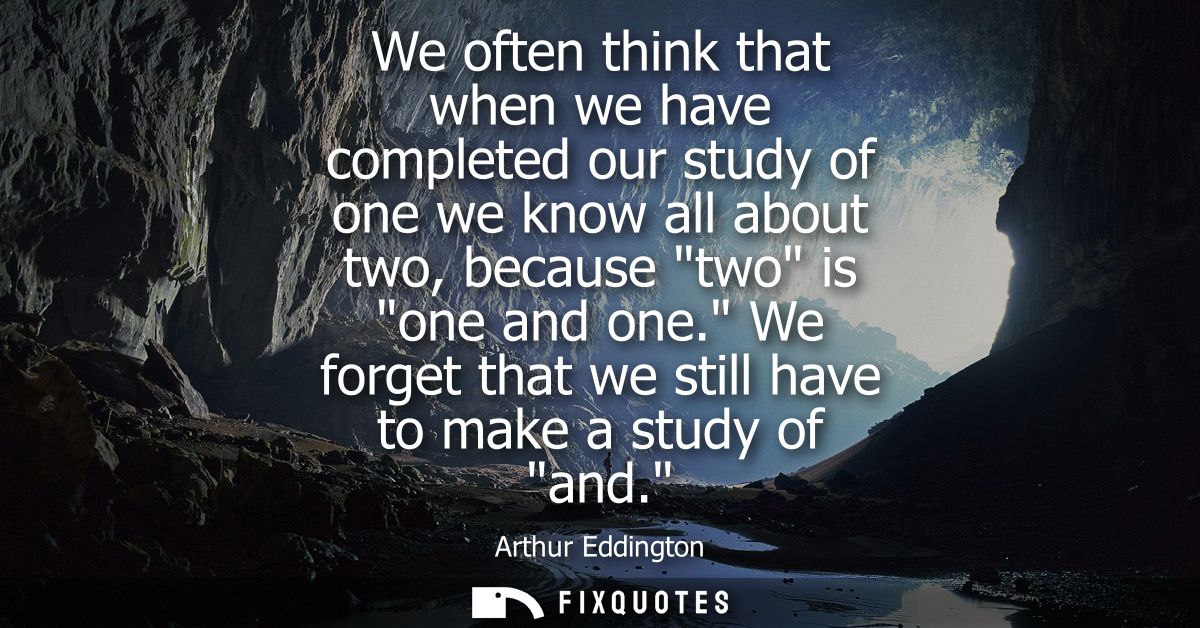
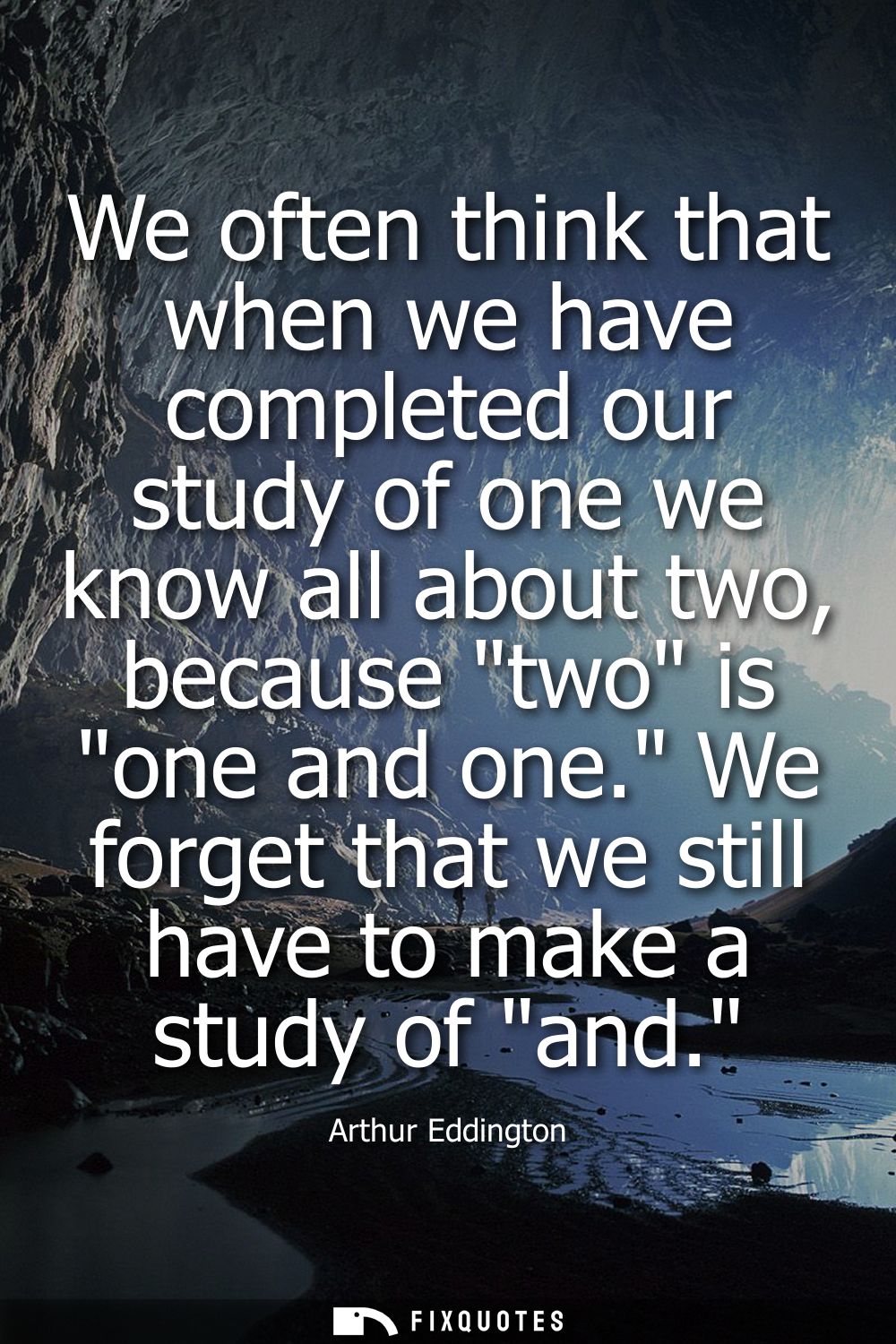
"We often think that when we have completed our study of one we know all about two, because "two" is "one and one". We forget that we still have to make a study of "and""
About this Quote
As a scientist who worked at the hinge between classical physics and the new relativistic, quantum-era weirdness, Eddington had reasons to distrust commonsense composition. Early 20th-century physics kept discovering that interaction terms matter more than the ingredients: gravity isn’t a force that politely stacks; it’s geometry. Measurement isn’t a neutral glance; it disturbs what it observes. In modern language, he’s pointing at emergence and nonlinearity: properties of systems that cannot be predicted by inspecting components in isolation.
The subtext is also social and epistemic. Humans love nouns (“one,” “two”) because they feel concrete. “And” is relational, processual, harder to pin down, easier to ignore. Eddington is urging attention to coupling, context, and the connective tissue of reality: the rules of combination, the conditions of observation, the structure of inference. It’s a reminder that knowledge fails not only by missing facts, but by oversimplifying relationships. The humility here is sharp: mastery of things is never mastery of how things meet.
Quote Details
| Topic | Reason & Logic |
|---|---|
| Source | Help us find the source |
| Cite |
Citation Formats
APA Style (7th ed.)
Eddington, Arthur. (2026, February 19). We often think that when we have completed our study of one we know all about two, because "two" is "one and one". We forget that we still have to make a study of "and". FixQuotes. https://fixquotes.com/quotes/we-often-think-that-when-we-have-completed-our-42566/
Chicago Style
Eddington, Arthur. "We often think that when we have completed our study of one we know all about two, because "two" is "one and one". We forget that we still have to make a study of "and"." FixQuotes. February 19, 2026. https://fixquotes.com/quotes/we-often-think-that-when-we-have-completed-our-42566/.
MLA Style (9th ed.)
"We often think that when we have completed our study of one we know all about two, because "two" is "one and one". We forget that we still have to make a study of "and"." FixQuotes, 19 Feb. 2026, https://fixquotes.com/quotes/we-often-think-that-when-we-have-completed-our-42566/. Accessed 29 Mar. 2026.