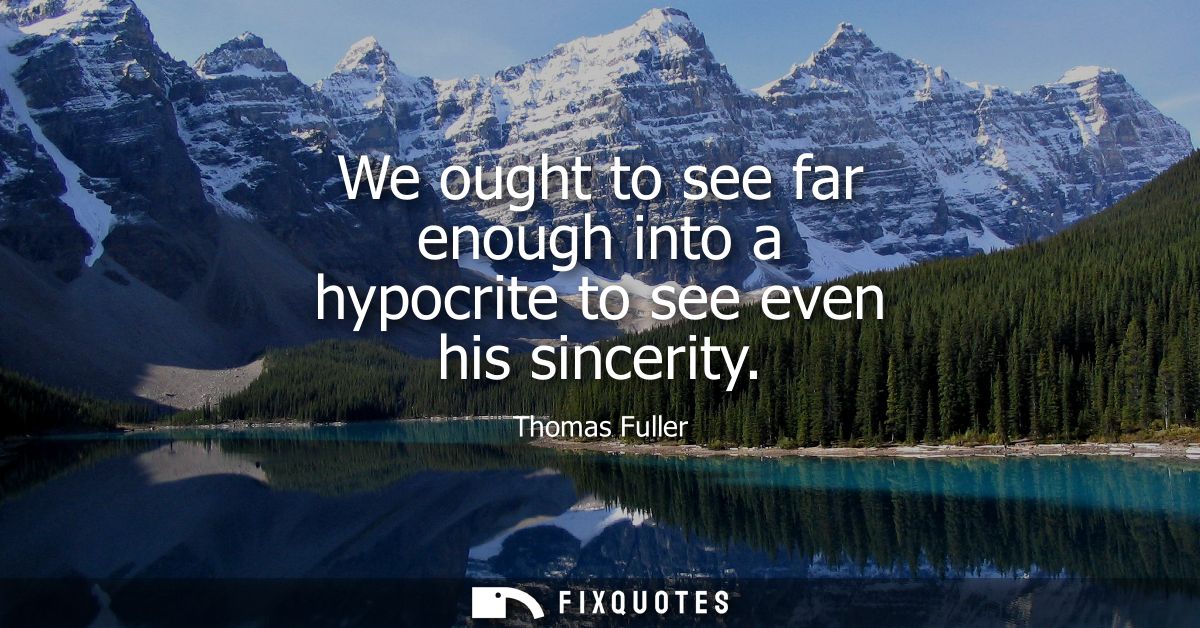
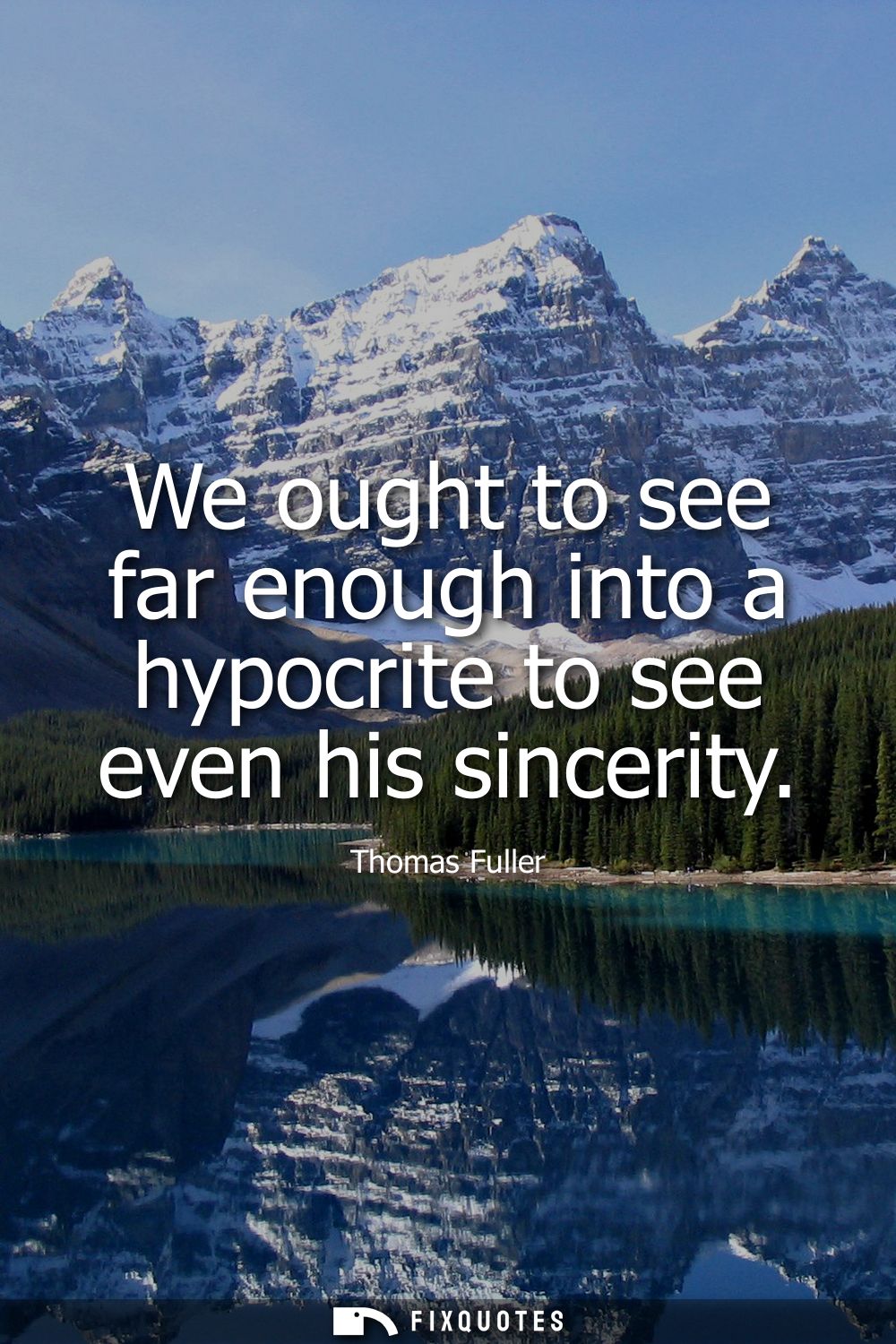
"We ought to see far enough into a hypocrite to see even his sincerity"
About this Quote
Fuller lands the blade where hypocrisy usually hides: not in the lie, but in the strangely earnest need to perform virtue. "We ought to see far enough" flatters the reader into being a moral diagnostician, not just a scold. The target isn't merely the fraud who knows he's faking; it's the person who can both posture and believe, sometimes in the same breath. That twist - "to see even his sincerity" - is the line's real provocation. It suggests hypocrisy isn't the opposite of sincerity but a parasitic cousin: a sincere desire to be seen as good, to belong to goodness, to purchase moral credit on installment.
As a 17th-century English cleric, Fuller is writing in a world where public piety is social currency and religious identity is politically charged. In that environment, hypocrisy isn't a private flaw; it's a public technology. The quote quietly refuses the cheap pleasure of moral denunciation. Fuller asks for a more unsettling literacy: to read the hypocrite as a human being whose conscience is active, just misaligned. That has pastoral utility. If there's sincerity inside the performance, there's leverage for reform; you can appeal to the part that genuinely wants righteousness, not just punish the part that wants applause.
The subtext also checks the righteous observer. To "see far enough" is to admit our own temptation to reduce people to a single vice. Fuller smuggles empathy into judgment, not to excuse hypocrisy, but to explain its engine - and to warn how easily any of us can run on it.
As a 17th-century English cleric, Fuller is writing in a world where public piety is social currency and religious identity is politically charged. In that environment, hypocrisy isn't a private flaw; it's a public technology. The quote quietly refuses the cheap pleasure of moral denunciation. Fuller asks for a more unsettling literacy: to read the hypocrite as a human being whose conscience is active, just misaligned. That has pastoral utility. If there's sincerity inside the performance, there's leverage for reform; you can appeal to the part that genuinely wants righteousness, not just punish the part that wants applause.
The subtext also checks the righteous observer. To "see far enough" is to admit our own temptation to reduce people to a single vice. Fuller smuggles empathy into judgment, not to excuse hypocrisy, but to explain its engine - and to warn how easily any of us can run on it.
Quote Details
| Topic | Honesty & Integrity |
|---|---|
| Source | Help us find the source |
| Cite |
Citation Formats
APA Style (7th ed.)
Fuller, Thomas. (2026, January 18). We ought to see far enough into a hypocrite to see even his sincerity. FixQuotes. https://fixquotes.com/quotes/we-ought-to-see-far-enough-into-a-hypocrite-to-10346/
Chicago Style
Fuller, Thomas. "We ought to see far enough into a hypocrite to see even his sincerity." FixQuotes. January 18, 2026. https://fixquotes.com/quotes/we-ought-to-see-far-enough-into-a-hypocrite-to-10346/.
MLA Style (9th ed.)
"We ought to see far enough into a hypocrite to see even his sincerity." FixQuotes, 18 Jan. 2026, https://fixquotes.com/quotes/we-ought-to-see-far-enough-into-a-hypocrite-to-10346/. Accessed 11 Mar. 2026.
More Quotes by Thomas
Add to List