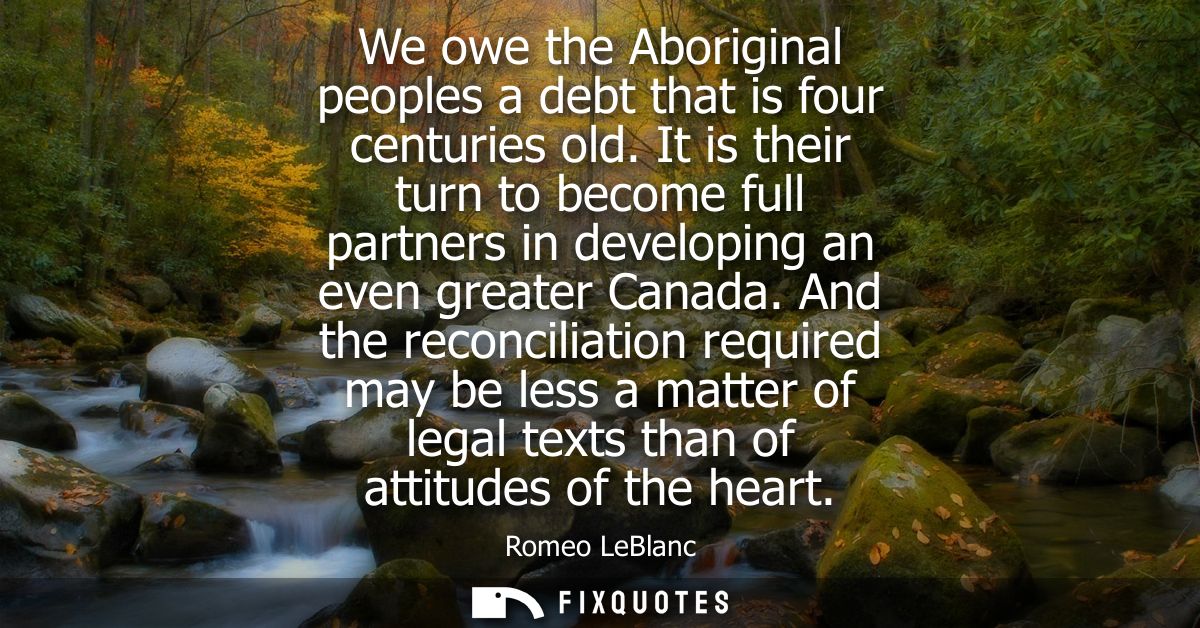
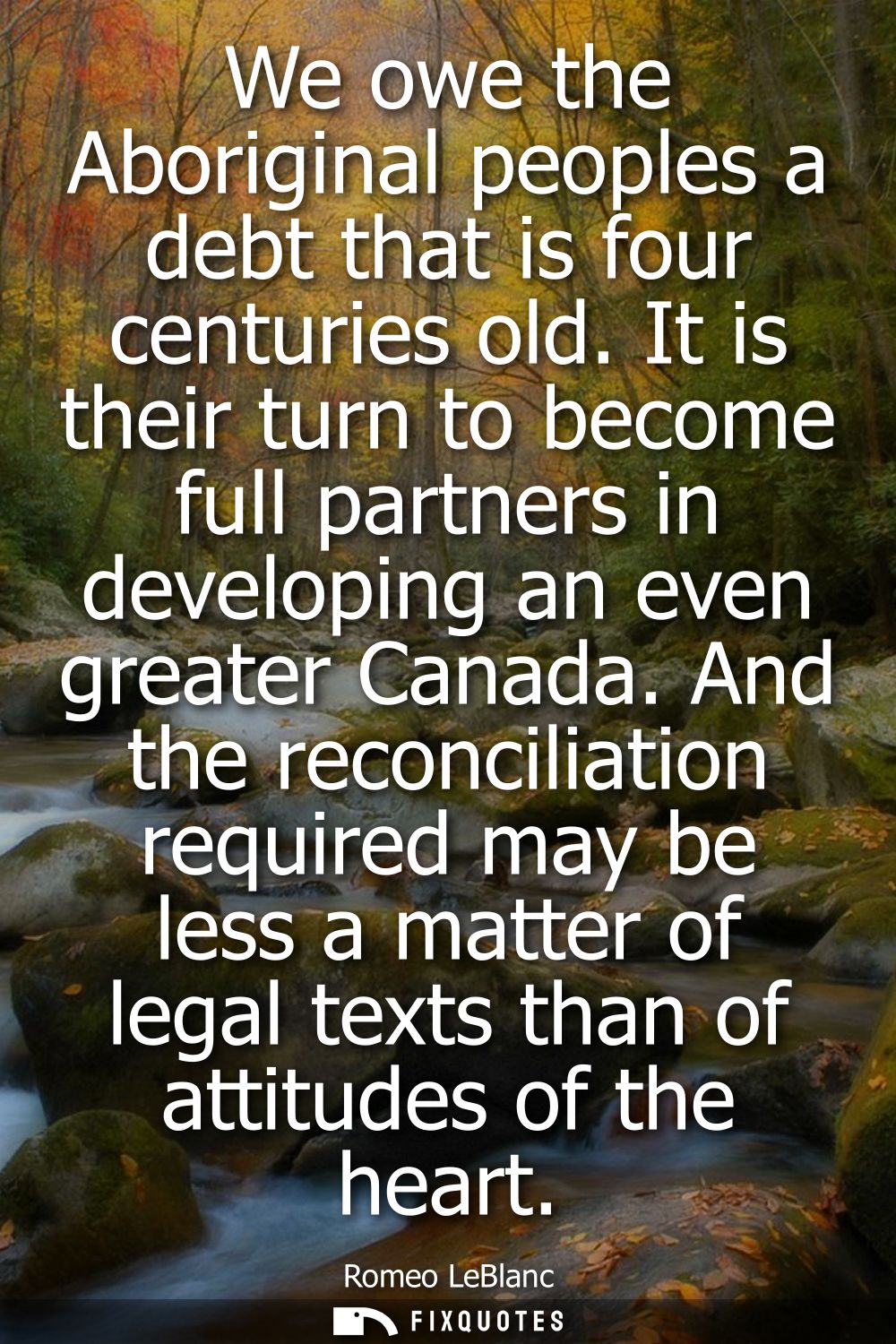
"We owe the Aboriginal peoples a debt that is four centuries old. It is their turn to become full partners in developing an even greater Canada. And the reconciliation required may be less a matter of legal texts than of attitudes of the heart"
About this Quote
Then comes the pivot: “their turn to become full partners in developing an even greater Canada.” The phrasing is generous and revealing. “Their turn” implies a queue, a patience tested, as if inclusion is something the state schedules rather than a right long denied. “Full partners” signals equality, but “developing…Canada” quietly keeps the nation-state as the main project, with Indigenous peoples invited into a shared future whose frame is still “Canada,” not sovereignty on Indigenous terms. It’s reconciliation as nation-building, not necessarily nation-reckoning.
The final sentence is the most strategically ambitious: reconciliation “less a matter of legal texts than of attitudes of the heart.” It tries to move the debate from courts and constitutional wrangling into conscience and everyday behavior. That’s rhetorically elegant - it sidesteps the fatigue many voters feel around legal complexity - but it also risks becoming an escape hatch. If reconciliation is primarily “heart,” governments can perform sincerity while deferring land, jurisdiction, and material repair. LeBlanc is offering moral persuasion with a built-in tension: the country is asked to feel its way toward justice while still controlling the terms of it.
Quote Details
| Topic | Equality |
|---|---|
| Source | Help us find the source |
| Cite |
Citation Formats
APA Style (7th ed.)
LeBlanc, Romeo. (2026, January 14). We owe the Aboriginal peoples a debt that is four centuries old. It is their turn to become full partners in developing an even greater Canada. And the reconciliation required may be less a matter of legal texts than of attitudes of the heart. FixQuotes. https://fixquotes.com/quotes/we-owe-the-aboriginal-peoples-a-debt-that-is-four-151274/
Chicago Style
LeBlanc, Romeo. "We owe the Aboriginal peoples a debt that is four centuries old. It is their turn to become full partners in developing an even greater Canada. And the reconciliation required may be less a matter of legal texts than of attitudes of the heart." FixQuotes. January 14, 2026. https://fixquotes.com/quotes/we-owe-the-aboriginal-peoples-a-debt-that-is-four-151274/.
MLA Style (9th ed.)
"We owe the Aboriginal peoples a debt that is four centuries old. It is their turn to become full partners in developing an even greater Canada. And the reconciliation required may be less a matter of legal texts than of attitudes of the heart." FixQuotes, 14 Jan. 2026, https://fixquotes.com/quotes/we-owe-the-aboriginal-peoples-a-debt-that-is-four-151274/. Accessed 30 Mar. 2026.