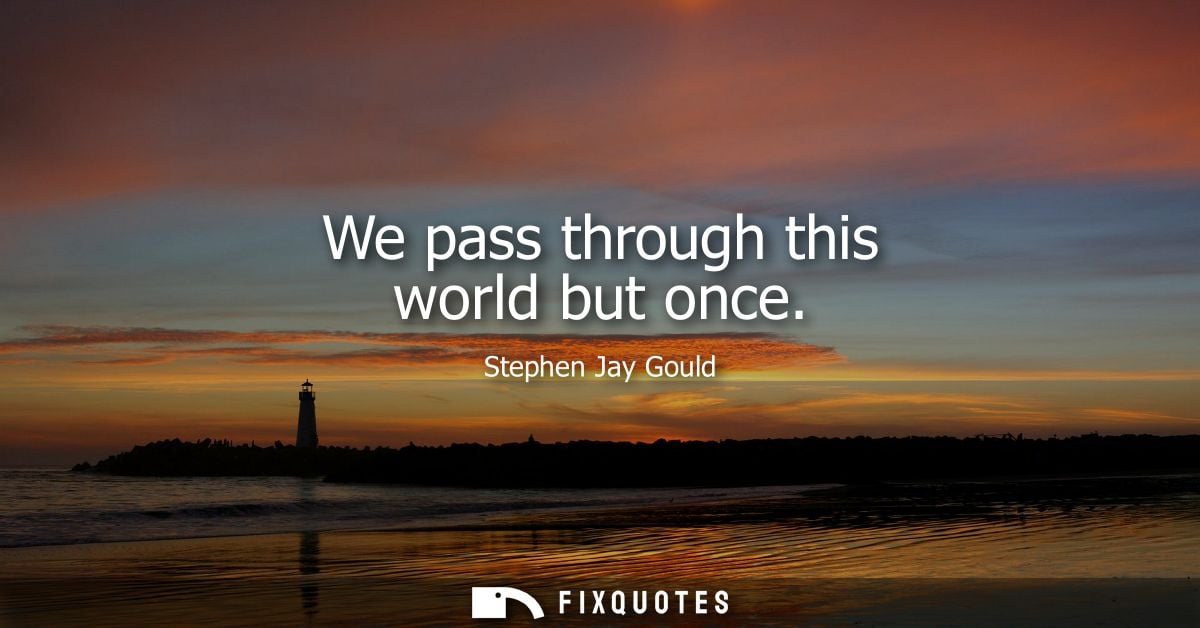
"We pass through this world but once"
About this Quote
Gould’s line lands like a scalpel, not a greeting card. “We pass through this world but once” sounds simple, almost antique, yet it carries the hard-edged secular moralism that runs through his writing: you don’t get cosmic do-overs, so stop outsourcing meaning to eternity and start behaving as if consequences are real, now.
The intent is partly corrective. As an evolutionary biologist who spent a career puncturing comforting narratives - progress as destiny, humans as the climax, nature as neatly purposeful - Gould is allergic to any worldview that treats life as rehearsal for a better, truer realm. “Pass through” suggests motion without ownership: you’re a transient organism in deep time, not the landlord of creation. “But once” is the quiet ultimatum. No rerun, no hidden ledger that will retroactively justify cruelty or waste.
The subtext is also a rebuke to fatalism. If there’s only one trip, then choosing not to choose is still a choice. Gould often paired scientific humility with civic urgency; understanding contingency in evolution makes room for responsibility in culture. Nothing was guaranteed, including us, which makes our brief tenure both less ordained and more precious.
Context matters: late 20th-century America, where science, religion, and politics were in constant friction, and where “meaning” was frequently sold either as certainty or as consumer lifestyle. Gould’s sentence offers a third posture - sober, unsentimental, insisting that wonder and ethics can survive without metaphysical scaffolding.
The intent is partly corrective. As an evolutionary biologist who spent a career puncturing comforting narratives - progress as destiny, humans as the climax, nature as neatly purposeful - Gould is allergic to any worldview that treats life as rehearsal for a better, truer realm. “Pass through” suggests motion without ownership: you’re a transient organism in deep time, not the landlord of creation. “But once” is the quiet ultimatum. No rerun, no hidden ledger that will retroactively justify cruelty or waste.
The subtext is also a rebuke to fatalism. If there’s only one trip, then choosing not to choose is still a choice. Gould often paired scientific humility with civic urgency; understanding contingency in evolution makes room for responsibility in culture. Nothing was guaranteed, including us, which makes our brief tenure both less ordained and more precious.
Context matters: late 20th-century America, where science, religion, and politics were in constant friction, and where “meaning” was frequently sold either as certainty or as consumer lifestyle. Gould’s sentence offers a third posture - sober, unsentimental, insisting that wonder and ethics can survive without metaphysical scaffolding.
Quote Details
| Topic | Life |
|---|---|
| Source | Help us find the source |
| Cite |
Citation Formats
APA Style (7th ed.)
Gould, Stephen Jay. (2026, January 17). We pass through this world but once. FixQuotes. https://fixquotes.com/quotes/we-pass-through-this-world-but-once-75911/
Chicago Style
Gould, Stephen Jay. "We pass through this world but once." FixQuotes. January 17, 2026. https://fixquotes.com/quotes/we-pass-through-this-world-but-once-75911/.
MLA Style (9th ed.)
"We pass through this world but once." FixQuotes, 17 Jan. 2026, https://fixquotes.com/quotes/we-pass-through-this-world-but-once-75911/. Accessed 28 Mar. 2026.
More Quotes by Stephen
Add to List