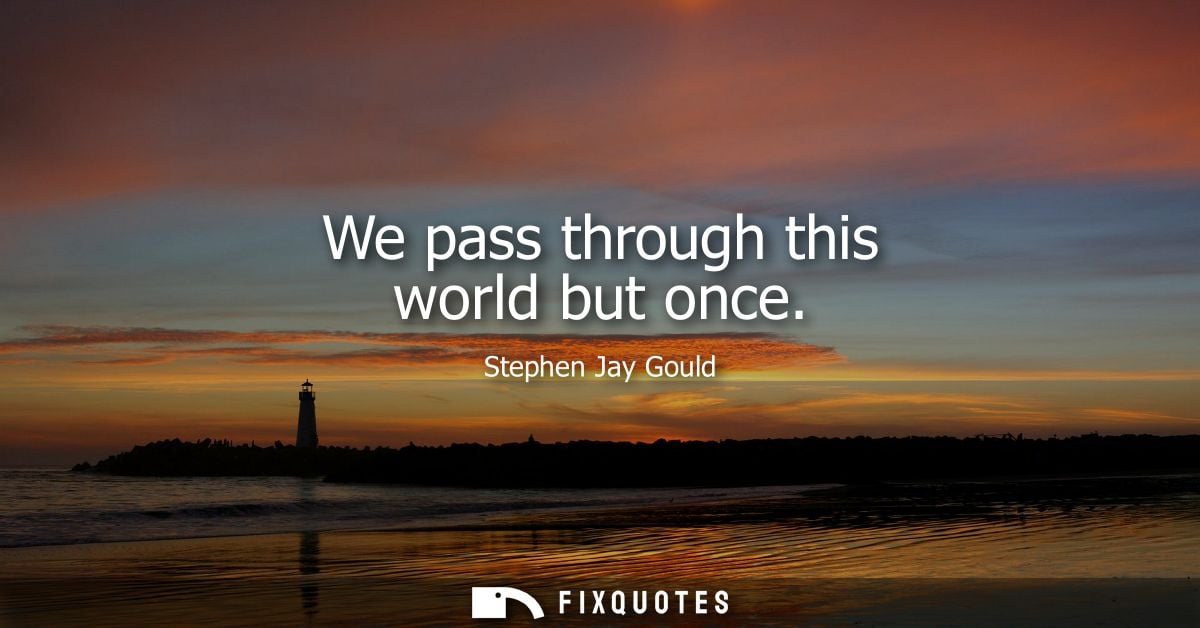
"We pass through this world but once"
About this Quote
A single sentence compresses urgency, humility, and ethical responsibility. To pass through this world but once is to live under the pressure of irreversibility: choices cannot be rewound, experiences are not rehearsals, time flows in one direction. Rather than license for haste or hedonism, the line urges attention and care. It invites a reckoning with scarcity: of days, of opportunities to mend harm, to learn, to love, to preserve what is fragile. The ethical charge comes from finitude. If there is only one passage, then waste is tragic, and conscience must act now, not eventually.
Stephen Jay Gould’s body of work turns this intuition into a worldview grounded in deep time. Human life is a blink against the vast chronicle of evolution, a thin filament laid across epochs of contingency. In Wonderful Life he argues that the history of life is not a ladder but a branching bush full of accidents; our presence is not guaranteed by any cosmic plan. That sense of precarious arrival sharpens the value of our brief tenure. In The Median Isnt the Message, written after his cancer diagnosis, he refuses to let a statistical median dictate an individual fate, finding in variation the space for hope and purposeful living. Passing through once becomes an argument for measured defiance: use knowledge to expand possibility, not to capitulate to averages.
Gould also pressed the moral implications of our one-time passage. We inherit a planet we did not make and will not long possess; extinction is permanent, and so is the harm we inflict on cultures and species. Stewardship, curiosity, and intellectual honesty become obligations, not luxuries. Time’s arrow points forward, and with it goes the chance to do justice to the richness of nature and to each other. To recognize singular passage is to choose engagement over apathy, depth over distraction, and generosity over postponement while we still can.
Stephen Jay Gould’s body of work turns this intuition into a worldview grounded in deep time. Human life is a blink against the vast chronicle of evolution, a thin filament laid across epochs of contingency. In Wonderful Life he argues that the history of life is not a ladder but a branching bush full of accidents; our presence is not guaranteed by any cosmic plan. That sense of precarious arrival sharpens the value of our brief tenure. In The Median Isnt the Message, written after his cancer diagnosis, he refuses to let a statistical median dictate an individual fate, finding in variation the space for hope and purposeful living. Passing through once becomes an argument for measured defiance: use knowledge to expand possibility, not to capitulate to averages.
Gould also pressed the moral implications of our one-time passage. We inherit a planet we did not make and will not long possess; extinction is permanent, and so is the harm we inflict on cultures and species. Stewardship, curiosity, and intellectual honesty become obligations, not luxuries. Time’s arrow points forward, and with it goes the chance to do justice to the richness of nature and to each other. To recognize singular passage is to choose engagement over apathy, depth over distraction, and generosity over postponement while we still can.
Quote Details
| Topic | Life |
|---|
More Quotes by Stephen
Add to List