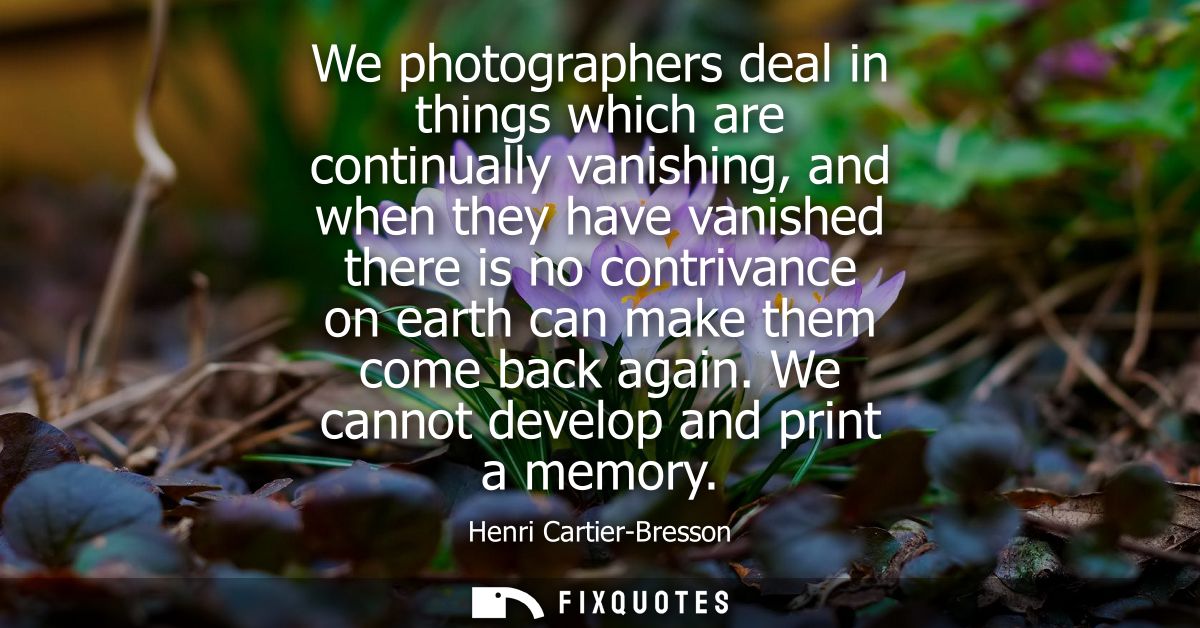
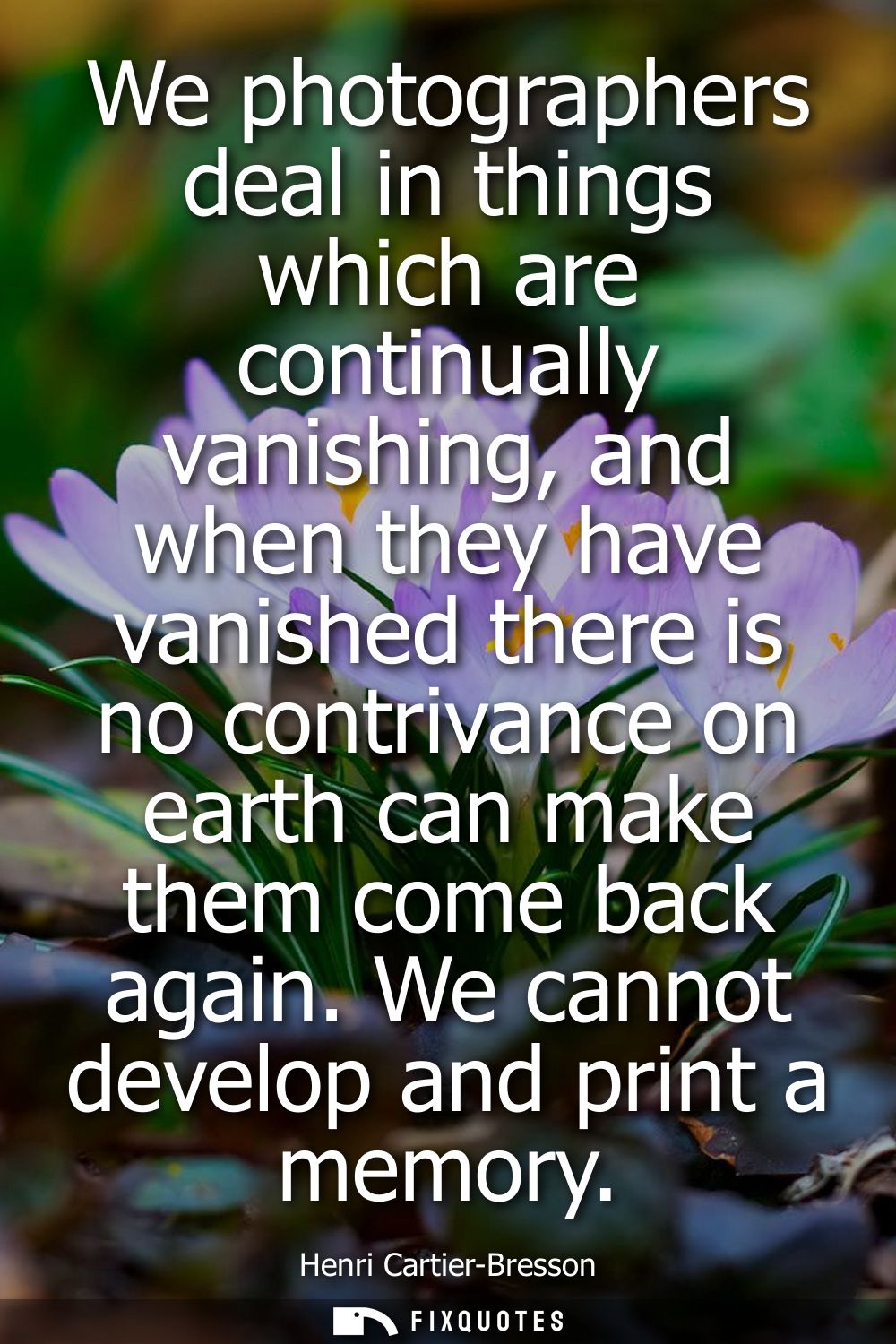
"We photographers deal in things which are continually vanishing, and when they have vanished there is no contrivance on earth can make them come back again. We cannot develop and print a memory"
About this Quote
The phrasing does crucial work. “Deal in things” makes image-making sound like trade or contraband: photographers traffic in the fleeting. “Continually vanishing” strips away any romantic fantasy that reality holds still for art. Then the hard stop: “no contrivance on earth.” That word choice rejects both technology and cleverness as saviors. Better lenses, faster shutters, new formats - none of it resurrects what you missed. It’s a warning aimed at the overconfident technician.
The subtext is also a quiet argument against sentimental myths about photos as “memory.” Cartier-Bresson, father of the “decisive moment,” insists the decisive moment cannot be retroactively manufactured. You can’t “develop and print a memory” because memory isn’t a negative waiting in the darkroom; it’s unstable, biased, rewritten. Photography can fix a surface, not restore an interior life.
Context matters: coming out of the 20th century’s convulsions - war, upheaval, rapid modernity - Cartier-Bresson understood that history doesn’t pose. His remark reads like an ethic: pay attention, be present, because the world isn’t obligated to repeat itself for your art.
Quote Details
| Topic | Art |
|---|---|
| Source | Help us find the source |
| Cite |
Citation Formats
APA Style (7th ed.)
Cartier-Bresson, Henri. (2026, January 17). We photographers deal in things which are continually vanishing, and when they have vanished there is no contrivance on earth can make them come back again. We cannot develop and print a memory. FixQuotes. https://fixquotes.com/quotes/we-photographers-deal-in-things-which-are-54565/
Chicago Style
Cartier-Bresson, Henri. "We photographers deal in things which are continually vanishing, and when they have vanished there is no contrivance on earth can make them come back again. We cannot develop and print a memory." FixQuotes. January 17, 2026. https://fixquotes.com/quotes/we-photographers-deal-in-things-which-are-54565/.
MLA Style (9th ed.)
"We photographers deal in things which are continually vanishing, and when they have vanished there is no contrivance on earth can make them come back again. We cannot develop and print a memory." FixQuotes, 17 Jan. 2026, https://fixquotes.com/quotes/we-photographers-deal-in-things-which-are-54565/. Accessed 29 Mar. 2026.