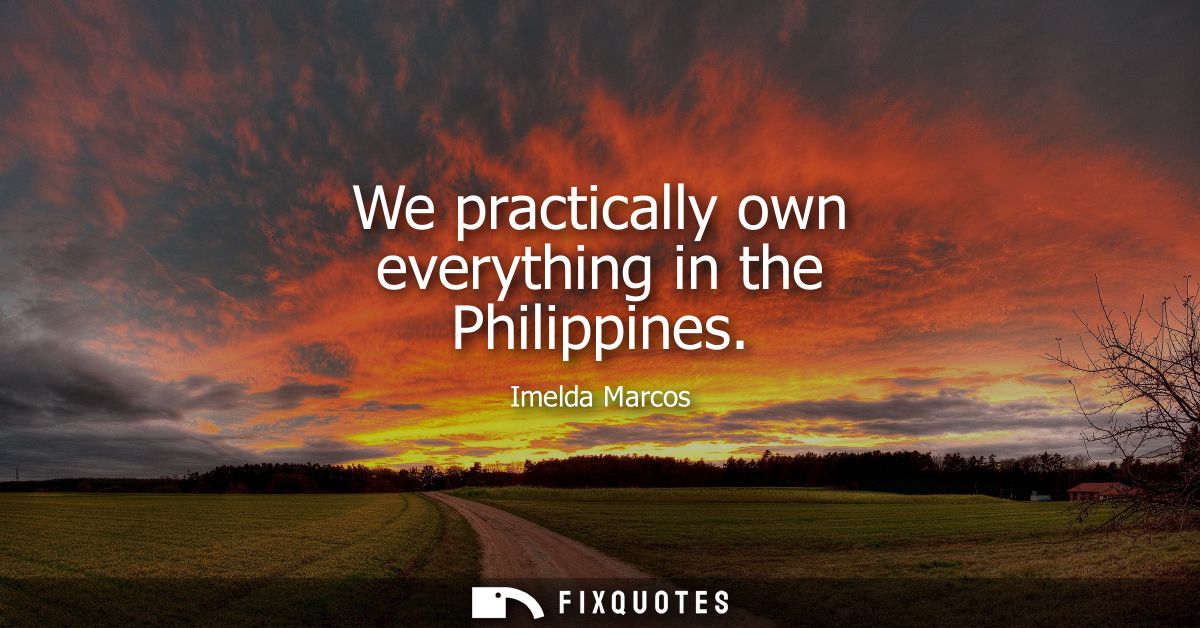
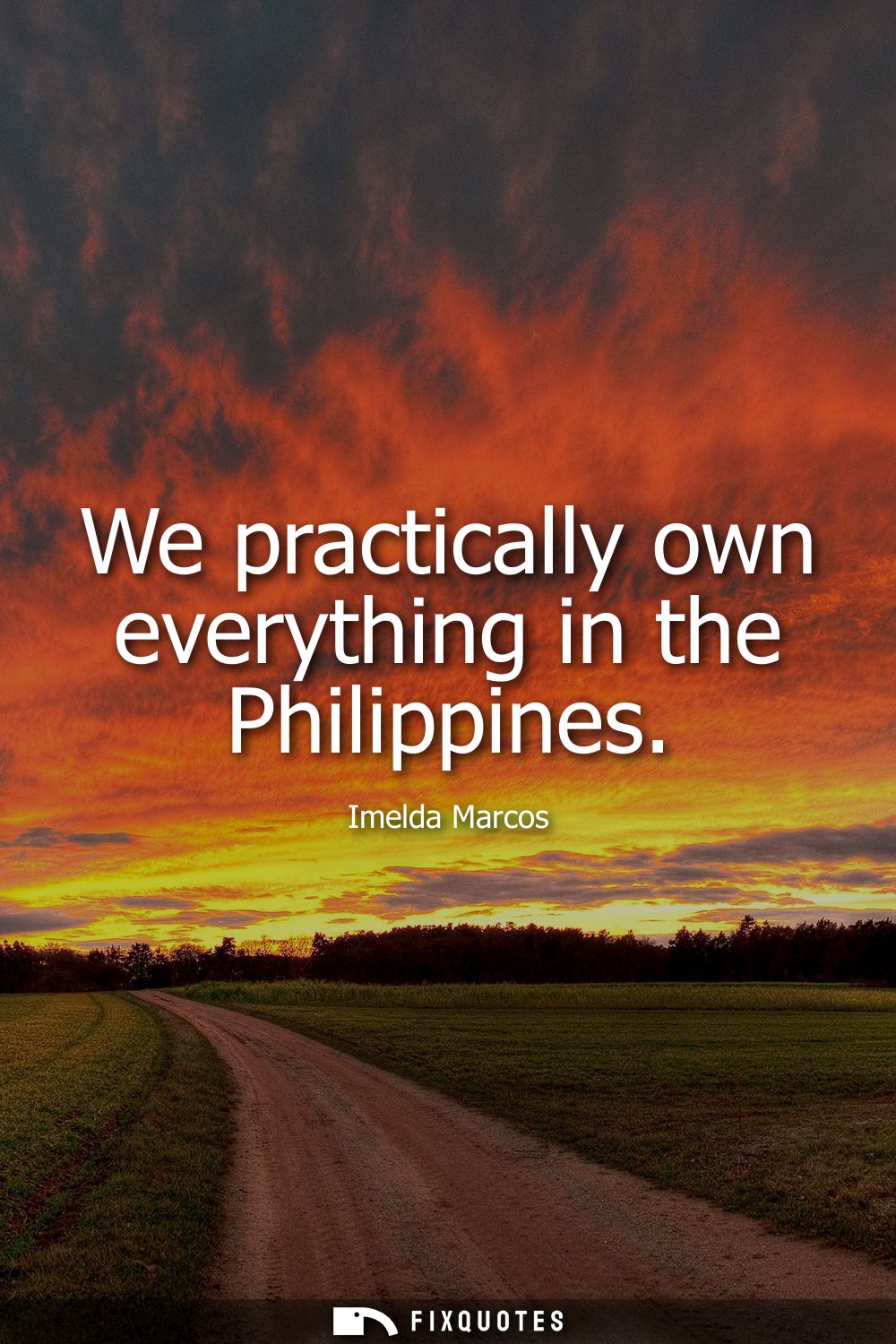
"We practically own everything in the Philippines"
About this Quote
A single adverb does most of the dirty work here. "Practically" pretends to be modest, the little shrug that makes a brazen claim sound like a reasonable observation. It’s a linguistic manicure over a clenched fist. Imelda Marcos isn’t arguing; she’s normalizing. The line doesn’t just confess power, it rehearses it out loud, as if ownership were the natural state of things and the only question is how openly you’re allowed to say it.
The specific intent is almost performative: to project inevitability. "We" collapses the boundary between family, state, and regime, turning private appetite into public fact. "Own everything" is cartoonishly total, but the exaggeration is strategic. It dares the listener to dispute it, because disputing it means admitting the terms of the game: that the Philippines is an asset, not a polity; a portfolio, not a people.
The context makes the sentence sting. Under Ferdinand Marcos, the Philippines became a laboratory for kleptocracy wrapped in pageantry: martial law, crony capitalism, curated glamour, and a public narrative of national destiny that conveniently tracked the family’s bank accounts. Imelda’s celebrity wasn’t incidental; it was infrastructure. The shoes, the cultural projects, the relentless visibility functioned as soft power that distracted from hard extraction.
Subtextually, the quote reveals an imperial mindset turned inward. It’s colonization by domestic elites: the nation as a mansion, citizens as staff, institutions as closets you can rummage through. That casualness is the most chilling part. It treats capture as accomplished, corruption as architecture, and accountability as a PR problem.
The specific intent is almost performative: to project inevitability. "We" collapses the boundary between family, state, and regime, turning private appetite into public fact. "Own everything" is cartoonishly total, but the exaggeration is strategic. It dares the listener to dispute it, because disputing it means admitting the terms of the game: that the Philippines is an asset, not a polity; a portfolio, not a people.
The context makes the sentence sting. Under Ferdinand Marcos, the Philippines became a laboratory for kleptocracy wrapped in pageantry: martial law, crony capitalism, curated glamour, and a public narrative of national destiny that conveniently tracked the family’s bank accounts. Imelda’s celebrity wasn’t incidental; it was infrastructure. The shoes, the cultural projects, the relentless visibility functioned as soft power that distracted from hard extraction.
Subtextually, the quote reveals an imperial mindset turned inward. It’s colonization by domestic elites: the nation as a mansion, citizens as staff, institutions as closets you can rummage through. That casualness is the most chilling part. It treats capture as accomplished, corruption as architecture, and accountability as a PR problem.
Quote Details
| Topic | Human Rights |
|---|---|
| Source | Help us find the source |
| Cite |
Citation Formats
APA Style (7th ed.)
Marcos, Imelda. (2026, January 14). We practically own everything in the Philippines. FixQuotes. https://fixquotes.com/quotes/we-practically-own-everything-in-the-philippines-49483/
Chicago Style
Marcos, Imelda. "We practically own everything in the Philippines." FixQuotes. January 14, 2026. https://fixquotes.com/quotes/we-practically-own-everything-in-the-philippines-49483/.
MLA Style (9th ed.)
"We practically own everything in the Philippines." FixQuotes, 14 Jan. 2026, https://fixquotes.com/quotes/we-practically-own-everything-in-the-philippines-49483/. Accessed 6 Mar. 2026.
More Quotes by Imelda
Add to List