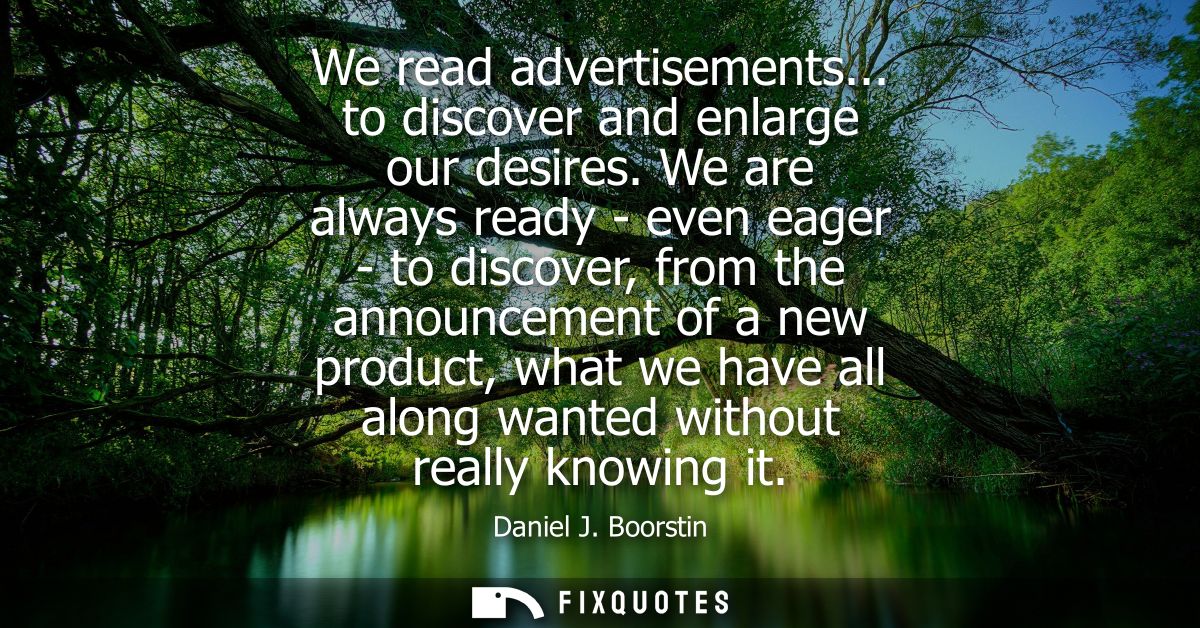
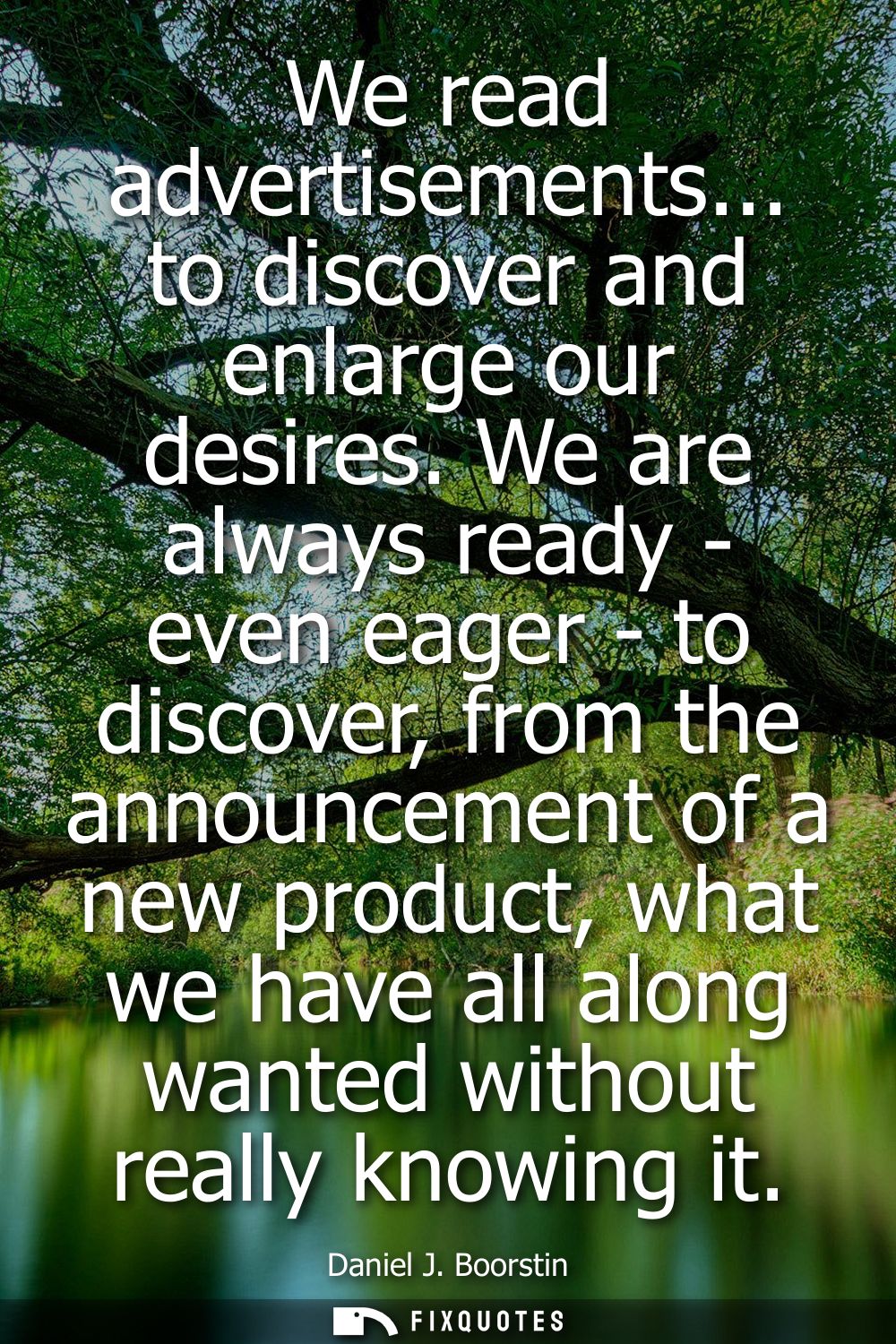
"We read advertisements... to discover and enlarge our desires. We are always ready - even eager - to discover, from the announcement of a new product, what we have all along wanted without really knowing it"
About this Quote
The line works because it flatters and indicts at once. “Enlarge our desires” sounds like enrichment, the rhetoric of personal growth. But enlargement here is inflation: the stretching of want until it fills the space where judgment used to be. His sharpest move is the paradox “what we have all along wanted without really knowing it.” Ads don’t merely persuade; they confer retroactive destiny. The new product arrives as a revelation of your “real” needs, making consumption feel less like impulse and more like recognition.
Context matters. Writing in the mid-to-late 20th century, Boorstin watched mass media mature into a system that didn’t just report reality but manufactured “images” of it. Postwar affluence, national television, and the rise of branding created a marketplace where identity could be assembled from purchasable parts. In that environment, advertising’s genius is psychological: it reduces the discomfort of wanting by turning want into a missing piece of the self.
Boorstin’s subtext is not anti-pleasure; it’s anti-amnesia. When desire is continually “discovered” on cue, the consumer’s inner life becomes a feedback loop, and the capacity to want deliberately - to choose a life rather than browse one - quietly erodes.
Quote Details
| Topic | Marketing |
|---|---|
| Source | Later attribution: The New Penguin Dictionary of Modern Quotations (Robert Andrews, 2003) modern compilationISBN: 9780141965314 · ID: VK0vR4fsaigC
Evidence:
... We read advertisements to discover and enlarge our desires . We are always ready even eager to discover , from the announcement of a new product , what we have all along wanted without really knowing it . Ibid . , ch . 5 ... 4 The world ... |
| Cite |
Citation Formats
APA Style (7th ed.)
Boorstin, Daniel J. (2026, March 25). We read advertisements... to discover and enlarge our desires. We are always ready - even eager - to discover, from the announcement of a new product, what we have all along wanted without really knowing it. FixQuotes. https://fixquotes.com/quotes/we-read-advertisements-to-discover-and-enlarge-99588/
Chicago Style
Boorstin, Daniel J. "We read advertisements... to discover and enlarge our desires. We are always ready - even eager - to discover, from the announcement of a new product, what we have all along wanted without really knowing it." FixQuotes. March 25, 2026. https://fixquotes.com/quotes/we-read-advertisements-to-discover-and-enlarge-99588/.
MLA Style (9th ed.)
"We read advertisements... to discover and enlarge our desires. We are always ready - even eager - to discover, from the announcement of a new product, what we have all along wanted without really knowing it." FixQuotes, 25 Mar. 2026, https://fixquotes.com/quotes/we-read-advertisements-to-discover-and-enlarge-99588/. Accessed 27 Mar. 2026.