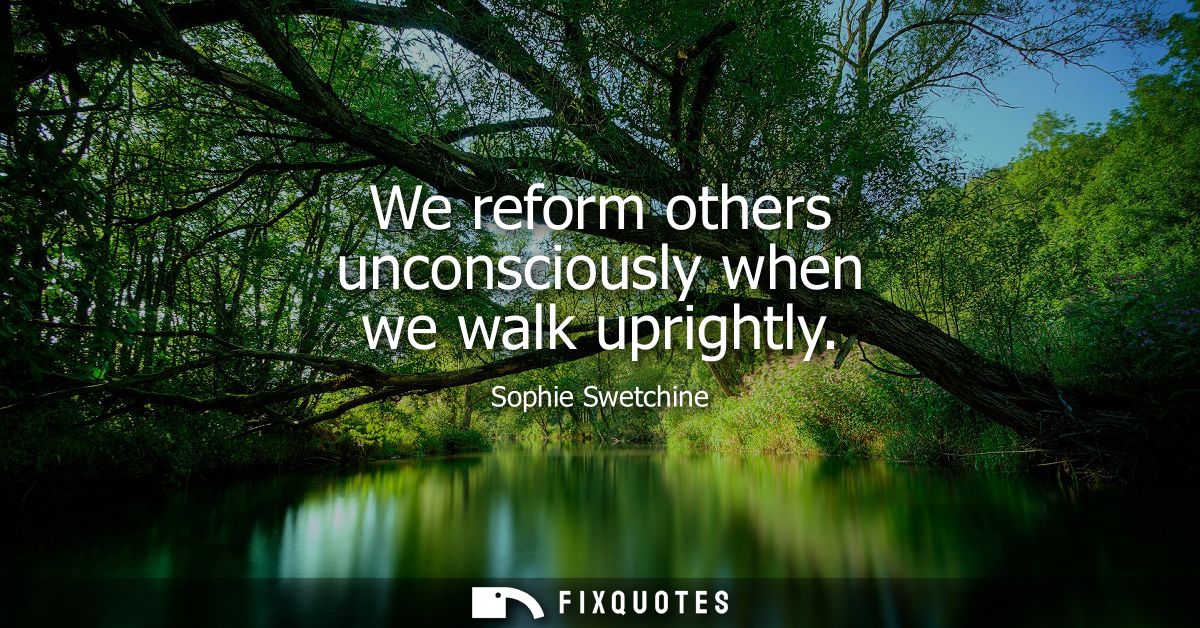
"We reform others unconsciously when we walk uprightly"
About this Quote
Moral influence, Swetchine suggests, is less a sermon than a contagion. "We reform others unconsciously when we walk uprightly" hinges on a sly inversion of the usual reformer fantasy: that change comes from argument, persuasion, or the sheer force of will. Instead, she relocates power to the quiet theater of conduct. "Unconsciously" is the dagger word. It implies our best social impact often happens when we stop trying to manage it, when virtue is practiced as habit rather than performed as messaging. The line flatters no one who wants credit.
The phrase "walk uprightly" carries the period's bodily moral symbolism: character is posture, ethics are gait. It's also strategic ambiguity. Upright can mean religious rectitude, civic decency, or simple self-respect, allowing the sentence to travel across social classes and doctrinal lines. That portability is part of why it works; it reads like private counsel but behaves like a public rule.
Swetchine, a Russian-born salonniere who moved through Catholic and aristocratic circles in 19th-century France, knew a culture where influence was often indirect: conversation, example, reputation. In that context, the quote doubles as both spiritual advice and social technology. It tells the conscientious reader: stop fixating on fixing people; focus on being the kind of person whose presence makes certain behaviors feel slightly harder to justify. Reform, here, is not coercion. It's ambient pressure, the gentle discomfort of being witnessed by integrity.
The phrase "walk uprightly" carries the period's bodily moral symbolism: character is posture, ethics are gait. It's also strategic ambiguity. Upright can mean religious rectitude, civic decency, or simple self-respect, allowing the sentence to travel across social classes and doctrinal lines. That portability is part of why it works; it reads like private counsel but behaves like a public rule.
Swetchine, a Russian-born salonniere who moved through Catholic and aristocratic circles in 19th-century France, knew a culture where influence was often indirect: conversation, example, reputation. In that context, the quote doubles as both spiritual advice and social technology. It tells the conscientious reader: stop fixating on fixing people; focus on being the kind of person whose presence makes certain behaviors feel slightly harder to justify. Reform, here, is not coercion. It's ambient pressure, the gentle discomfort of being witnessed by integrity.
Quote Details
| Topic | Honesty & Integrity |
|---|---|
| Source | Help us find the source |
| Cite |
Citation Formats
APA Style (7th ed.)
Swetchine, Sophie. (2026, January 16). We reform others unconsciously when we walk uprightly. FixQuotes. https://fixquotes.com/quotes/we-reform-others-unconsciously-when-we-walk-131017/
Chicago Style
Swetchine, Sophie. "We reform others unconsciously when we walk uprightly." FixQuotes. January 16, 2026. https://fixquotes.com/quotes/we-reform-others-unconsciously-when-we-walk-131017/.
MLA Style (9th ed.)
"We reform others unconsciously when we walk uprightly." FixQuotes, 16 Jan. 2026, https://fixquotes.com/quotes/we-reform-others-unconsciously-when-we-walk-131017/. Accessed 10 Mar. 2026.
More Quotes by Sophie
Add to List