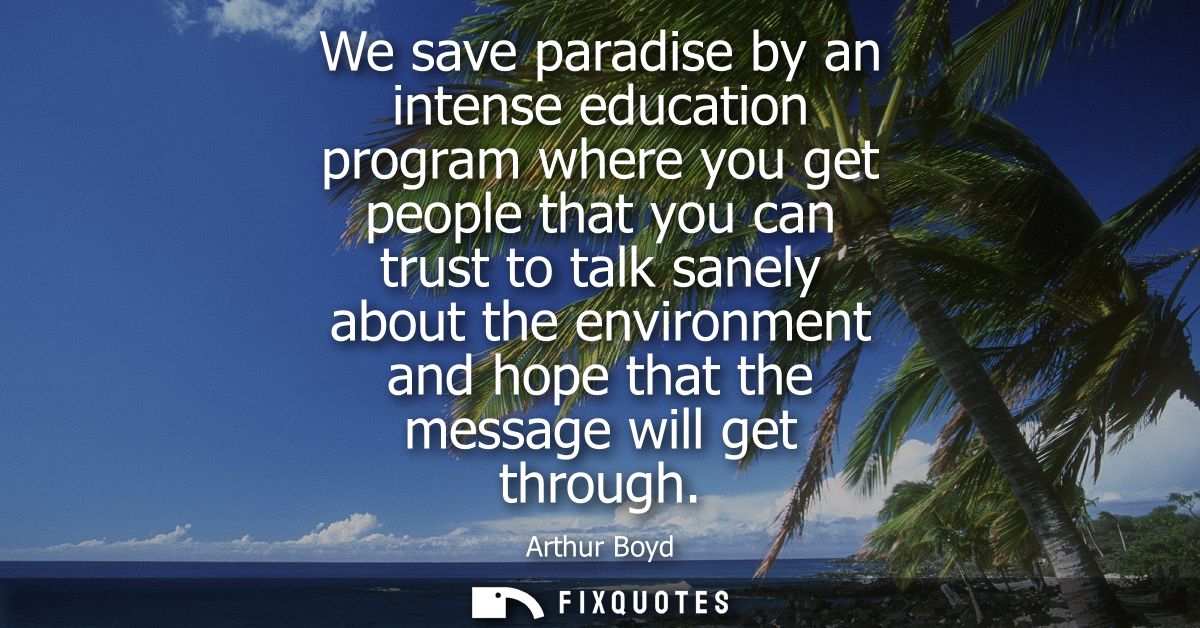
"We save paradise by an intense education program where you get people that you can trust to talk sanely about the environment, and hope that the message will get through"
About this Quote
The engine of the quote is his faith in “an intense education program,” but the telling word is “intense.” He’s not imagining a polite brochure campaign or a school unit tucked between exams. He’s describing a cultural re-training, a sustained pressure against the habits that make environmental harm feel normal. The subtext is that information alone hasn’t worked; what’s needed is education as moral formation.
Then comes the most revealing pivot: “people that you can trust to talk sanely.” Boyd anticipates the problem that still haunts climate communication - credibility and tone. “Trust” implies institutions have already burned social capital. “Sanely” is a quiet rebuke of both denialist bad faith and apocalyptic performance. He’s asking for messengers who can hold urgency without hysteria, and clarity without propaganda.
Finally, “hope that the message will get through” lands like an admission of fragility. Even the best art, the best science, the best teaching competes with louder, richer narratives. Boyd’s intent isn’t just to persuade; it’s to keep open the thinning possibility that public conscience can still be reached in time.
Quote Details
| Topic | Teaching |
|---|---|
| Source | Help us find the source |
| Cite |
Citation Formats
APA Style (7th ed.)
Boyd, Arthur. (2026, February 19). We save paradise by an intense education program where you get people that you can trust to talk sanely about the environment, and hope that the message will get through. FixQuotes. https://fixquotes.com/quotes/we-save-paradise-by-an-intense-education-program-42616/
Chicago Style
Boyd, Arthur. "We save paradise by an intense education program where you get people that you can trust to talk sanely about the environment, and hope that the message will get through." FixQuotes. February 19, 2026. https://fixquotes.com/quotes/we-save-paradise-by-an-intense-education-program-42616/.
MLA Style (9th ed.)
"We save paradise by an intense education program where you get people that you can trust to talk sanely about the environment, and hope that the message will get through." FixQuotes, 19 Feb. 2026, https://fixquotes.com/quotes/we-save-paradise-by-an-intense-education-program-42616/. Accessed 9 Mar. 2026.