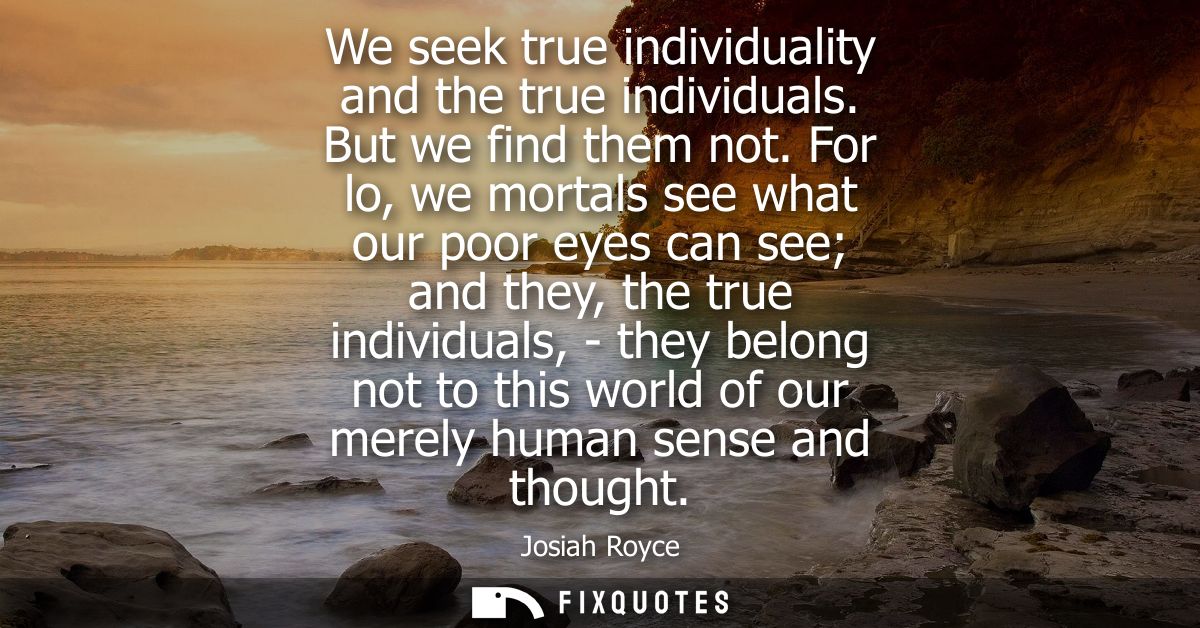
"We seek true individuality and the true individuals. But we find them not. For lo, we mortals see what our poor eyes can see; and they, the true individuals, - they belong not to this world of our merely human sense and thought"
About this Quote
The subtext is a quiet rebuke to both romantic individualism and consumer self-branding avant la lettre. If “our poor eyes” are all we have, then what we call “individuality” may be a projection: a flattering story we tell about difference that remains legible to the crowd. The genuinely individual, for Royce, wouldn’t be merely quirky or oppositional; they would exceed the grid of “human sense and thought” that makes recognition possible in the first place. That’s why “they belong not to this world” lands with metaphysical weight: the true individual is less a personality type than an ideal, perhaps even a spiritual category.
Context matters. Royce, a major American Idealist writing against the grain of emerging pragmatism and a rapidly modernizing U.S., is obsessed with the limits of the isolated self and the moral necessity of community (“loyalty”). This passage reads like a warning: when a culture fetishizes the lone genius, it may end up worshipping shadows - because the deepest individuality, if it exists, can’t be audited by our everyday ways of seeing.
Quote Details
| Topic | Truth |
|---|---|
| Source | Help us find the source |
| Cite |
Citation Formats
APA Style (7th ed.)
Royce, Josiah. (2026, January 18). We seek true individuality and the true individuals. But we find them not. For lo, we mortals see what our poor eyes can see; and they, the true individuals, - they belong not to this world of our merely human sense and thought. FixQuotes. https://fixquotes.com/quotes/we-seek-true-individuality-and-the-true-17723/
Chicago Style
Royce, Josiah. "We seek true individuality and the true individuals. But we find them not. For lo, we mortals see what our poor eyes can see; and they, the true individuals, - they belong not to this world of our merely human sense and thought." FixQuotes. January 18, 2026. https://fixquotes.com/quotes/we-seek-true-individuality-and-the-true-17723/.
MLA Style (9th ed.)
"We seek true individuality and the true individuals. But we find them not. For lo, we mortals see what our poor eyes can see; and they, the true individuals, - they belong not to this world of our merely human sense and thought." FixQuotes, 18 Jan. 2026, https://fixquotes.com/quotes/we-seek-true-individuality-and-the-true-17723/. Accessed 2 Apr. 2026.