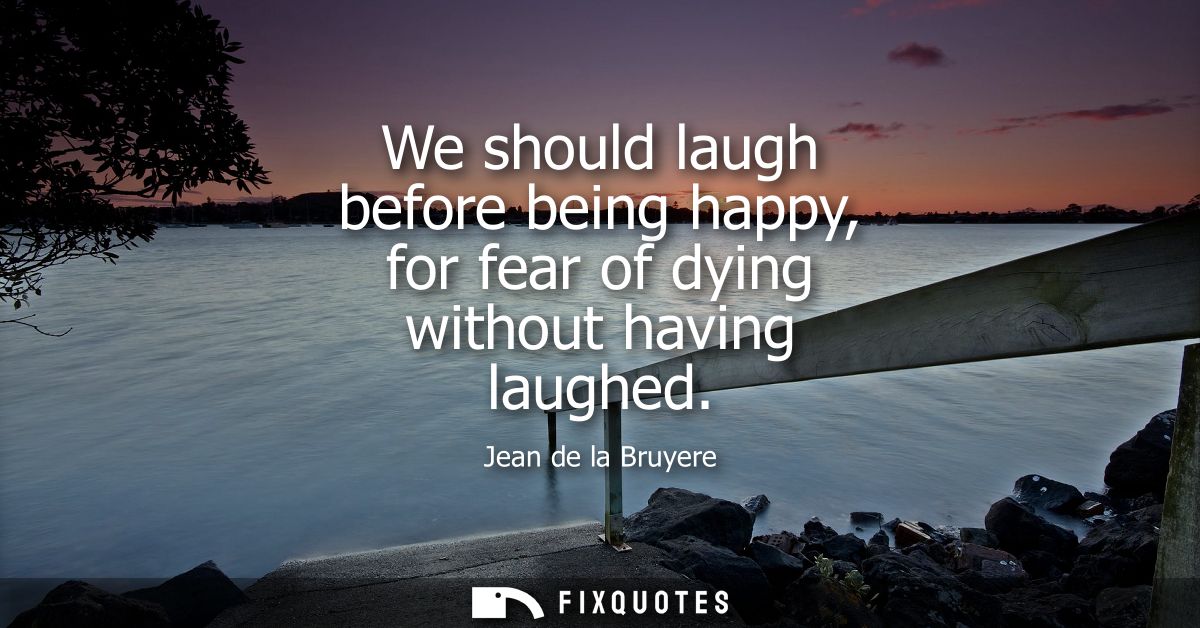
"We should laugh before being happy, for fear of dying without having laughed"
About this Quote
The subtext is pure 17th-century moralist: the courtly performance of seriousness is a kind of vanity, a wager that you control time. Laughter punctures that illusion. It acknowledges contingency, the speed of mortality, the absurdity of self-importance. Theres also a sly theological aftertaste: if salvation and worldly "happiness" are deferred, laughter becomes the one grace you can claim without credentials.
Context matters. La Bruyere wrote amid Versailles-era rigidity, where status was a choreography and wit could be a weapon or a shield. His maxim flatters no one. It implies that the socially approved pursuit of happiness is often just a delay tactic, a respectable way to avoid the present. Laugh first, he suggests, because death is punctual and our plans are not.
Quote Details
| Topic | Mortality |
|---|---|
| Source | Les Caracteres, Jean de La Bruyere, 1688. Aphorism commonly rendered in English as "We should laugh before being happy, for fear of dying without having laughed." |
| Cite |
Citation Formats
APA Style (7th ed.)
Bruyère, Jean de La. (2026, January 17). We should laugh before being happy, for fear of dying without having laughed. FixQuotes. https://fixquotes.com/quotes/we-should-laugh-before-being-happy-for-fear-of-24151/
Chicago Style
Bruyère, Jean de La. "We should laugh before being happy, for fear of dying without having laughed." FixQuotes. January 17, 2026. https://fixquotes.com/quotes/we-should-laugh-before-being-happy-for-fear-of-24151/.
MLA Style (9th ed.)
"We should laugh before being happy, for fear of dying without having laughed." FixQuotes, 17 Jan. 2026, https://fixquotes.com/quotes/we-should-laugh-before-being-happy-for-fear-of-24151/. Accessed 17 Mar. 2026.