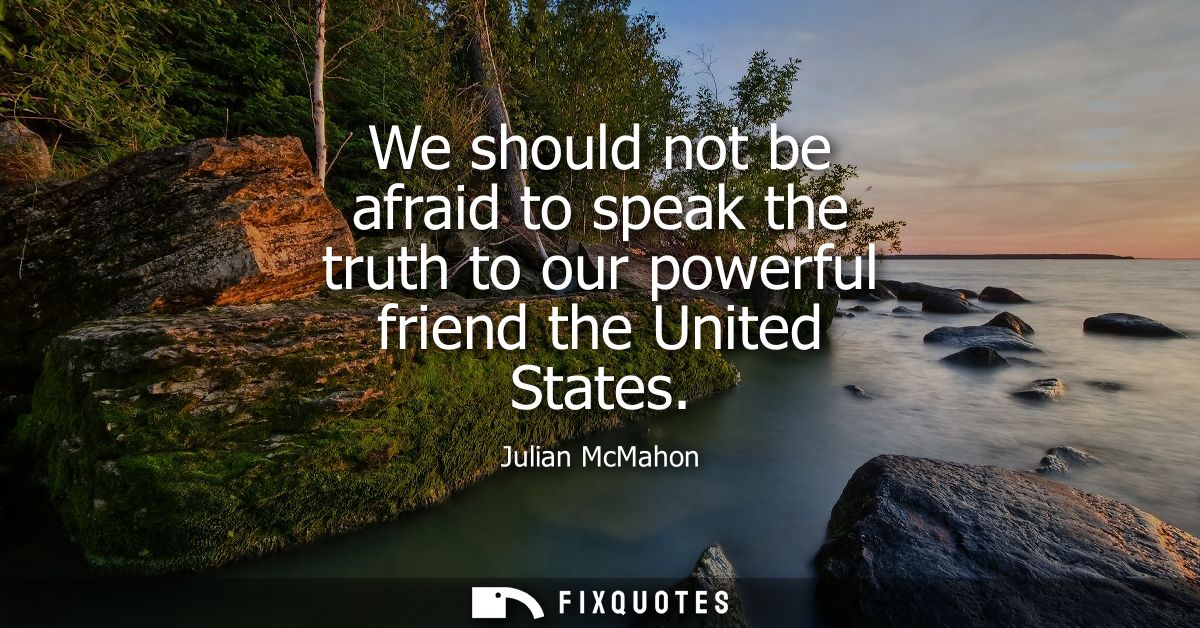
"We should not be afraid to speak the truth to our powerful friend the United States"
About this Quote
There’s a strategic audacity in calling the United States a “powerful friend” and then insisting you shouldn’t be afraid of it. McMahon’s line works because it refuses the two lazy scripts smaller allies often get trapped in: performative loyalty or performative hostility. By pairing “truth” with “friend,” he frames dissent as a duty inside a relationship, not a betrayal outside it. The word “powerful” does double duty: it acknowledges the real asymmetry (military, economic, cultural) while quietly naming the psychological problem that asymmetry creates - self-censorship.
Coming from an actor, the statement also reads as a cultural intervention, not a briefing note. It’s aimed at the public mood: the way American influence can seep into entertainment, politics, and even personal identity, especially in countries tethered to U.S. security or markets. The appeal is less about policy specifics than about permission - permission to critique the hand that helps fund, defend, or co-produce your world.
The subtext: alliances can become a kind of emotional dependency. When your “friend” is the superpower, gratitude gets weaponized, and disagreement is treated as ingratitude. McMahon pushes back on that soft coercion. He’s arguing for mature friendship: honesty that’s willing to risk awkwardness, and sovereignty that doesn’t need theatrics to prove itself. In an era where “anti-American” can be used as a conversational kill switch, the line tries to reopen the space where criticism is framed as civic hygiene, not disloyalty.
Coming from an actor, the statement also reads as a cultural intervention, not a briefing note. It’s aimed at the public mood: the way American influence can seep into entertainment, politics, and even personal identity, especially in countries tethered to U.S. security or markets. The appeal is less about policy specifics than about permission - permission to critique the hand that helps fund, defend, or co-produce your world.
The subtext: alliances can become a kind of emotional dependency. When your “friend” is the superpower, gratitude gets weaponized, and disagreement is treated as ingratitude. McMahon pushes back on that soft coercion. He’s arguing for mature friendship: honesty that’s willing to risk awkwardness, and sovereignty that doesn’t need theatrics to prove itself. In an era where “anti-American” can be used as a conversational kill switch, the line tries to reopen the space where criticism is framed as civic hygiene, not disloyalty.
Quote Details
| Topic | Truth |
|---|---|
| Source | Help us find the source |
More Quotes by Julian
Add to List