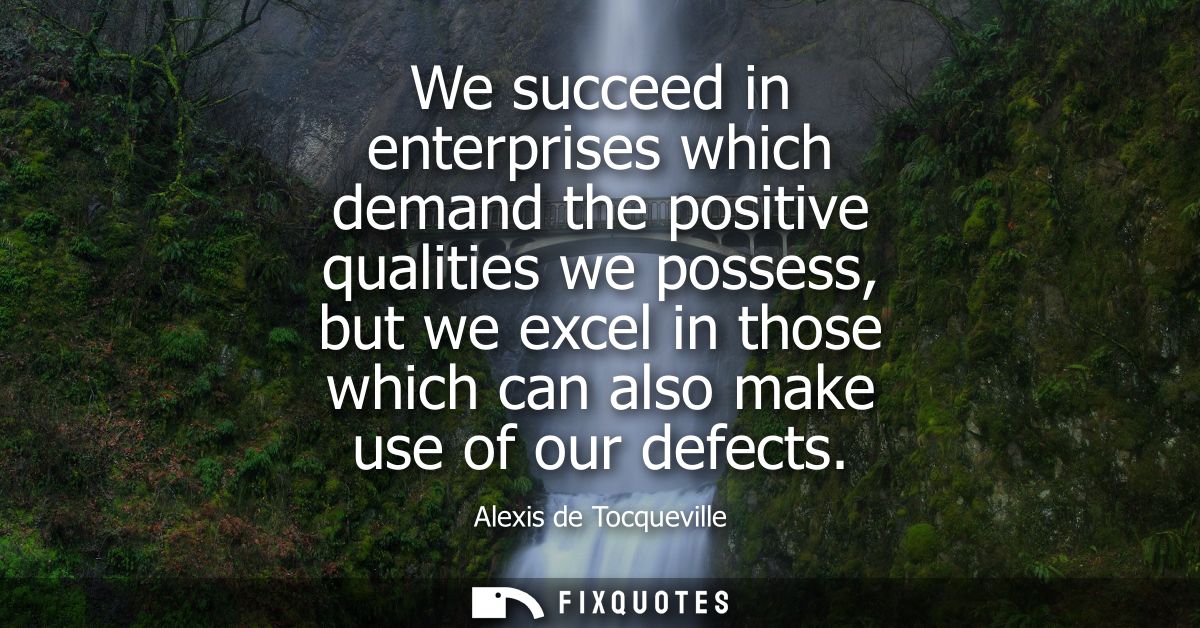
"We succeed in enterprises which demand the positive qualities we possess, but we excel in those which can also make use of our defects"
About this Quote
The intent is diagnostic, not consoling. Tocqueville spent his career studying how institutions and cultures don’t merely reward goodness; they select for particular temperaments. In Democracy in America, he’s fascinated by how democratic life channels ambition, restlessness, conformity, and vanity into productivity and civic energy. This line belongs to that world: modern societies, especially commercial ones, are expert at laundering vice into usefulness. Impatience becomes “drive.” Aggression becomes “leadership.” Even insecurity can become the engine of achievement if the environment pays for overcompensation.
The subtext is sharper than it looks. If systems can “make use of our defects,” then excellence can be morally ambiguous. You may shine not despite your vanity but because a culture of competition monetizes it. Tocqueville isn’t romanticizing brokenness; he’s warning that what we celebrate as brilliance often reflects what an era is designed to exploit. Excellence, in other words, is partly an indictment of the game you’re winning.
Quote Details
| Topic | Success |
|---|---|
| Source | Help us find the source |
| Cite |
Citation Formats
APA Style (7th ed.)
Tocqueville, Alexis de. (2026, January 15). We succeed in enterprises which demand the positive qualities we possess, but we excel in those which can also make use of our defects. FixQuotes. https://fixquotes.com/quotes/we-succeed-in-enterprises-which-demand-the-3498/
Chicago Style
Tocqueville, Alexis de. "We succeed in enterprises which demand the positive qualities we possess, but we excel in those which can also make use of our defects." FixQuotes. January 15, 2026. https://fixquotes.com/quotes/we-succeed-in-enterprises-which-demand-the-3498/.
MLA Style (9th ed.)
"We succeed in enterprises which demand the positive qualities we possess, but we excel in those which can also make use of our defects." FixQuotes, 15 Jan. 2026, https://fixquotes.com/quotes/we-succeed-in-enterprises-which-demand-the-3498/. Accessed 5 Mar. 2026.