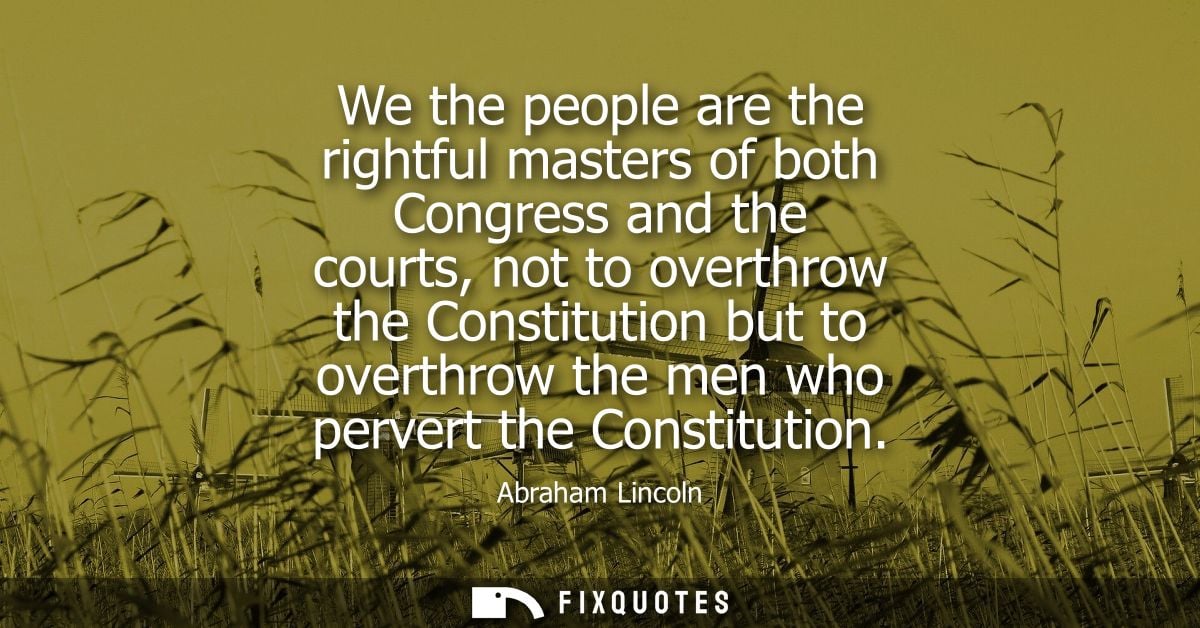
"We, the people, are the rightful masters of both Congress and the courts, not to overthrow the Constitution, but to overthrow the men who pervert the Constitution"
About this Quote
The sentence’s hinge is the double use of “overthrow.” He knows the charge that democratic energy is basically a mob with better branding, so he preempts it. Don’t overthrow the Constitution - overthrow the men who pervert it. That distinction is the whole argument: the danger isn’t the framework, it’s the human beings who can weaponize it while pretending to defend it. Lincoln is granting legitimacy to anger at institutions while carefully channeling it toward electoral and political accountability, not insurrection.
Context matters: Lincoln is speaking in a nation where the most explosive constitutional questions - slavery, federal power, the reach of court rulings - were being fought not only in legislatures but in the public’s idea of who gets to interpret “the law.” The subtext is a rebuke to elite finality, especially judicial sanctimony, without openly discarding the rule of law. It’s majoritarianism with guardrails, an invitation to treat democracy as active maintenance. Reverence, he implies, is how constitutions get hollowed out.
Quote Details
| Topic | Justice |
|---|---|
| Source | Later attribution: Vile Acts of Evil (Michael A. Kirchubel, 2009) modern compilation
Evidence: ... We the people are the rightful masters of both Congress and the courts , not to overthrow the Constitution but to overthrow the men who pervert the Constitution " – Abraham Lincoln . And now you know . “ We hold these truths to be self ... Other candidates (2) Abraham Lincoln (Abraham Lincoln) compilation88.9% r courts the people of these united states are the rightful masters of both congresses and courts not to overthrow th... Abraham Lincoln: The True Story of a Great Life, Volume 1... (Herndon, William Henry, 1891) primary40.6% ls they believe that the congress of the united states has no power under the constitution to interfere with the inst... |
| Cite |
Citation Formats
APA Style (7th ed.)
Lincoln, Abraham. (2026, February 16). We, the people, are the rightful masters of both Congress and the courts, not to overthrow the Constitution, but to overthrow the men who pervert the Constitution. FixQuotes. https://fixquotes.com/quotes/we-the-people-are-the-rightful-masters-of-both-34822/
Chicago Style
Lincoln, Abraham. "We, the people, are the rightful masters of both Congress and the courts, not to overthrow the Constitution, but to overthrow the men who pervert the Constitution." FixQuotes. February 16, 2026. https://fixquotes.com/quotes/we-the-people-are-the-rightful-masters-of-both-34822/.
MLA Style (9th ed.)
"We, the people, are the rightful masters of both Congress and the courts, not to overthrow the Constitution, but to overthrow the men who pervert the Constitution." FixQuotes, 16 Feb. 2026, https://fixquotes.com/quotes/we-the-people-are-the-rightful-masters-of-both-34822/. Accessed 29 Mar. 2026.