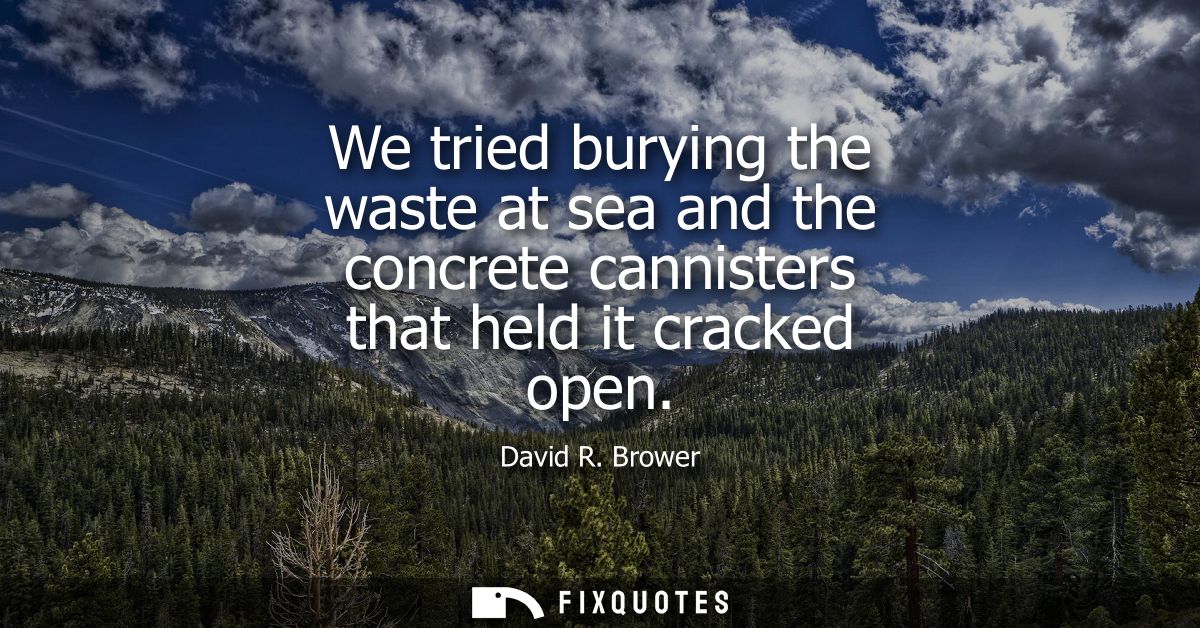
"We tried burying the waste at sea, and the concrete cannisters that held it cracked open"
About this Quote
“Burying the waste at sea” is a euphemism with saltwater on it. The verb “burying” borrows the comfort of earth and funerals, as if the ocean were an infinite graveyard that will keep our secrets. Brower punctures that fantasy with the most humiliating of plot twists: the concrete canisters crack. Not explode, not leak “a little,” but simply fail - because materials fail, time wins, and nature is not a landfill with a locking lid.
The subtext is Brower’s larger argument against the technocratic temperament of mid-century America: the conviction that industrial byproducts can be hidden, diluted, exported to “elsewhere.” In the era when nuclear optimism and disposal schemes were sold as manageable, Brower offers a single, damning data point that reads like a parable. The ocean, in this framing, becomes the ultimate witness: you can’t negotiate with chemistry, corrosion, pressure, and currents. The cracked canister is the crack in the story we tell ourselves about control.
Quote Details
| Topic | Ocean & Sea |
|---|---|
| Source | Help us find the source |
| Cite |
Citation Formats
APA Style (7th ed.)
Brower, David R. (2026, February 19). We tried burying the waste at sea, and the concrete cannisters that held it cracked open. FixQuotes. https://fixquotes.com/quotes/we-tried-burying-the-waste-at-sea-and-the-43400/
Chicago Style
Brower, David R. "We tried burying the waste at sea, and the concrete cannisters that held it cracked open." FixQuotes. February 19, 2026. https://fixquotes.com/quotes/we-tried-burying-the-waste-at-sea-and-the-43400/.
MLA Style (9th ed.)
"We tried burying the waste at sea, and the concrete cannisters that held it cracked open." FixQuotes, 19 Feb. 2026, https://fixquotes.com/quotes/we-tried-burying-the-waste-at-sea-and-the-43400/. Accessed 15 Mar. 2026.