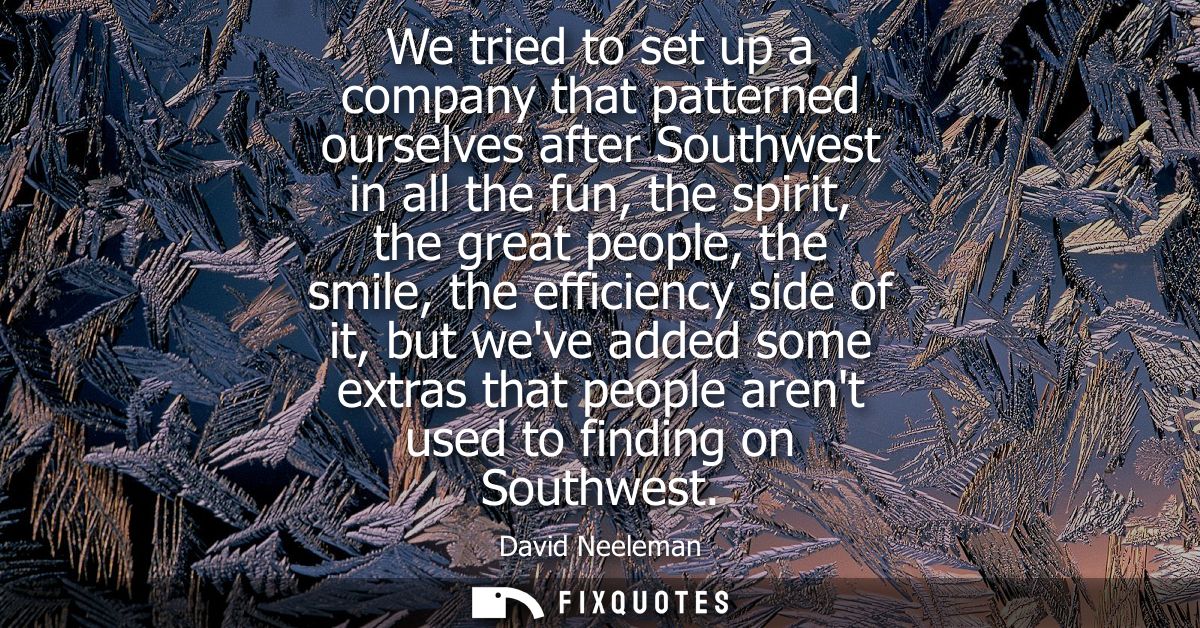
"We tried to set up a company that patterned ourselves after Southwest in all the fun, the spirit, the great people, the smile, the efficiency side of it, but we've added some extras that people aren't used to finding on Southwest"
About this Quote
The line is a founder’s wink and a pitch deck in one breath: take the beloved parts of a cult airline brand, then promise the upgrade. Neeleman reaches for Southwest because “fun” and “efficiency” aren’t just traits, they’re shorthand for a whole social contract with flyers: low fares without feeling low-rent, employees who seem like they’re allowed to be human, operations that (mostly) don’t melt down. He’s borrowing trust.
But he also slips in a competitive jab. “Extras that people aren’t used to finding on Southwest” politely frames Southwest’s famous minimalism as a gap, not a principle. It’s differentiation without naming a rival’s weakness directly, the corporate version of saying, “I’m not like other airlines.” The phrase “people aren’t used to” does additional work: it suggests the market has been trained to accept less, and he’s here to reset expectations.
The subtext is that airline loyalty is emotional before it’s rational. “Smile” is doing as much labor as “efficiency,” implying that service isn’t an amenity; it’s the product. At the same time, the quote telegraphs the tightrope he’s walking: adding “extras” in an industry where extras usually mean complexity, costs, and eventually resentment when they get cut.
Contextually, it reflects the early-2000s playbook of “Southwest, but…” carriers (including Neeleman’s own JetBlue): leverage a proven low-cost model, then layer in consumer-visible perks to feel premium without pricing like legacy airlines. It’s ambition packaged as familiarity, disruption disguised as comfort.
But he also slips in a competitive jab. “Extras that people aren’t used to finding on Southwest” politely frames Southwest’s famous minimalism as a gap, not a principle. It’s differentiation without naming a rival’s weakness directly, the corporate version of saying, “I’m not like other airlines.” The phrase “people aren’t used to” does additional work: it suggests the market has been trained to accept less, and he’s here to reset expectations.
The subtext is that airline loyalty is emotional before it’s rational. “Smile” is doing as much labor as “efficiency,” implying that service isn’t an amenity; it’s the product. At the same time, the quote telegraphs the tightrope he’s walking: adding “extras” in an industry where extras usually mean complexity, costs, and eventually resentment when they get cut.
Contextually, it reflects the early-2000s playbook of “Southwest, but…” carriers (including Neeleman’s own JetBlue): leverage a proven low-cost model, then layer in consumer-visible perks to feel premium without pricing like legacy airlines. It’s ambition packaged as familiarity, disruption disguised as comfort.
Quote Details
| Topic | Customer Service |
|---|
More Quotes by David
Add to List