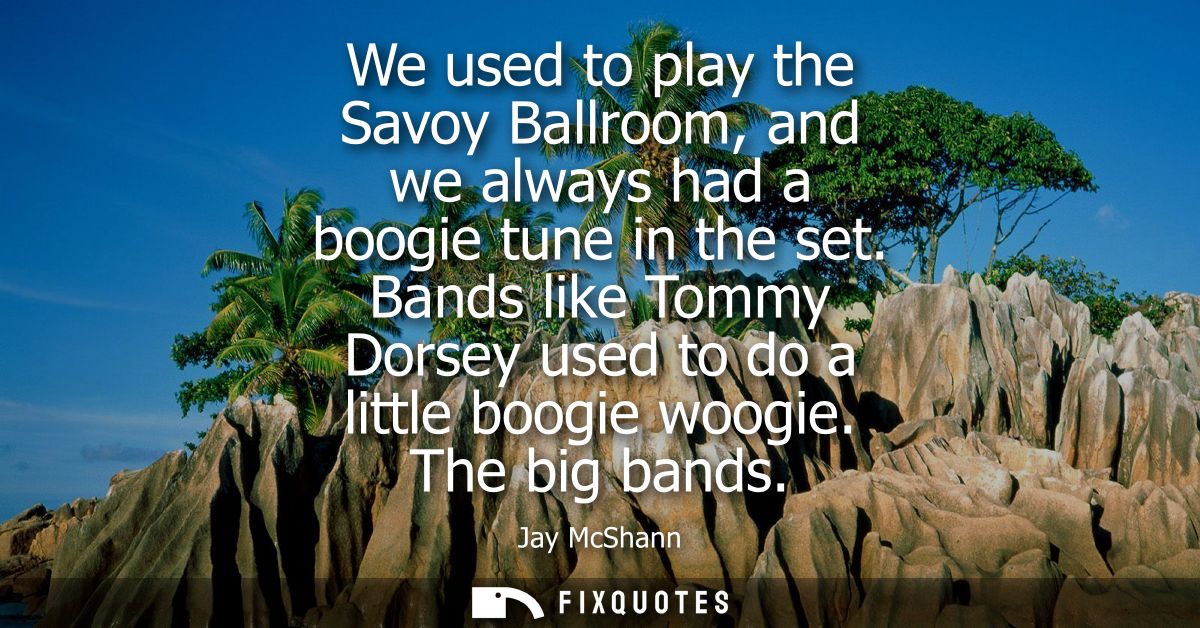
"We used to play the Savoy Ballroom, and we always had a boogie tune in the set. Bands like Tommy Dorsey used to do a little boogie woogie. The big bands"
About this Quote
The sly cultural work happens in the name-check. Tommy Dorsey, shorthand for white, mainstream big-band success, “used to do a little boogie woogie.” McShann isn’t begging for credit; he’s calmly reminding you of the traffic pattern: Black vernacular styles didn’t stay politely quarantined in “race music.” They migrated, got adapted, and often got repackaged for broader markets. “A little” is doing double duty, too. It signals how boogie might be treated as spice in a polished arrangement while, in Black dance halls, it could be the main course - louder, harder, more percussive, closer to what would later fuel R&B and rock.
Then there’s the abrupt cutoff: “The big bands” trailing into silence. It’s an ellipsis that feels historical. Big bands were both opportunity and ceiling, a system that could feature this rhythmic heat while still controlling who got to define it, sell it, and be remembered for it. McShann’s recollection is a small act of archival correction, delivered with bandleader understatement.
Quote Details
| Topic | Music |
|---|---|
| Source | Help us find the source |
| Cite |
Citation Formats
APA Style (7th ed.)
McShann, Jay. (2026, January 15). We used to play the Savoy Ballroom, and we always had a boogie tune in the set. Bands like Tommy Dorsey used to do a little boogie woogie. The big bands. FixQuotes. https://fixquotes.com/quotes/we-used-to-play-the-savoy-ballroom-and-we-always-167699/
Chicago Style
McShann, Jay. "We used to play the Savoy Ballroom, and we always had a boogie tune in the set. Bands like Tommy Dorsey used to do a little boogie woogie. The big bands." FixQuotes. January 15, 2026. https://fixquotes.com/quotes/we-used-to-play-the-savoy-ballroom-and-we-always-167699/.
MLA Style (9th ed.)
"We used to play the Savoy Ballroom, and we always had a boogie tune in the set. Bands like Tommy Dorsey used to do a little boogie woogie. The big bands." FixQuotes, 15 Jan. 2026, https://fixquotes.com/quotes/we-used-to-play-the-savoy-ballroom-and-we-always-167699/. Accessed 20 Mar. 2026.