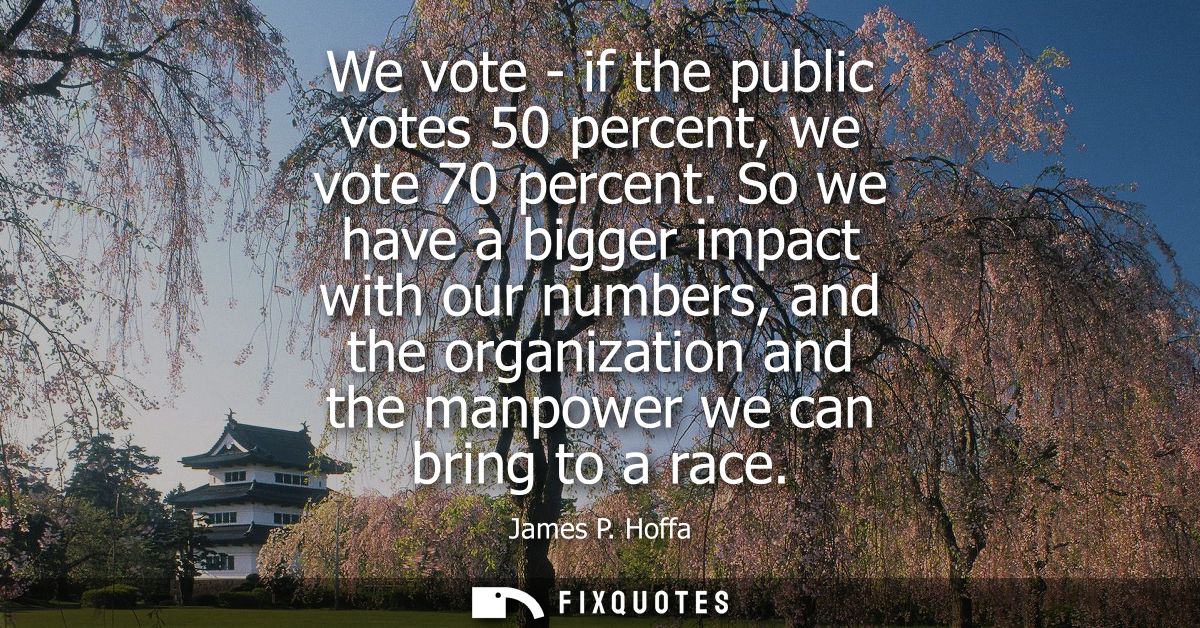
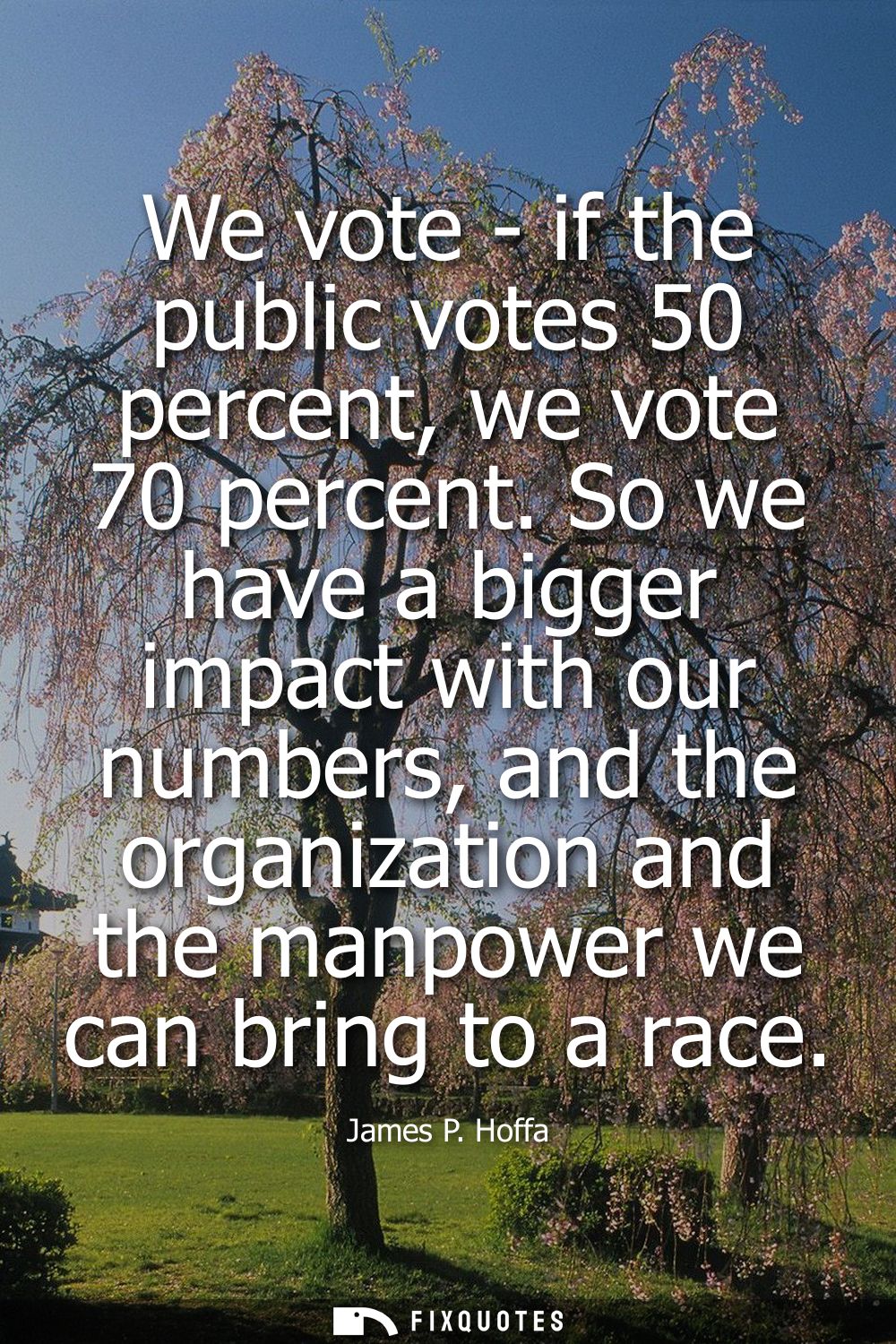
"We vote - if the public votes 50 percent, we vote 70 percent. So we have a bigger impact with our numbers, and the organization and the manpower we can bring to a race"
About this Quote
The pronouns tell the story. “The public” is amorphous, distracted, almost accidental. “We” is disciplined, coordinated, a machine that can be aimed. The subtext is that elections aren’t decided by abstract majorities but by motivated blocs with infrastructure: phone banks, carpools, door-knocks, endorsement networks, and a culture that treats voting like a union shift - you do it because the group needs it. “Organization and manpower” sounds like workplace language because it is; Hoffa frames politics as another arena where labor’s comparative advantage is logistics.
Context matters: this is classic union power-talk, in the long shadow of the Teamsters’ reputation for hardball politics and transactional alliances. It’s a pitch outward and a pep talk inward. To members, it flatters: your participation is amplified. To politicians, it’s a warning wrapped as a promise: ignore us and we can swing a race; work with us and we can deliver.
The intent is practical, not philosophical. Hoffa isn’t arguing that voting is sacred. He’s arguing that turnout is muscle, and muscle changes outcomes.
Quote Details
| Topic | Vision & Strategy |
|---|---|
| Source | Help us find the source |
| Cite |
Citation Formats
APA Style (7th ed.)
Hoffa, James P. (2026, January 16). We vote - if the public votes 50 percent, we vote 70 percent. So we have a bigger impact with our numbers, and the organization and the manpower we can bring to a race. FixQuotes. https://fixquotes.com/quotes/we-vote-if-the-public-votes-50-percent-we-vote-121775/
Chicago Style
Hoffa, James P. "We vote - if the public votes 50 percent, we vote 70 percent. So we have a bigger impact with our numbers, and the organization and the manpower we can bring to a race." FixQuotes. January 16, 2026. https://fixquotes.com/quotes/we-vote-if-the-public-votes-50-percent-we-vote-121775/.
MLA Style (9th ed.)
"We vote - if the public votes 50 percent, we vote 70 percent. So we have a bigger impact with our numbers, and the organization and the manpower we can bring to a race." FixQuotes, 16 Jan. 2026, https://fixquotes.com/quotes/we-vote-if-the-public-votes-50-percent-we-vote-121775/. Accessed 30 Mar. 2026.