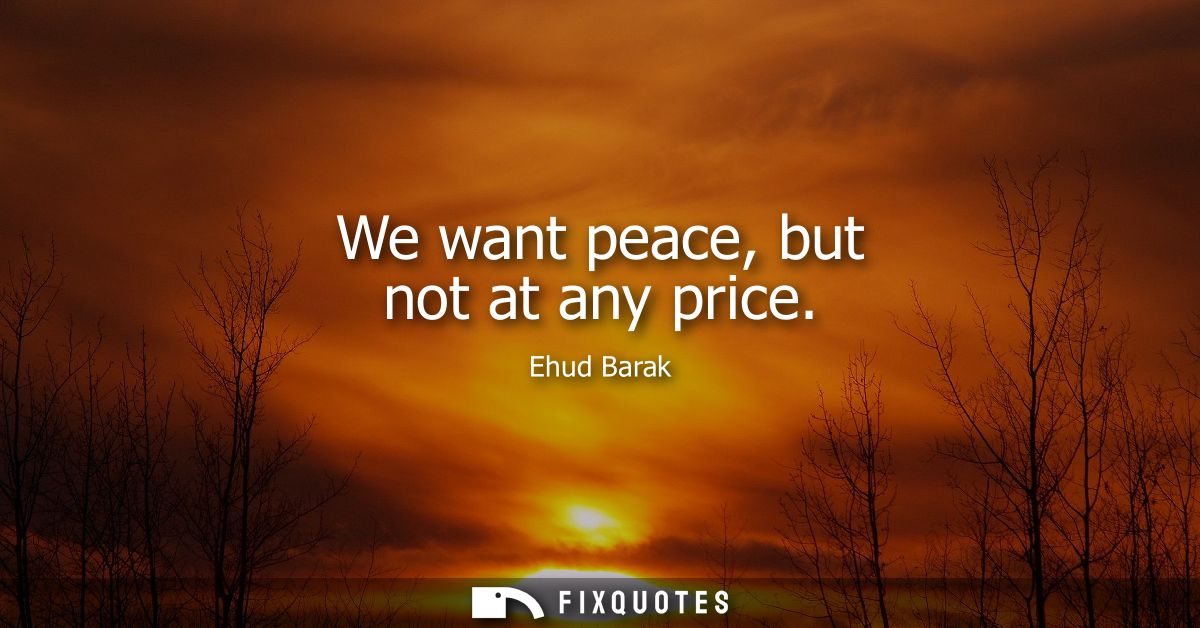
"We want peace, but not at any price"
About this Quote
Peace is the headline, but the fine print is deterrence. Ehud Barak's "We want peace, but not at any price" is built to sound conciliatory while quietly hardening the bargaining table. The first clause performs civility: it reassures allies, calms domestic moderates, and signals to adversaries that diplomacy remains possible. The second clause is the payload. "Not at any price" redraws peace from moral aspiration into a transaction with a ceiling, where territory, security arrangements, recognition, and sovereignty become the currency - and where some concessions are pre-declared non-starters.
Barak, a soldier-statesman shaped by Israel's security doctrine, uses the language of desire ("we want") to avoid sounding belligerent, then pivots to conditionality to reassert red lines. It's a phrase engineered for an audience that lives with chronic threat and political fragmentation: it tells the public, "We are not zealots for endless conflict", while inoculating leadership against accusations of weakness if talks stall or force is used.
The subtext is also strategic theater. Declaring limits early is meant to discipline expectations and shape the other side's calculations: peace is available, but coercion, terrorism, or maximalist demands won't lower the price. Contextually, it sits in the late-90s/early-2000s peace-process arc - high hopes, then disillusionment - where leaders needed to keep the door open to negotiation without handing opponents a narrative of surrender. The line works because it offers a virtue (peace) without the vulnerability (concession without reciprocity).
Barak, a soldier-statesman shaped by Israel's security doctrine, uses the language of desire ("we want") to avoid sounding belligerent, then pivots to conditionality to reassert red lines. It's a phrase engineered for an audience that lives with chronic threat and political fragmentation: it tells the public, "We are not zealots for endless conflict", while inoculating leadership against accusations of weakness if talks stall or force is used.
The subtext is also strategic theater. Declaring limits early is meant to discipline expectations and shape the other side's calculations: peace is available, but coercion, terrorism, or maximalist demands won't lower the price. Contextually, it sits in the late-90s/early-2000s peace-process arc - high hopes, then disillusionment - where leaders needed to keep the door open to negotiation without handing opponents a narrative of surrender. The line works because it offers a virtue (peace) without the vulnerability (concession without reciprocity).
Quote Details
| Topic | Peace |
|---|
More Quotes by Ehud
Add to List