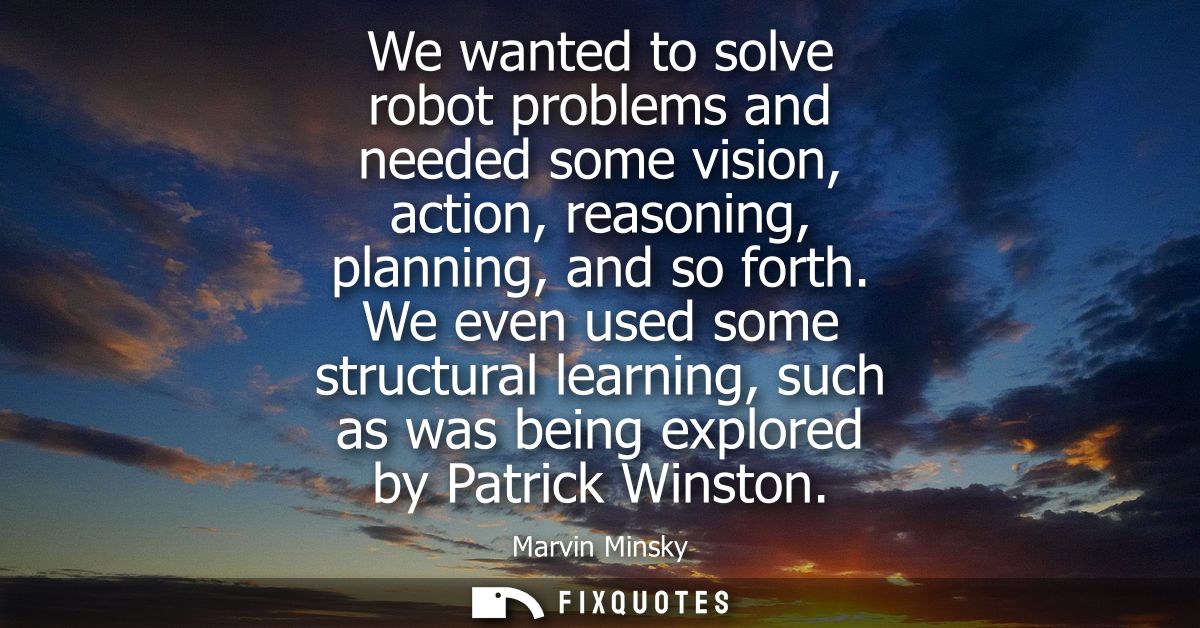
"We wanted to solve robot problems and needed some vision, action, reasoning, planning, and so forth. We even used some structural learning, such as was being explored by Patrick Winston"
About this Quote
There is a blunt, almost mischievous pragmatism in Minsky’s phrasing: “We wanted to solve robot problems” sounds like a shop-floor objective, not a manifesto. That’s the point. He’s signaling an era when AI was less brand identity than engineering ambition, when “robot problems” meant concrete headaches: perception that doesn’t crumble under noise, actions that don’t fail outside the lab, plans that survive contact with reality.
The shopping-list cadence - “vision, action, reasoning, planning, and so forth” - is doing quiet rhetorical work. It refuses to crown any single faculty as the secret sauce. Minsky is implicitly pushing back against the temptation to anoint one paradigm (pure logic, pure learning, pure perception) as the royal road to intelligence. The “and so forth” is a wink at the sprawling mess: intelligence isn’t a module, it’s an ecosystem of kludged competencies stitched together.
Then he slips in the telling concession: “We even used some structural learning.” The “even” carries subtext. In that period, learning wasn’t yet the prestige center of AI the way it is now; it was a tool you might deploy, not a creed. Name-checking Patrick Winston places the quote in the MIT lineage of early machine vision and symbolic/structured representations - learning as building and refining interpretable models, not statistical alchemy.
Read against today’s model-centric discourse, Minsky’s intent lands as a reminder and a critique: robots don’t care what’s fashionable. They demand integrated intelligence, and they expose every missing piece.
The shopping-list cadence - “vision, action, reasoning, planning, and so forth” - is doing quiet rhetorical work. It refuses to crown any single faculty as the secret sauce. Minsky is implicitly pushing back against the temptation to anoint one paradigm (pure logic, pure learning, pure perception) as the royal road to intelligence. The “and so forth” is a wink at the sprawling mess: intelligence isn’t a module, it’s an ecosystem of kludged competencies stitched together.
Then he slips in the telling concession: “We even used some structural learning.” The “even” carries subtext. In that period, learning wasn’t yet the prestige center of AI the way it is now; it was a tool you might deploy, not a creed. Name-checking Patrick Winston places the quote in the MIT lineage of early machine vision and symbolic/structured representations - learning as building and refining interpretable models, not statistical alchemy.
Read against today’s model-centric discourse, Minsky’s intent lands as a reminder and a critique: robots don’t care what’s fashionable. They demand integrated intelligence, and they expose every missing piece.
Quote Details
| Topic | Artificial Intelligence |
|---|
More Quotes by Marvin
Add to List