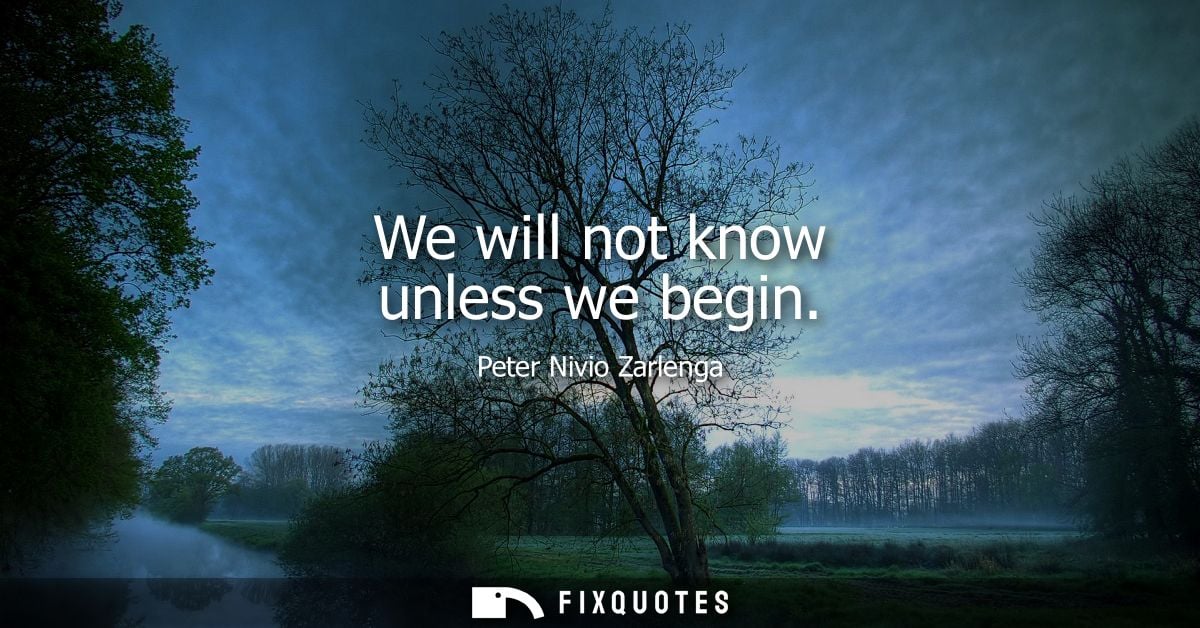
"We will not know unless we begin"
About this Quote
A businessman’s version of courage rarely arrives dressed as poetry; it shows up as a deadline. “We will not know unless we begin” is spare, almost aggressively plain, and that’s the point: it treats uncertainty not as a philosophical dilemma but as a solvable operational problem. The sentence is built like a gate that only swings one way. “Know” is held hostage by “begin,” and the implied message is that analysis, reassurance, and consensus are luxuries you earn after motion, not prerequisites for it.
The intent reads as a push against paralysis-by-planning, a familiar corporate disease where risk is managed by endlessly renaming it. Zarlenga’s phrasing reframes “not knowing” from a warning sign into a starting condition. That subtext matters because it flatters action without pretending action is clean. It doesn’t promise success; it promises data. In business language: you don’t get certainty, you get signals - market feedback, traction, resistance, numbers. Beginning becomes the experiment that converts anxiety into information.
Contextually, coming from a businessman rather than a self-help guru, it carries the moral authority of someone who’s watched decisions decay on conference-room tables. It’s also a subtle critique of status-quo comfort: if knowledge only arrives after initiation, then waiting is not neutral. Waiting is a choice to keep the current arrangement intact. The line works because it makes starting feel less like a leap of faith and more like basic due diligence - the only honest way to find out.
The intent reads as a push against paralysis-by-planning, a familiar corporate disease where risk is managed by endlessly renaming it. Zarlenga’s phrasing reframes “not knowing” from a warning sign into a starting condition. That subtext matters because it flatters action without pretending action is clean. It doesn’t promise success; it promises data. In business language: you don’t get certainty, you get signals - market feedback, traction, resistance, numbers. Beginning becomes the experiment that converts anxiety into information.
Contextually, coming from a businessman rather than a self-help guru, it carries the moral authority of someone who’s watched decisions decay on conference-room tables. It’s also a subtle critique of status-quo comfort: if knowledge only arrives after initiation, then waiting is not neutral. Waiting is a choice to keep the current arrangement intact. The line works because it makes starting feel less like a leap of faith and more like basic due diligence - the only honest way to find out.
Quote Details
| Topic | New Beginnings |
|---|
More Quotes by Peter
Add to List