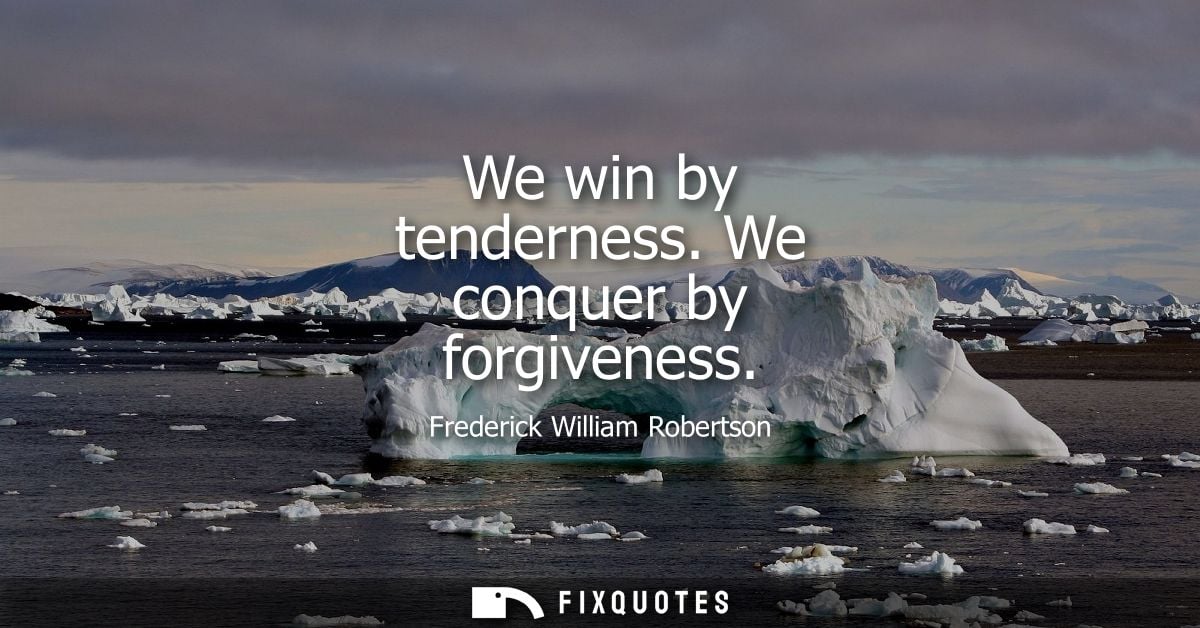
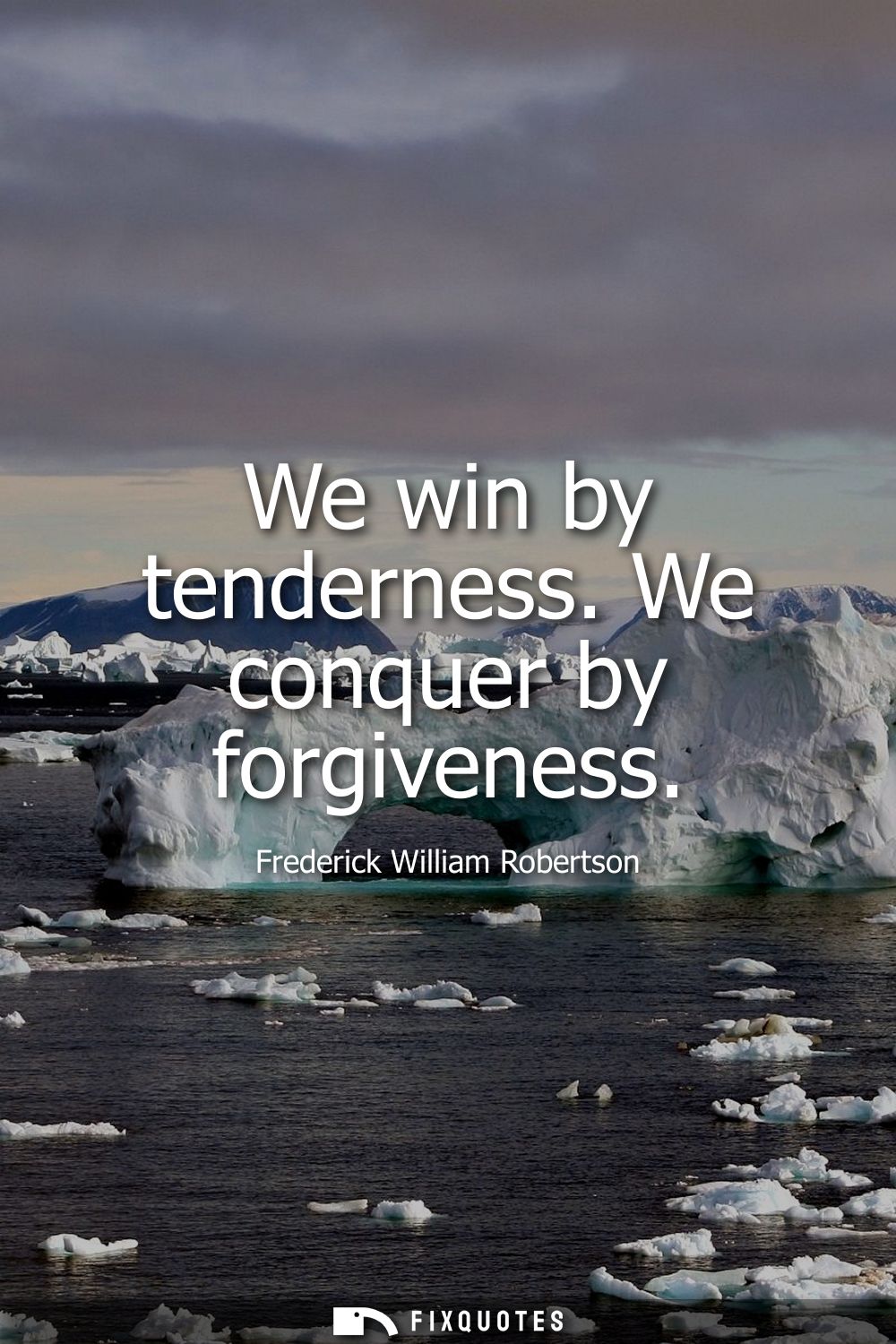
"We win by tenderness. We conquer by forgiveness"
About this Quote
Winning and conquering are the verbs of empires, sports, and masculine self-mythology. Robertson hijacks them and swaps in two forces most power-politics traditions treat as liabilities: tenderness and forgiveness. The line works because it’s a bait-and-switch. It borrows the glamour of dominance and then quietly rewires what counts as strength, suggesting that the only victories worth having are the ones that don’t leave bodies, grudges, or scorched-earth relationships behind.
As a 19th-century Anglican clergyman, Robertson is speaking into a culture steeped in Victorian moral seriousness, class rigidity, and a national story of British might. The subtext is a critique of coercion dressed up as spirituality: if you need to crush someone to “win,” you’ve already lost the more consequential contest, the one over character. “Tenderness” here isn’t softness for its own sake; it’s strategic intimacy, a willingness to see another person clearly enough to treat them as human rather than as an obstacle. “Forgiveness” isn’t amnesia. It’s the refusal to let injury dictate the future.
The pairing matters. Tenderness is proactive; it prevents conflicts from hardening into war. Forgiveness is reactive; it breaks the cycle once harm has already happened. Together they form a moral alternative to escalation: power that persuades rather than compels, authority that disarms rather than humiliates. Robertson’s intent is pastoral, but the rhetoric is quietly radical: he’s offering a different definition of conquest, one measured not in submission extracted, but in resentment dissolved.
As a 19th-century Anglican clergyman, Robertson is speaking into a culture steeped in Victorian moral seriousness, class rigidity, and a national story of British might. The subtext is a critique of coercion dressed up as spirituality: if you need to crush someone to “win,” you’ve already lost the more consequential contest, the one over character. “Tenderness” here isn’t softness for its own sake; it’s strategic intimacy, a willingness to see another person clearly enough to treat them as human rather than as an obstacle. “Forgiveness” isn’t amnesia. It’s the refusal to let injury dictate the future.
The pairing matters. Tenderness is proactive; it prevents conflicts from hardening into war. Forgiveness is reactive; it breaks the cycle once harm has already happened. Together they form a moral alternative to escalation: power that persuades rather than compels, authority that disarms rather than humiliates. Robertson’s intent is pastoral, but the rhetoric is quietly radical: he’s offering a different definition of conquest, one measured not in submission extracted, but in resentment dissolved.
Quote Details
| Topic | Forgiveness |
|---|---|
| Source | Verified source: Sermons Preached at Brighton, Third Series (Frederick William Robertson, 1858)
Evidence:
We win by tenderness; we conquer by forgiveness. (Likely from the sermon later excerpted in periodicals; exact sermon/page not yet securely identified from the primary volume). The quote is clearly attested as Robertson's own words in an early secondary reprint from the Review and Herald (August 4, 1904), where it appears in a longer excerpt attributed to “F. W. Robertson”: “Therefore, come what may, hold fast to love... We win by tenderness; we conquer by forgiveness.” ([documents.adventistarchives.org](https://documents.adventistarchives.org/Periodicals/RH/RH19040804-V81-31.pdf)) The wording uses a semicolon, not a period. The evidence strongly suggests the line comes from one of Frederick William Robertson's Brighton sermons, later collected in 'Sermons Preached at Brighton, Third Series,' a posthumous volume first published in 1858. ([gutenberg.org](https://www.gutenberg.org/ebooks/16645?utm_source=openai)) However, I could not securely isolate the exact sermon title and page inside the primary collected volume from the available searchable text. So the best verified primary-source identification is Robertson's own sermon corpus, collected in that 1858 volume, but the exact first spoken date and page remain unresolved from the sources I could verify. |
| Cite |
Citation Formats
APA Style (7th ed.)
Robertson, Frederick William. (2026, March 6). We win by tenderness. We conquer by forgiveness. FixQuotes. https://fixquotes.com/quotes/we-win-by-tenderness-we-conquer-by-forgiveness-169395/
Chicago Style
Robertson, Frederick William. "We win by tenderness. We conquer by forgiveness." FixQuotes. March 6, 2026. https://fixquotes.com/quotes/we-win-by-tenderness-we-conquer-by-forgiveness-169395/.
MLA Style (9th ed.)
"We win by tenderness. We conquer by forgiveness." FixQuotes, 6 Mar. 2026, https://fixquotes.com/quotes/we-win-by-tenderness-we-conquer-by-forgiveness-169395/. Accessed 26 Mar. 2026.
More Quotes by Frederick
Add to List