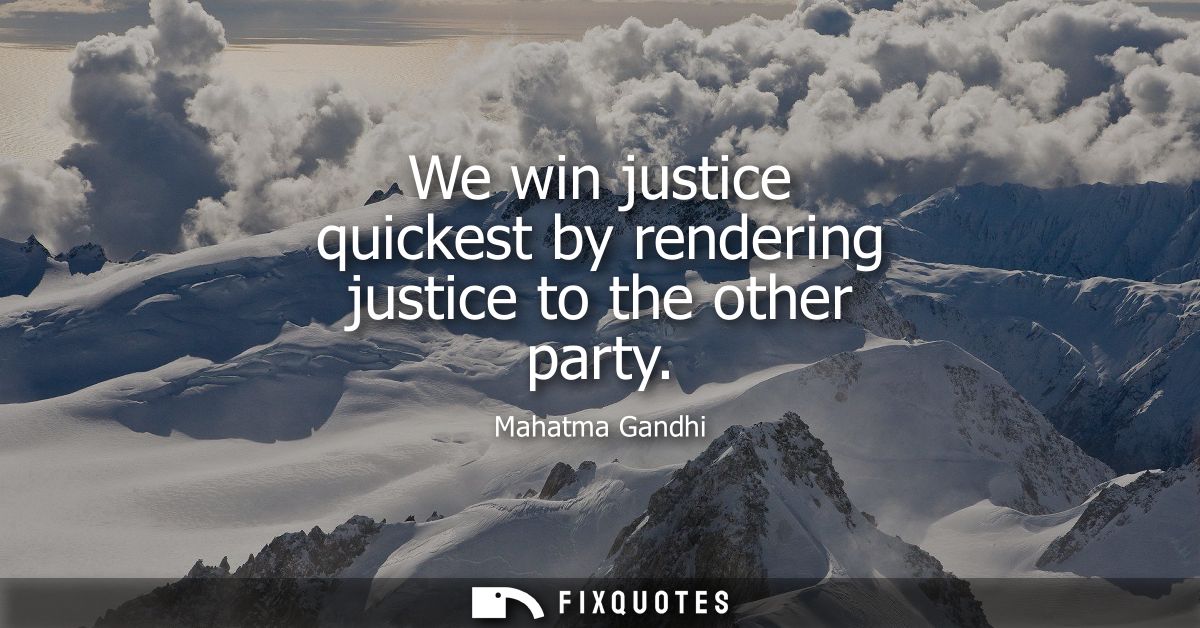
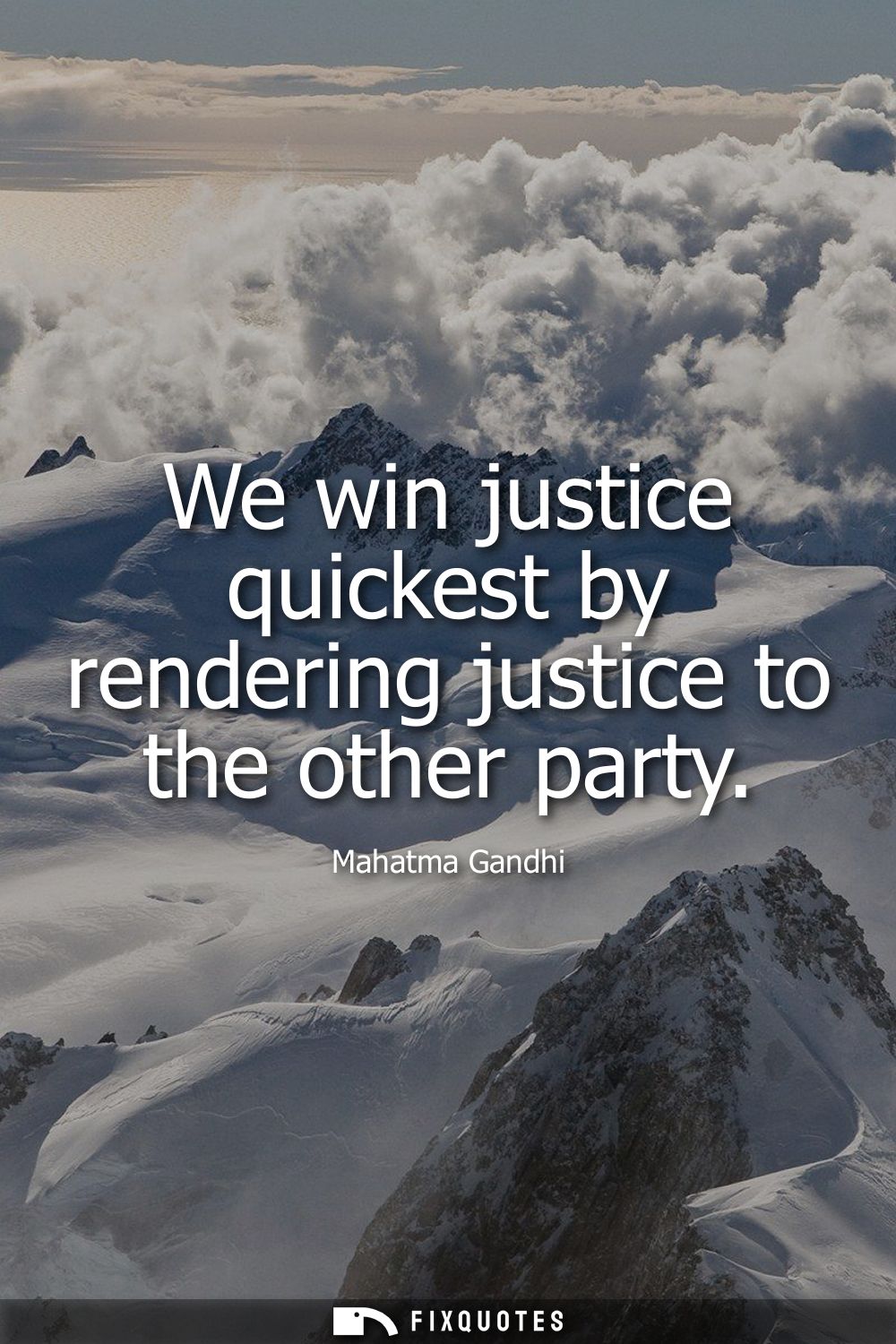
"We win justice quickest by rendering justice to the other party"
About this Quote
Justice, Gandhi reminds us, is not a trophy you seize but a discipline you practice - especially when it costs you. The line is engineered to unsettle the instinctive script of political struggle, where winning usually means outmaneuvering, humiliating, or exhausting an opponent. Instead, he proposes a strategy that sounds like morality but behaves like leverage: treat the other party justly and you accelerate your own claim to justice.
The intent is tactical as much as ethical. In Gandhi's world of colonial rule, courts and laws were often instruments of empire, not neutral referees. If the system won't reliably deliver fairness, the movement has to manufacture legitimacy another way: by demonstrating it. Rendering justice to the other side is a form of political jujitsu. It strips the opponent of the excuse that you're merely seeking revenge or power, and it builds a public record of restraint that can shame institutions, sway bystanders, and fracture the moral confidence of those enforcing injustice.
The subtext is also a warning to allies: the fastest way to lose the moral high ground is to mimic the cruelty you oppose. Gandhi is speaking to the temptations of righteous anger - to the urge to dehumanize the "other party" because history seems to have done it first. His phrasing, "quickest", is the tell. He isn't preaching patience for its own sake; he's arguing that reciprocity and fairness are accelerants. Nonviolence here isn't passivity. It's a method for turning ethics into momentum, forcing a conflict into the only arena where an empire is fragile: its claim to righteousness.
The intent is tactical as much as ethical. In Gandhi's world of colonial rule, courts and laws were often instruments of empire, not neutral referees. If the system won't reliably deliver fairness, the movement has to manufacture legitimacy another way: by demonstrating it. Rendering justice to the other side is a form of political jujitsu. It strips the opponent of the excuse that you're merely seeking revenge or power, and it builds a public record of restraint that can shame institutions, sway bystanders, and fracture the moral confidence of those enforcing injustice.
The subtext is also a warning to allies: the fastest way to lose the moral high ground is to mimic the cruelty you oppose. Gandhi is speaking to the temptations of righteous anger - to the urge to dehumanize the "other party" because history seems to have done it first. His phrasing, "quickest", is the tell. He isn't preaching patience for its own sake; he's arguing that reciprocity and fairness are accelerants. Nonviolence here isn't passivity. It's a method for turning ethics into momentum, forcing a conflict into the only arena where an empire is fragile: its claim to righteousness.
Quote Details
| Topic | Justice |
|---|---|
| Source | Help us find the source |
| Cite |
Citation Formats
APA Style (7th ed.)
Gandhi, Mahatma. (2026, January 17). We win justice quickest by rendering justice to the other party. FixQuotes. https://fixquotes.com/quotes/we-win-justice-quickest-by-rendering-justice-to-26122/
Chicago Style
Gandhi, Mahatma. "We win justice quickest by rendering justice to the other party." FixQuotes. January 17, 2026. https://fixquotes.com/quotes/we-win-justice-quickest-by-rendering-justice-to-26122/.
MLA Style (9th ed.)
"We win justice quickest by rendering justice to the other party." FixQuotes, 17 Jan. 2026, https://fixquotes.com/quotes/we-win-justice-quickest-by-rendering-justice-to-26122/. Accessed 12 Mar. 2026.
More Quotes by Mahatma
Add to List