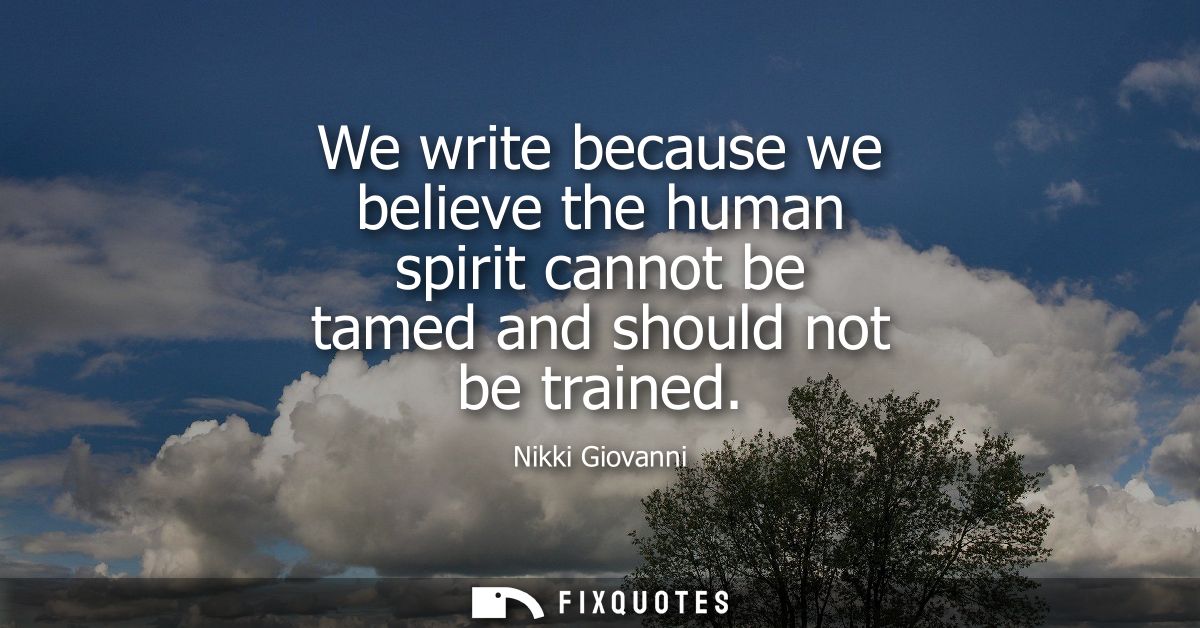
"We write because we believe the human spirit cannot be tamed and should not be trained"
About this Quote
The phrasing is doing double work. “Tamed” evokes the violent intimacy of domination: the leash, the cage, the expectation that certain people soften their anger, lower their voice, shrink their ambition. “Trained” is sharper, more modern, and more insidious. Training sounds like school, professionalism, etiquette, even “self-improvement” - the respectable vocabulary of conformity. Giovanni rejects both the obvious forms of control and the polite ones.
The subtext is a warning about what institutions do to language. They don’t only silence; they shape what counts as articulate, what counts as “good,” what kinds of emotion are acceptable, which stories are “universal” and which are “too specific.” Her answer is to keep the spirit undomesticated by putting it on the page - not to tidy experience into palatable lessons, but to preserve its wildness, its contradiction, its heat.
In Giovanni’s hands, writing becomes an act of untraining: a way to unlearn obedience and to make freedom sound like a voice that won’t behave.
Quote Details
| Topic | Writing |
|---|---|
| Source | Help us find the source |
| Cite |
Citation Formats
APA Style (7th ed.)
Giovanni, Nikki. (2026, January 16). We write because we believe the human spirit cannot be tamed and should not be trained. FixQuotes. https://fixquotes.com/quotes/we-write-because-we-believe-the-human-spirit-103900/
Chicago Style
Giovanni, Nikki. "We write because we believe the human spirit cannot be tamed and should not be trained." FixQuotes. January 16, 2026. https://fixquotes.com/quotes/we-write-because-we-believe-the-human-spirit-103900/.
MLA Style (9th ed.)
"We write because we believe the human spirit cannot be tamed and should not be trained." FixQuotes, 16 Jan. 2026, https://fixquotes.com/quotes/we-write-because-we-believe-the-human-spirit-103900/. Accessed 12 Mar. 2026.