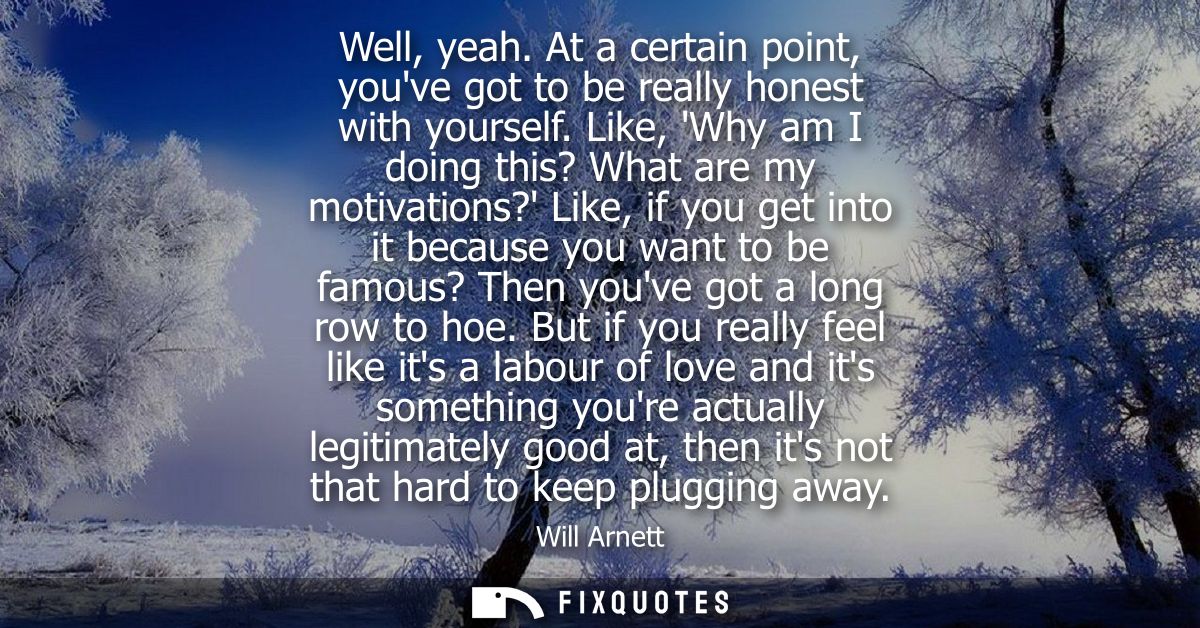
"Well, yeah. At a certain point, you've got to be really honest with yourself. Like, 'Why am I doing this? What are my motivations?' Like, if you get into it because you want to be famous? Then you've got a long row to hoe. But if you really feel like it's a labour of love and it's something you're actually legitimately good at, then it's not that hard to keep plugging away"
About this Quote
The real target is fame as a motivation. “A long row to hoe” is blunt, old-school phrasing that makes celebrity feel less like sparkle and more like agricultural punishment: repetitive, unglamorous labor with no guaranteed harvest. Subtext: if your reward system depends on external validation, you’re handing your mental health to an algorithm, a casting director, a trend cycle. That’s not grit; that’s a rigged game.
He offers a different survival strategy that’s almost aggressively unromantic: be “legitimately good” and treat it as “labour of love.” Not love as vibes, but love as endurance - the kind that tolerates rejection, bad notes, and long stretches of invisibility. The quiet flex is that competence makes persistence easier. If you have a craft you can improve, you always have something to do, even when no one is watching.
Contextually, it reads like veteran advice from someone who understands the distance between being known and being satisfied. Fame is a moving target; work you can stand behind isn’t.
Quote Details
| Topic | Perseverance |
|---|---|
| Source | Help us find the source |
| Cite |
Citation Formats
APA Style (7th ed.)
Arnett, Will. (2026, January 16). Well, yeah. At a certain point, you've got to be really honest with yourself. Like, 'Why am I doing this? What are my motivations?' Like, if you get into it because you want to be famous? Then you've got a long row to hoe. But if you really feel like it's a labour of love and it's something you're actually legitimately good at, then it's not that hard to keep plugging away. FixQuotes. https://fixquotes.com/quotes/well-yeah-at-a-certain-point-youve-got-to-be-84352/
Chicago Style
Arnett, Will. "Well, yeah. At a certain point, you've got to be really honest with yourself. Like, 'Why am I doing this? What are my motivations?' Like, if you get into it because you want to be famous? Then you've got a long row to hoe. But if you really feel like it's a labour of love and it's something you're actually legitimately good at, then it's not that hard to keep plugging away." FixQuotes. January 16, 2026. https://fixquotes.com/quotes/well-yeah-at-a-certain-point-youve-got-to-be-84352/.
MLA Style (9th ed.)
"Well, yeah. At a certain point, you've got to be really honest with yourself. Like, 'Why am I doing this? What are my motivations?' Like, if you get into it because you want to be famous? Then you've got a long row to hoe. But if you really feel like it's a labour of love and it's something you're actually legitimately good at, then it's not that hard to keep plugging away." FixQuotes, 16 Jan. 2026, https://fixquotes.com/quotes/well-yeah-at-a-certain-point-youve-got-to-be-84352/. Accessed 13 Feb. 2026.