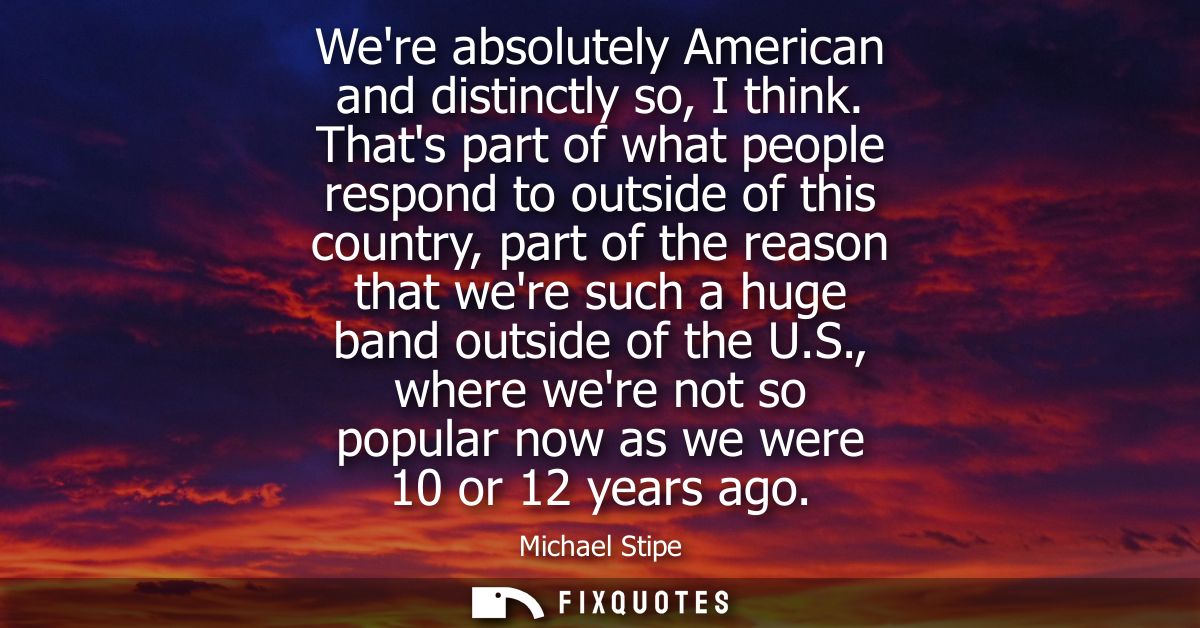
"We're absolutely American and distinctly so, I think. That's part of what people respond to outside of this country, part of the reason that we're such a huge band outside of the U.S., where we're not so popular now as we were 10 or 12 years ago"
About this Quote
The subtext is sharper: Americanness plays better at a distance. Outside the U.S., "American" can read as myth, texture, attitude - the jangly guitars, the road-worn melancholy, the promise of a vast country where weirdness can become culture. At home, that same identity gets crowded out by trend cycles, by younger scenes, by the way a nation can be bored by its own accent. Stipe frames the band’s waning domestic popularity not as failure but as a market reality: the U.S. has moved on; the rest of the world still wants the export.
There's also a quiet comment on cultural imperialism that Stipe never quite names. Being "huge" abroad while fading domestically is the paradox of American soft power: the image travels better than the lived experience. R.E.M. becomes less a current band than a reliable American artifact - and Stipe, ever the strategist, turns that into a story of authenticity rather than decline.
Quote Details
| Topic | Music |
|---|---|
| Source | Help us find the source |
| Cite |
Citation Formats
APA Style (7th ed.)
Stipe, Michael. (2026, January 17). We're absolutely American and distinctly so, I think. That's part of what people respond to outside of this country, part of the reason that we're such a huge band outside of the U.S., where we're not so popular now as we were 10 or 12 years ago. FixQuotes. https://fixquotes.com/quotes/were-absolutely-american-and-distinctly-so-i-64183/
Chicago Style
Stipe, Michael. "We're absolutely American and distinctly so, I think. That's part of what people respond to outside of this country, part of the reason that we're such a huge band outside of the U.S., where we're not so popular now as we were 10 or 12 years ago." FixQuotes. January 17, 2026. https://fixquotes.com/quotes/were-absolutely-american-and-distinctly-so-i-64183/.
MLA Style (9th ed.)
"We're absolutely American and distinctly so, I think. That's part of what people respond to outside of this country, part of the reason that we're such a huge band outside of the U.S., where we're not so popular now as we were 10 or 12 years ago." FixQuotes, 17 Jan. 2026, https://fixquotes.com/quotes/were-absolutely-american-and-distinctly-so-i-64183/. Accessed 21 Feb. 2026.