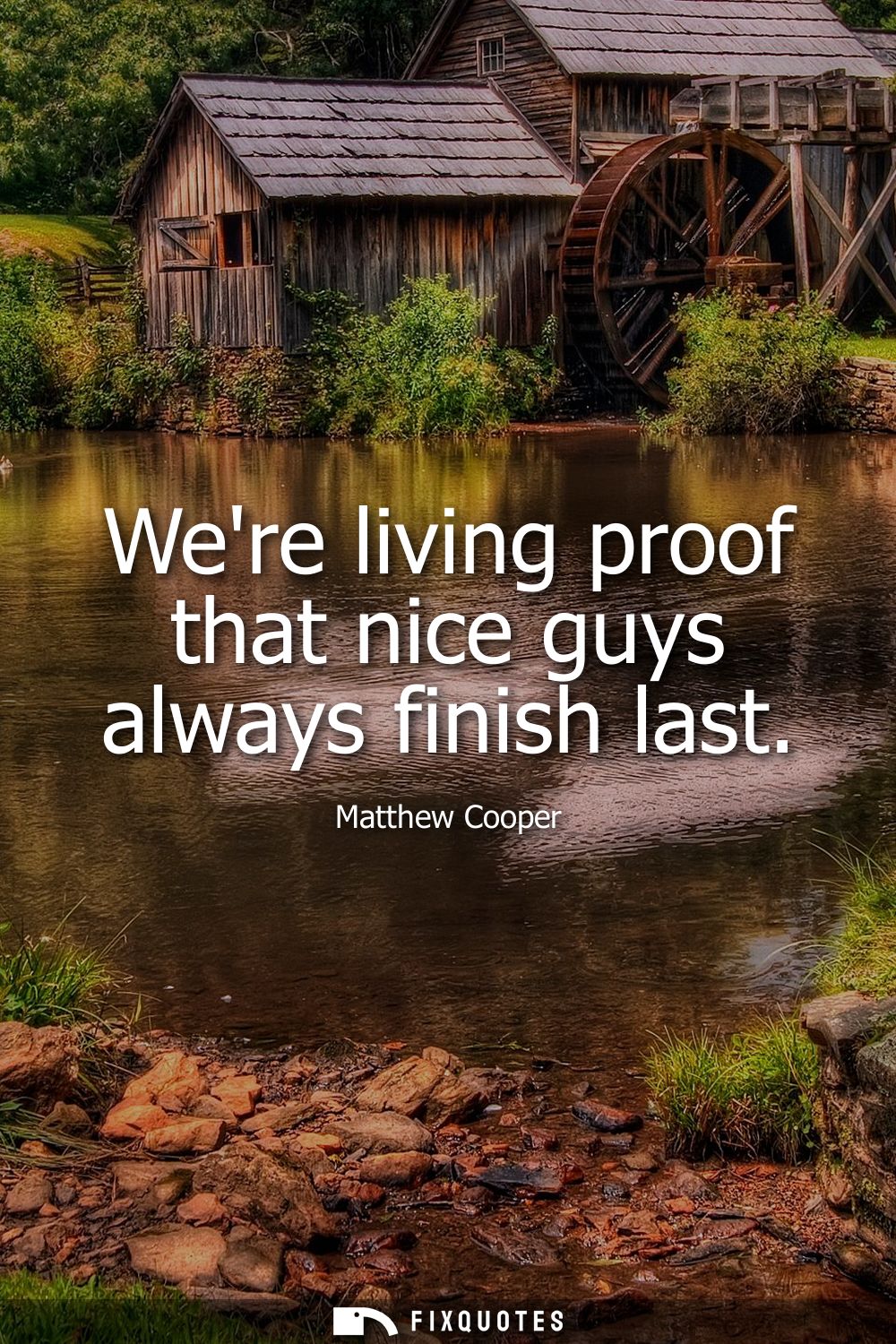
"We're living proof that nice guys always finish last"
About this Quote
That line lands like a grin you don’t trust. “We’re living proof” borrows the language of courtroom evidence and turns a tired aphorism into testimony: not an opinion, not a vibe, but a claimed fact. It’s a neat journalistic move from Matthew Cooper, a writer trained to posture as the sober recorder of reality even while shaping it. The punch comes from the collision between “nice guys” (a phrase already sticky with self-mythology) and “always” (the absolute that dares you to argue). It’s bait, and it knows it.
The intent feels less like confessing goodness than staking out grievance. “Nice guys” here aren’t saintly; they’re a brand of person who believes decency should be rewarded like a loyalty program. The subtext is transactional: I behaved, the world owes me. That’s why the line plays as both self-defense and soft accusation, a way to preempt criticism by framing any loss as moral injustice rather than miscalculation, bad luck, or ordinary competition.
Contextually, it echoes a recurring American mood: suspicion that the system prizes ruthlessness, and that “winning” requires a little ethical shaving at the edges. Coming from a journalist, it also reads as a knowing wink at media narratives that celebrate sharp elbows while relegating restraint to the lifestyle section. The line’s power is its cynicism with plausible deniability: a complaint that doubles as a cultural diagnosis, sharp enough to sting, vague enough to travel.
The intent feels less like confessing goodness than staking out grievance. “Nice guys” here aren’t saintly; they’re a brand of person who believes decency should be rewarded like a loyalty program. The subtext is transactional: I behaved, the world owes me. That’s why the line plays as both self-defense and soft accusation, a way to preempt criticism by framing any loss as moral injustice rather than miscalculation, bad luck, or ordinary competition.
Contextually, it echoes a recurring American mood: suspicion that the system prizes ruthlessness, and that “winning” requires a little ethical shaving at the edges. Coming from a journalist, it also reads as a knowing wink at media narratives that celebrate sharp elbows while relegating restraint to the lifestyle section. The line’s power is its cynicism with plausible deniability: a complaint that doubles as a cultural diagnosis, sharp enough to sting, vague enough to travel.
Quote Details
| Topic | Witty One-Liners |
|---|---|
| Source | Help us find the source |
| Cite |
Citation Formats
APA Style (7th ed.)
Cooper, Matthew. (2026, January 16). We're living proof that nice guys always finish last. FixQuotes. https://fixquotes.com/quotes/were-living-proof-that-nice-guys-always-finish-130010/
Chicago Style
Cooper, Matthew. "We're living proof that nice guys always finish last." FixQuotes. January 16, 2026. https://fixquotes.com/quotes/were-living-proof-that-nice-guys-always-finish-130010/.
MLA Style (9th ed.)
"We're living proof that nice guys always finish last." FixQuotes, 16 Jan. 2026, https://fixquotes.com/quotes/were-living-proof-that-nice-guys-always-finish-130010/. Accessed 26 Mar. 2026.
More Quotes by Matthew
Add to List