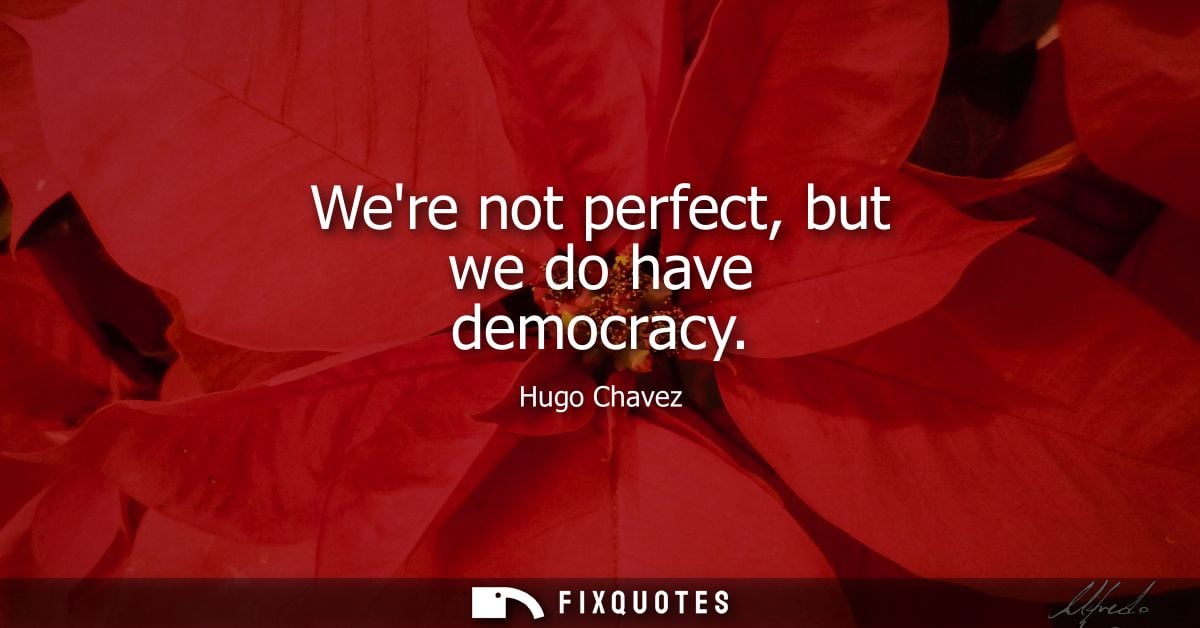
"We're not perfect, but we do have democracy"
About this Quote
"We're not perfect" is the disarming half-smile before the shove. Chavez opens with a concession that sounds humble but functions as inoculation: if you admit your flaws first, you steal your critics' thunder and recast their accusations as stale, even petty. Then comes the pivot - "but we do have democracy" - delivered like a receipt. Whatever the mess, the essential credential has been paid.
The intent is defensive and assertive at once. Chavez is speaking from the position of a leader routinely condemned abroad as authoritarian and at home as polarizing. The line is built to answer international scolding without fully engaging it. It reframes the argument from human rights reports, institutional erosion, and media pressures into a single, high-ground test: elections. If ballots exist, the thinking goes, the rest is negotiable, or at least forgivable.
The subtext is more ambitious: democracy becomes not a system of constraints but a stamp of legitimacy. By collapsing democracy into the fact of democratic process, Chavez sidesteps the harder questions about pluralism, independent courts, and whether opponents can compete on equal terms. It's a rhetorical move common to populists: they fuse the people with their mandate, then treat criticism as an attack on the people themselves.
Context matters. In the early 2000s, after the 2002 coup attempt and amid a widening U.S.-Venezuela standoff, Chavez needed language that could rally supporters and blunt foreign pressure. The quote does that efficiently: it embraces imperfection as relatable while insisting on the one word that, in global politics, still buys you moral leverage - democracy.
The intent is defensive and assertive at once. Chavez is speaking from the position of a leader routinely condemned abroad as authoritarian and at home as polarizing. The line is built to answer international scolding without fully engaging it. It reframes the argument from human rights reports, institutional erosion, and media pressures into a single, high-ground test: elections. If ballots exist, the thinking goes, the rest is negotiable, or at least forgivable.
The subtext is more ambitious: democracy becomes not a system of constraints but a stamp of legitimacy. By collapsing democracy into the fact of democratic process, Chavez sidesteps the harder questions about pluralism, independent courts, and whether opponents can compete on equal terms. It's a rhetorical move common to populists: they fuse the people with their mandate, then treat criticism as an attack on the people themselves.
Context matters. In the early 2000s, after the 2002 coup attempt and amid a widening U.S.-Venezuela standoff, Chavez needed language that could rally supporters and blunt foreign pressure. The quote does that efficiently: it embraces imperfection as relatable while insisting on the one word that, in global politics, still buys you moral leverage - democracy.
Quote Details
| Topic | Freedom |
|---|---|
| Source | Help us find the source |
| Cite |
Citation Formats
APA Style (7th ed.)
Chavez, Hugo. (2026, January 15). We're not perfect, but we do have democracy. FixQuotes. https://fixquotes.com/quotes/were-not-perfect-but-we-do-have-democracy-89290/
Chicago Style
Chavez, Hugo. "We're not perfect, but we do have democracy." FixQuotes. January 15, 2026. https://fixquotes.com/quotes/were-not-perfect-but-we-do-have-democracy-89290/.
MLA Style (9th ed.)
"We're not perfect, but we do have democracy." FixQuotes, 15 Jan. 2026, https://fixquotes.com/quotes/were-not-perfect-but-we-do-have-democracy-89290/. Accessed 5 Mar. 2026.
More Quotes by Hugo
Add to List