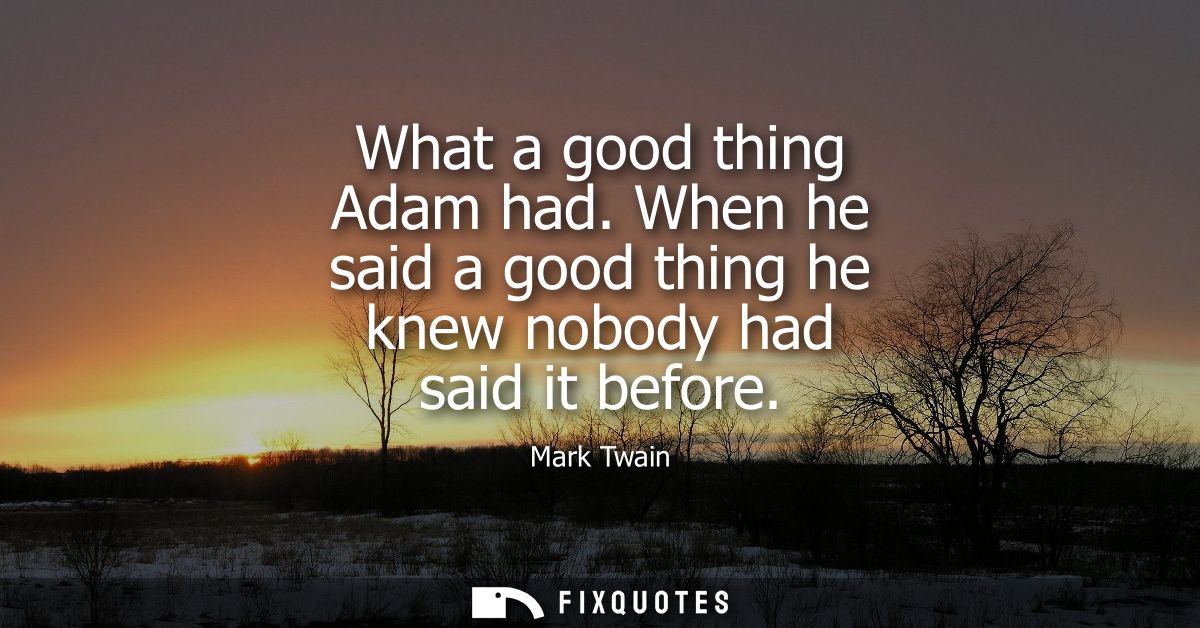
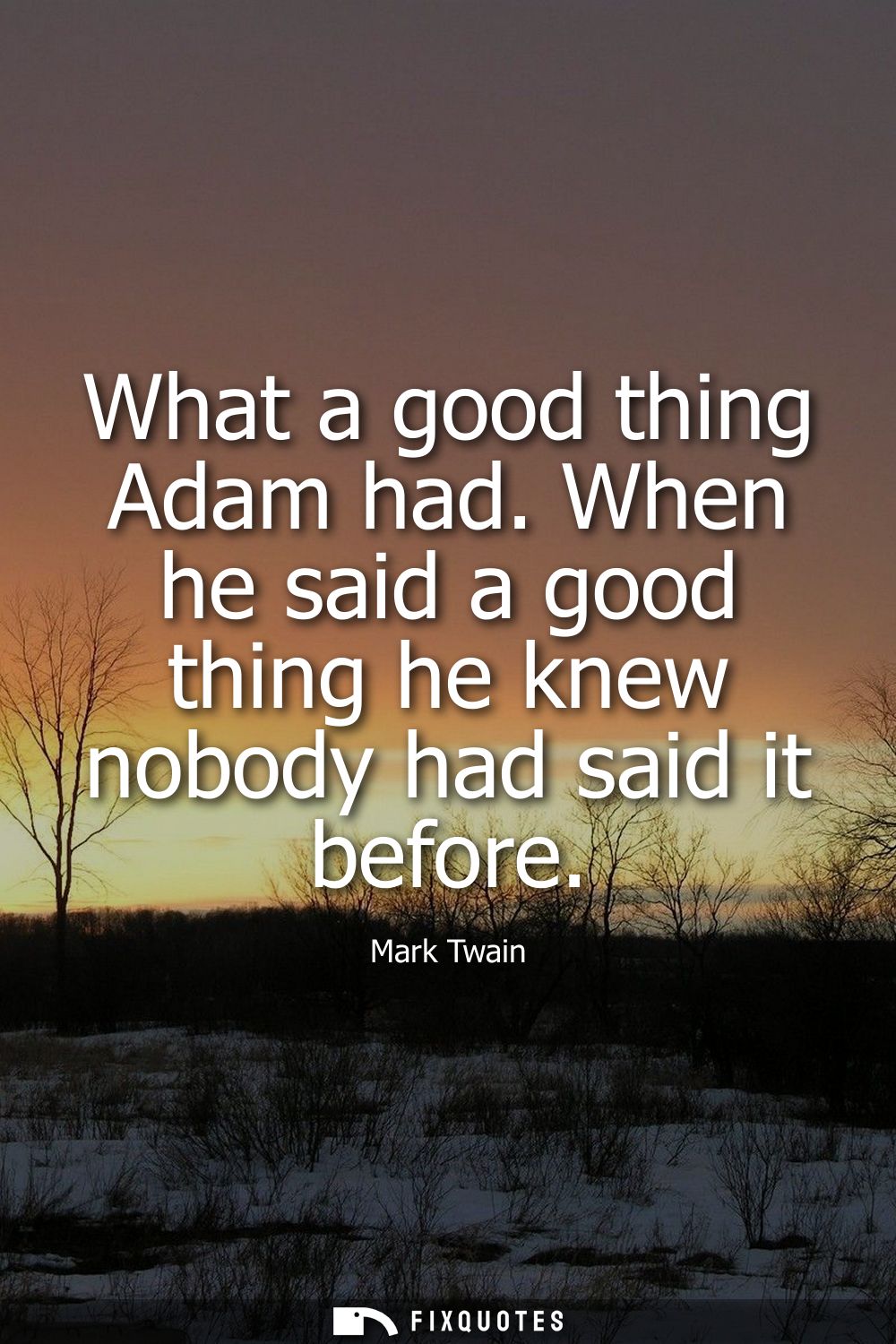
"What a good thing Adam had. When he said a good thing, he knew nobody had said it before"
About this Quote
The line also needles the social economy of language. Praise feels best when it comes with ownership, when your "good thing" isn't just true but yours. Twain compresses the whole churn of authorship - influence, quotation, plagiarism panic - into a primitive scene where none of that exists. In doing so, he mocks the romantic myth of the solitary genius while still conceding why we crave it. The subtext is basically: you're not imagining it; the crowd really does make your thoughts feel secondhand.
Context matters. Twain wrote in an America that was industrializing fast, standardizing taste, and mass-producing print. The marketplace was filling up with slogans, sermons, and newspaper wisdom. Against that background, Adam becomes a comic patron saint of pre-media life, when a "good thing" could be pure because it couldn't yet be repeated. Twain's irony is affectionate but ruthless: originality is easiest when nobody's listening, and hardest the moment it becomes worth saying.
Quote Details
| Topic | Witty One-Liners |
|---|---|
| Source | Verified source: Mark Twain's Notebook (Mark Twain, 1935)
Evidence: What a good thing Adam had, when he said a good thing he knew nobody had said it before. (Page 67 (entry dated 2 July 1867)). This line is attributed (by multiple reference sources) to Twain’s private notebook entry dated 2 July 1867, but it was not published during Twain’s lifetime. The earliest publication I can verify to a specific primary-work container is the 1935 edited volume Mark Twain's Notebook (prepared for publication with comments by Albert Bigelow Paine) issued by Harper & Brothers. A widely used reference list also points to p. 67 of that 1935 notebook volume for this exact wording. Because the notebook itself is a posthumous publication and I could not access a scan to independently confirm the printed page image in this session, confidence is 'medium' rather than 'high'. Other candidates (1) Psyche and the Literary Muses (Martin S. Lindauer, 2009) compilation95.0% ... What a good thing Adam had . When he said a good thing he knew nobody had said it before ( Mark Twain ) . 8. I lo... |
| Cite |
Citation Formats
APA Style (7th ed.)
Twain, Mark. (2026, February 16). What a good thing Adam had. When he said a good thing, he knew nobody had said it before. FixQuotes. https://fixquotes.com/quotes/what-a-good-thing-adam-had-when-he-said-a-good-22271/
Chicago Style
Twain, Mark. "What a good thing Adam had. When he said a good thing, he knew nobody had said it before." FixQuotes. February 16, 2026. https://fixquotes.com/quotes/what-a-good-thing-adam-had-when-he-said-a-good-22271/.
MLA Style (9th ed.)
"What a good thing Adam had. When he said a good thing, he knew nobody had said it before." FixQuotes, 16 Feb. 2026, https://fixquotes.com/quotes/what-a-good-thing-adam-had-when-he-said-a-good-22271/. Accessed 5 Apr. 2026.