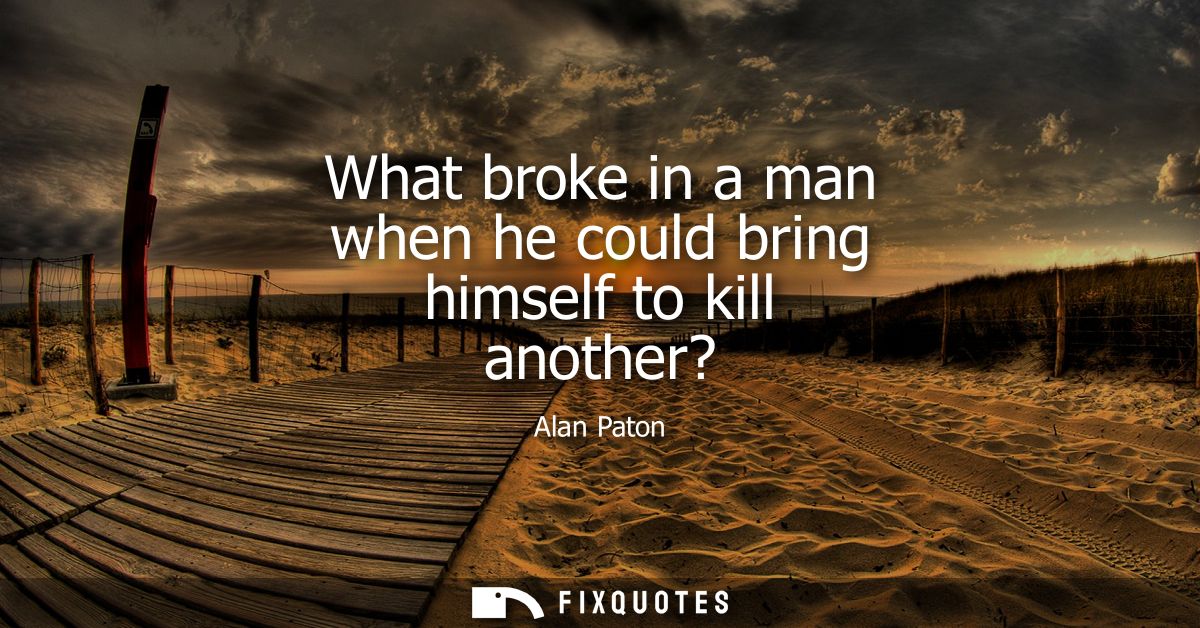
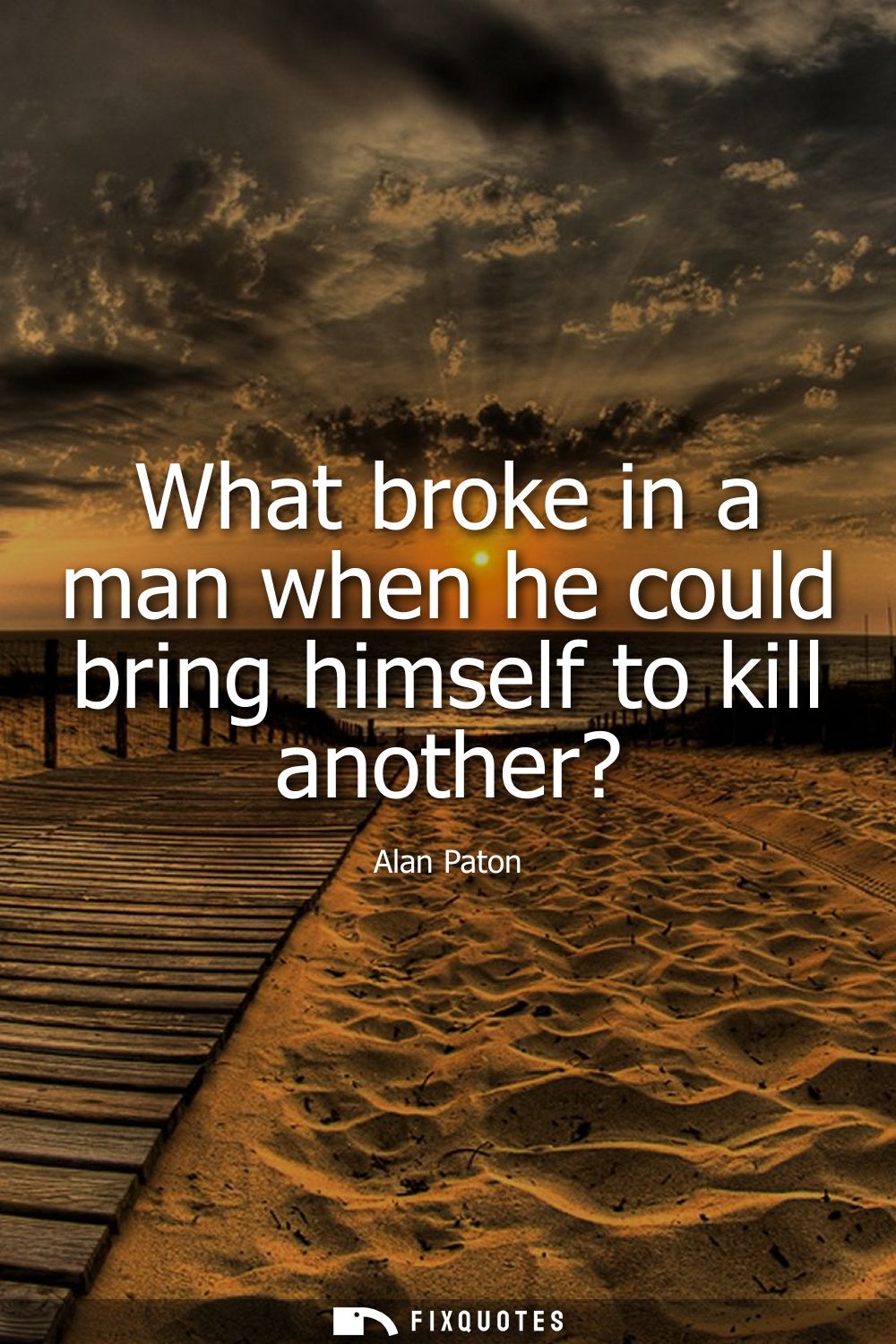
"What broke in a man when he could bring himself to kill another?"
About this Quote
The question lands like a moral x-ray: not “why did he kill?” but “what snapped inside him so that killing became possible?” Paton frames violence as an interior catastrophe before it’s an exterior act. The verb “broke” is doing the heavy lifting. It suggests a fracture in the self - a collapse of empathy, conscience, or the basic trust that makes other people real. By choosing a question rather than an accusation, Paton refuses the cheap comfort of certainty. He forces the reader to sit with a more corrosive possibility: that murder isn’t only the work of monsters, but the end point of ordinary human damage.
There’s also a quiet indictment of the systems that produce that damage. Paton, writing out of apartheid-era South Africa’s brutal stratifications, understood how law, poverty, and racialized fear can grind people into corners where violence feels like agency. The line doesn’t excuse the killer; it shifts the frame from individual wickedness to moral injury - the way a society can train people to harden, to dehumanize, to treat life as disposable. “Bring himself” hints at self-persuasion, the internal negotiations required to cross that line, as if the mind must be talked into betrayal.
Paton’s intent is pastoral but unsentimental: to make readers mourn the dead and still ask what happened to the living. It’s a sentence that turns judgment into diagnosis, and diagnosis into a demand for accountability that extends beyond one man.
There’s also a quiet indictment of the systems that produce that damage. Paton, writing out of apartheid-era South Africa’s brutal stratifications, understood how law, poverty, and racialized fear can grind people into corners where violence feels like agency. The line doesn’t excuse the killer; it shifts the frame from individual wickedness to moral injury - the way a society can train people to harden, to dehumanize, to treat life as disposable. “Bring himself” hints at self-persuasion, the internal negotiations required to cross that line, as if the mind must be talked into betrayal.
Paton’s intent is pastoral but unsentimental: to make readers mourn the dead and still ask what happened to the living. It’s a sentence that turns judgment into diagnosis, and diagnosis into a demand for accountability that extends beyond one man.
Quote Details
| Topic | Ethics & Morality |
|---|---|
| Source | Cry, the Beloved Country — Alan Paton (novel, 1948). The line appears in Paton's novel (exact page varies by edition). |
| Cite |
Citation Formats
APA Style (7th ed.)
Paton, Alan. (2026, January 17). What broke in a man when he could bring himself to kill another? FixQuotes. https://fixquotes.com/quotes/what-broke-in-a-man-when-he-could-bring-himself-71596/
Chicago Style
Paton, Alan. "What broke in a man when he could bring himself to kill another?" FixQuotes. January 17, 2026. https://fixquotes.com/quotes/what-broke-in-a-man-when-he-could-bring-himself-71596/.
MLA Style (9th ed.)
"What broke in a man when he could bring himself to kill another?" FixQuotes, 17 Jan. 2026, https://fixquotes.com/quotes/what-broke-in-a-man-when-he-could-bring-himself-71596/. Accessed 8 Mar. 2026.
More Quotes by Alan
Add to List