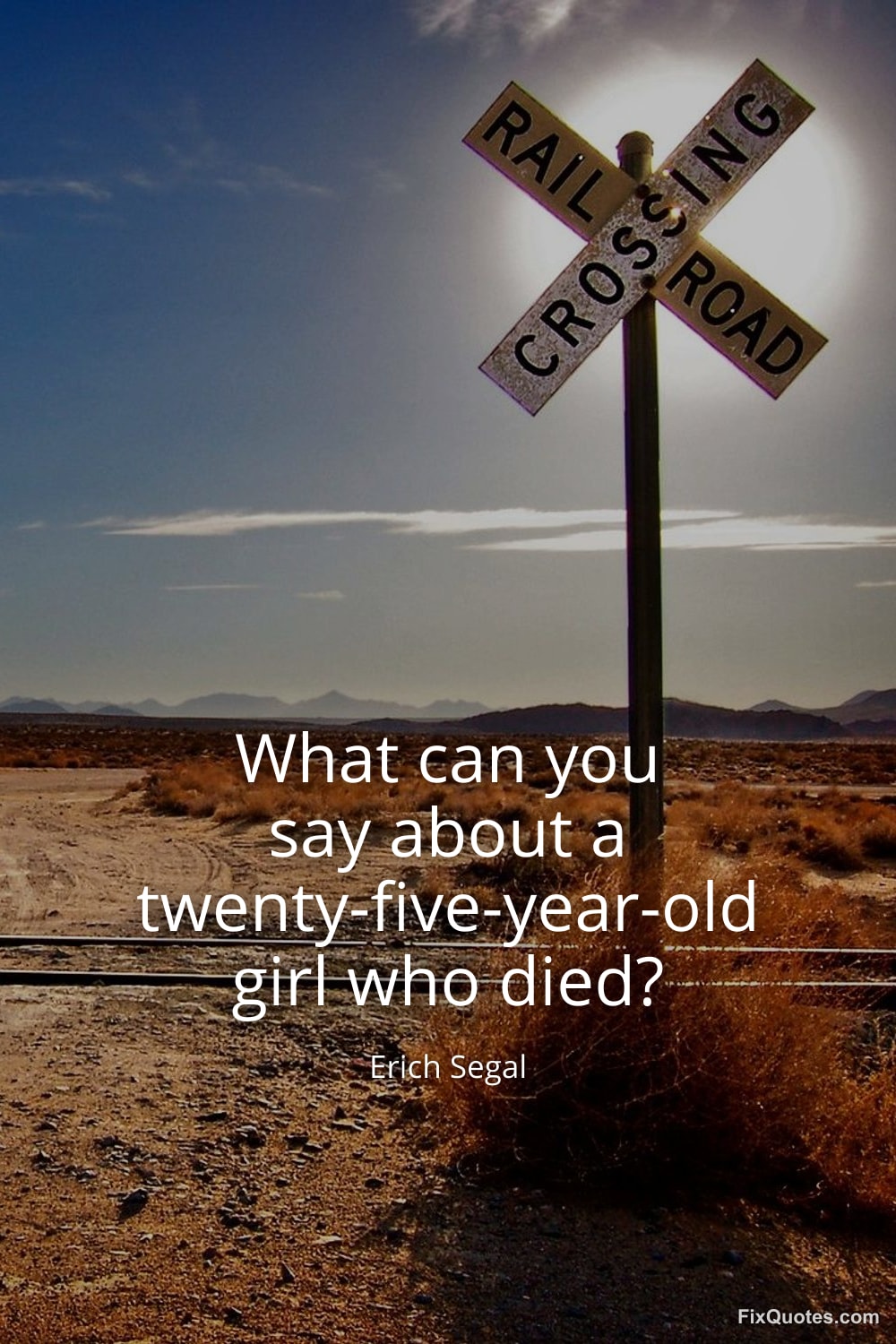
"What can you say about a twenty-five-year-old girl who died?"
About this Quote
It’s a sucker punch disguised as a question: a line that pretends to invite reflection while really closing off every adequate response. Segal opens Love Story with a dare to the reader’s emotional conscience. You can’t answer it without sounding cruel, and you can’t refuse to answer without conceding the premise that this death demands meaning. The genius is its coercion: it turns grief into a narrative contract.
The phrasing is carefully, almost cynically, economical. “Twenty-five-year-old girl” is engineered to trigger a cultural reflex: youth as moral alibi, femininity as innocence, “girl” (not woman) as heightened vulnerability. Death at 25 isn’t just sad; it’s portrayed as a theft of potential, a plot interrupted mid-sentence. The question also smuggles in a second implication: maybe all the interesting things you could say about her are now irrelevant, flattened by the fact of her dying. In other words, death doesn’t just end a life; it edits it.
Context matters. Published in 1970, Love Story hit a moment when mass-market fiction and Hollywood were discovering how efficiently a tragic romance could monetize sincerity. The line functions like a toll booth on the way into a tearjerker: pay in advance with your empathy, then proceed. It’s also a preemptive defense against skepticism. If you roll your eyes, you’ve already failed the test the sentence sets up.
The subtext is both tender and transactional: grief as proof of love, and love as something you demonstrate by how quickly you’re willing to be wrecked.
The phrasing is carefully, almost cynically, economical. “Twenty-five-year-old girl” is engineered to trigger a cultural reflex: youth as moral alibi, femininity as innocence, “girl” (not woman) as heightened vulnerability. Death at 25 isn’t just sad; it’s portrayed as a theft of potential, a plot interrupted mid-sentence. The question also smuggles in a second implication: maybe all the interesting things you could say about her are now irrelevant, flattened by the fact of her dying. In other words, death doesn’t just end a life; it edits it.
Context matters. Published in 1970, Love Story hit a moment when mass-market fiction and Hollywood were discovering how efficiently a tragic romance could monetize sincerity. The line functions like a toll booth on the way into a tearjerker: pay in advance with your empathy, then proceed. It’s also a preemptive defense against skepticism. If you roll your eyes, you’ve already failed the test the sentence sets up.
The subtext is both tender and transactional: grief as proof of love, and love as something you demonstrate by how quickly you’re willing to be wrecked.
Quote Details
| Topic | Mortality |
|---|---|
| Source | Verified source: Love Story (Erich Segal, 1970)
Evidence: What can you say about a twenty-five-year-old girl who died? (First sentence (Chapter 1 / opening line; exact page varies by edition)). Primary-source origin: this line is the opening sentence of Erich Segal’s novel Love Story (published 1970). A contemporaneous (June 11, 1970) Harvard Crimson review of the book reproduces it explicitly as the book’s first sentence, which is strong evidence for the novel text but not itself the first publication. Multiple references indicate segments of the story also appeared in Ladies’ Home Journal around the time of the book’s release; however, I could not verify (from a digitized issue/scan) the exact Ladies’ Home Journal installment/date/page where this exact opening sentence first appeared. If you need ‘first publication’ in the strictest sense, the next step is to locate the specific 1970 Ladies’ Home Journal excerpt/serialization and confirm whether it begins with this sentence and predates the Harper & Row book release. Other candidates (1) A Question of Quality (Louis Filler, 1976) compilation90.0% ... What can you say about a twenty - five - year - old- girl who died ? " is not the one which the book's title and ... |
| Cite |
Citation Formats
APA Style (7th ed.)
Segal, Erich. (2026, March 5). What can you say about a twenty-five-year-old girl who died? FixQuotes. https://fixquotes.com/quotes/what-can-you-say-about-a-twenty-five-year-old-173455/
Chicago Style
Segal, Erich. "What can you say about a twenty-five-year-old girl who died?" FixQuotes. March 5, 2026. https://fixquotes.com/quotes/what-can-you-say-about-a-twenty-five-year-old-173455/.
MLA Style (9th ed.)
"What can you say about a twenty-five-year-old girl who died?" FixQuotes, 5 Mar. 2026, https://fixquotes.com/quotes/what-can-you-say-about-a-twenty-five-year-old-173455/. Accessed 4 Apr. 2026.
More Quotes by Erich
Add to List