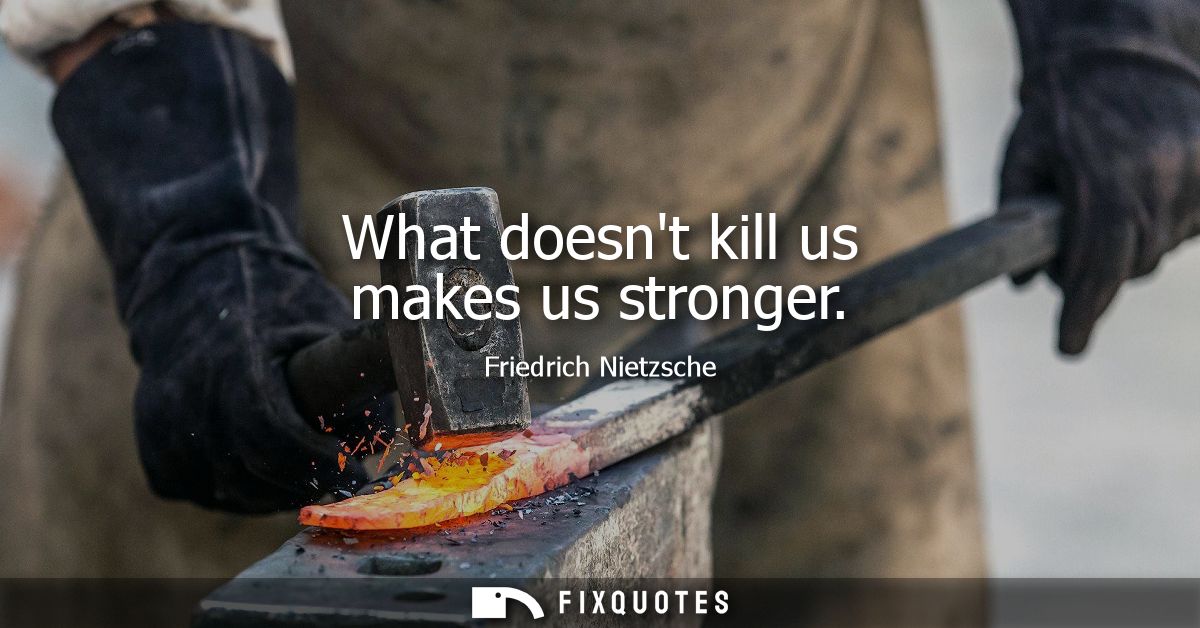
"What doesn't kill us makes us stronger"
About this Quote
Nietzsche’s line is a provocation disguised as a pep talk. Taken at face value, it sounds like stoic self-help: endure hardship, come out tougher. But Nietzsche isn’t selling comfort; he’s staging a challenge to a culture he thought was addicted to moral sedation. The point isn’t that suffering is good, or that survival automatically ennobles you. It’s that pain can be metabolized into power if you refuse the usual script of grievance, resentment, and spiritual bookkeeping.
The subtext is anti-victimhood, but not in the lazy, dismissive way the phrase gets used today. Nietzsche’s real target is what he calls the “slave morality” that turns weakness into virtue and makes a moral weapon out of injury. If you treat suffering primarily as evidence that the world owes you compensation, you stay trapped in it. If you treat it as raw material, you can transfigure it into insight, discipline, or daring - the kind of self-overcoming he admired.
Context matters: Nietzsche writes in the late 19th century, watching European Christianity’s authority wobble and modern life accelerate. His work is obsessed with what fills the vacuum once old certainties collapse. “Stronger” here isn’t gym strength or motivational grit; it’s existential capacity: the ability to bear ambiguity, to create values rather than inherit them.
That’s why the aphorism works. It’s brief enough to be misused, but sharp enough to sting: it forces a question with no sentimental exit. What are you going to do with what happened to you?
The subtext is anti-victimhood, but not in the lazy, dismissive way the phrase gets used today. Nietzsche’s real target is what he calls the “slave morality” that turns weakness into virtue and makes a moral weapon out of injury. If you treat suffering primarily as evidence that the world owes you compensation, you stay trapped in it. If you treat it as raw material, you can transfigure it into insight, discipline, or daring - the kind of self-overcoming he admired.
Context matters: Nietzsche writes in the late 19th century, watching European Christianity’s authority wobble and modern life accelerate. His work is obsessed with what fills the vacuum once old certainties collapse. “Stronger” here isn’t gym strength or motivational grit; it’s existential capacity: the ability to bear ambiguity, to create values rather than inherit them.
That’s why the aphorism works. It’s brief enough to be misused, but sharp enough to sting: it forces a question with no sentimental exit. What are you going to do with what happened to you?
Quote Details
| Topic | Resilience |
|---|---|
| Source | Later attribution: What Doesn't Kill Us Makes Us (Mike Mariani, 2022) modern compilation
Evidence: ... artlessly simple question . How valid was Nietzsche's claim that what doesn't kill us makes us stronger ? And if it was only partly valid - or not at all valid - then what did the broader 338 What Doesn't Kill Us Makes Us. Other candidates (2) Friedrich Nietzsche (Friedrich Nietzsche) compilation71.4% ings notebooks summer 1880 4271 that which does not kill us makes us stronger fr The Nietzsche-Wagner correspondence (Nietzsche, Friedrich Wilhelm, 1844-19..., 1921) primary32.5% ecome had i persistently clung to philology as matters now stand philology exert |
| Featured | This quote was our Quote of the Day on July 1, 2023 |
| Cite |
Citation Formats
APA Style (7th ed.)
Nietzsche, Friedrich. (2026, February 7). What doesn't kill us makes us stronger. FixQuotes. https://fixquotes.com/quotes/what-doesnt-kill-us-makes-us-stronger-321/
Chicago Style
Nietzsche, Friedrich. "What doesn't kill us makes us stronger." FixQuotes. February 7, 2026. https://fixquotes.com/quotes/what-doesnt-kill-us-makes-us-stronger-321/.
MLA Style (9th ed.)
"What doesn't kill us makes us stronger." FixQuotes, 7 Feb. 2026, https://fixquotes.com/quotes/what-doesnt-kill-us-makes-us-stronger-321/. Accessed 12 Feb. 2026.
More Quotes by Friedrich
Add to List