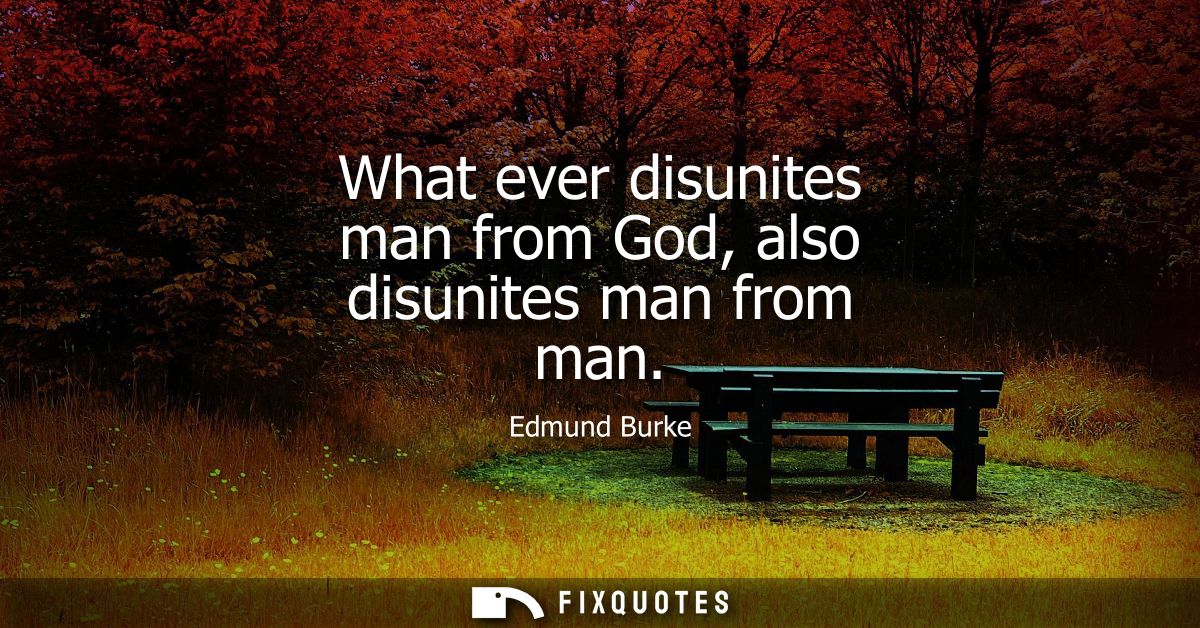
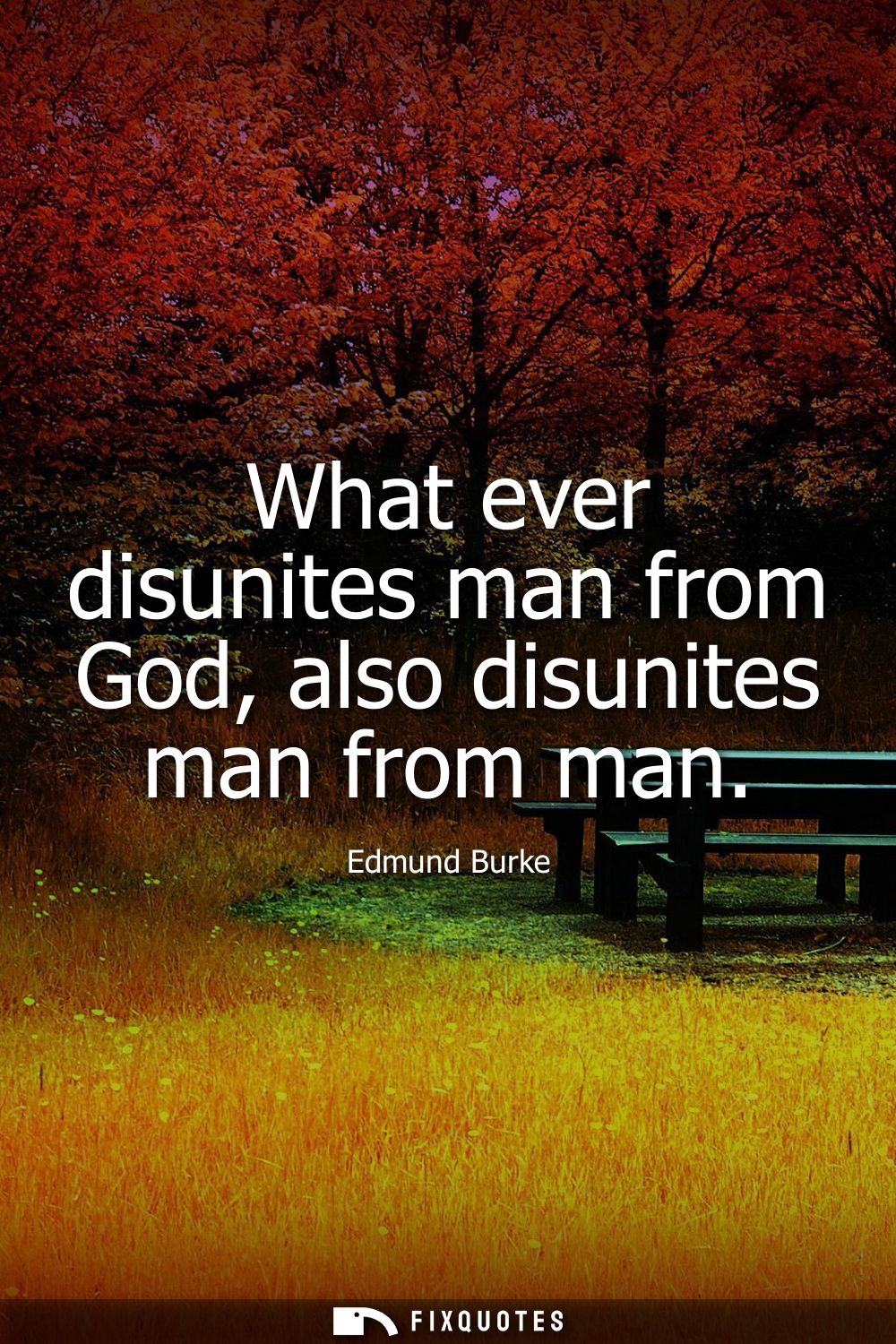
"What ever disunites man from God, also disunites man from man"
About this Quote
Burke is smuggling a political warning inside a theological claim: break the vertical bond and the horizontal one snaps soon after. Coming from an 18th-century statesman watching revolutions rewire Europe, the line isn’t misty piety; it’s a diagnosis of social glue. Burke treats religion less as private sentiment than as infrastructure: a shared moral vocabulary that makes strangers legible to one another, restrains appetite, and turns raw power into obligation.
The phrasing is sternly symmetrical, almost juridical. “Disunites” does the heavy lifting, implying not mere disagreement but the unraveling of a common world. Burke’s subtext is conservative in the classical sense: people don’t cooperate because they’ve solved ethics through reason; they cooperate because inherited rituals and limits teach them what a person is owed. Remove God from the picture and you don’t get liberated individuals so much as rival sovereigns, each authorizing themselves. That’s where “man from man” enters: cynicism becomes a civic force, trust becomes naive, and politics degrades into management by coercion or spectacle.
Context matters. Burke wasn’t abstractly “pro-religion”; he was reacting to Enlightenment certainty and, later, the French Revolution’s attempt to reboot society from first principles. The quote’s intent is to argue that metaphysical rupture has social consequences: when the highest authority is dethroned, the next authority is often the state, the mob, or the self. It’s less a sermon than a forecast about what happens to solidarity when the transcendent disappears.
The phrasing is sternly symmetrical, almost juridical. “Disunites” does the heavy lifting, implying not mere disagreement but the unraveling of a common world. Burke’s subtext is conservative in the classical sense: people don’t cooperate because they’ve solved ethics through reason; they cooperate because inherited rituals and limits teach them what a person is owed. Remove God from the picture and you don’t get liberated individuals so much as rival sovereigns, each authorizing themselves. That’s where “man from man” enters: cynicism becomes a civic force, trust becomes naive, and politics degrades into management by coercion or spectacle.
Context matters. Burke wasn’t abstractly “pro-religion”; he was reacting to Enlightenment certainty and, later, the French Revolution’s attempt to reboot society from first principles. The quote’s intent is to argue that metaphysical rupture has social consequences: when the highest authority is dethroned, the next authority is often the state, the mob, or the self. It’s less a sermon than a forecast about what happens to solidarity when the transcendent disappears.
Quote Details
| Topic | God |
|---|---|
| Source | Help us find the source |
| Cite |
Citation Formats
APA Style (7th ed.)
Burke, Edmund. (2026, January 18). What ever disunites man from God, also disunites man from man. FixQuotes. https://fixquotes.com/quotes/what-ever-disunites-man-from-god-also-disunites-19221/
Chicago Style
Burke, Edmund. "What ever disunites man from God, also disunites man from man." FixQuotes. January 18, 2026. https://fixquotes.com/quotes/what-ever-disunites-man-from-god-also-disunites-19221/.
MLA Style (9th ed.)
"What ever disunites man from God, also disunites man from man." FixQuotes, 18 Jan. 2026, https://fixquotes.com/quotes/what-ever-disunites-man-from-god-also-disunites-19221/. Accessed 5 Apr. 2026.
More Quotes by Edmund
Add to List