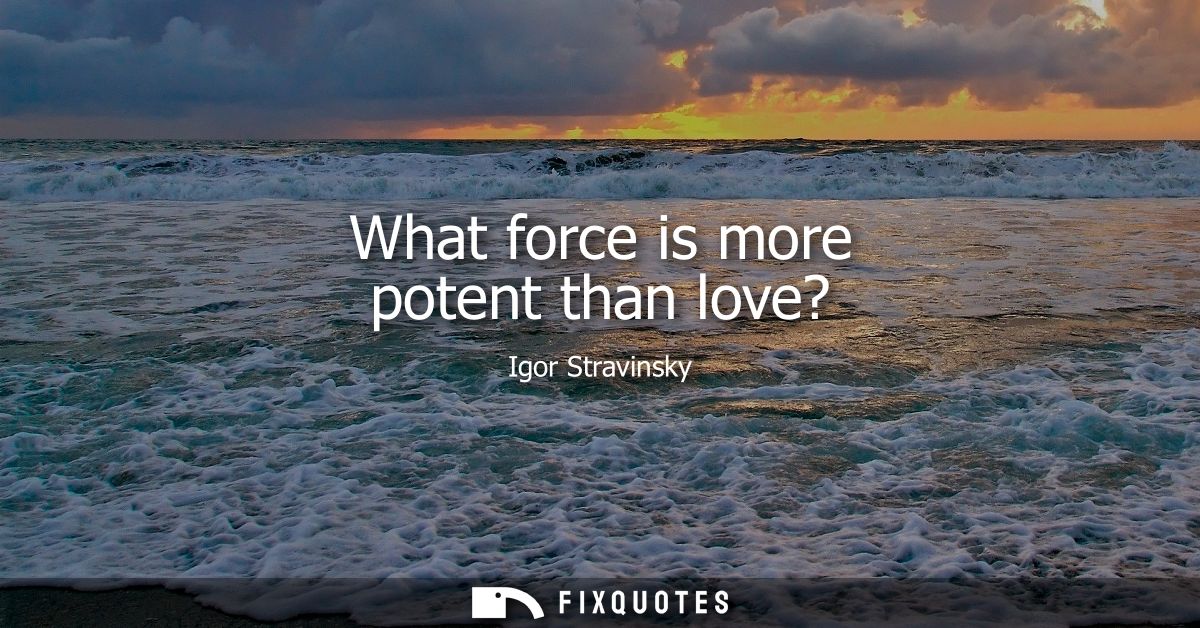
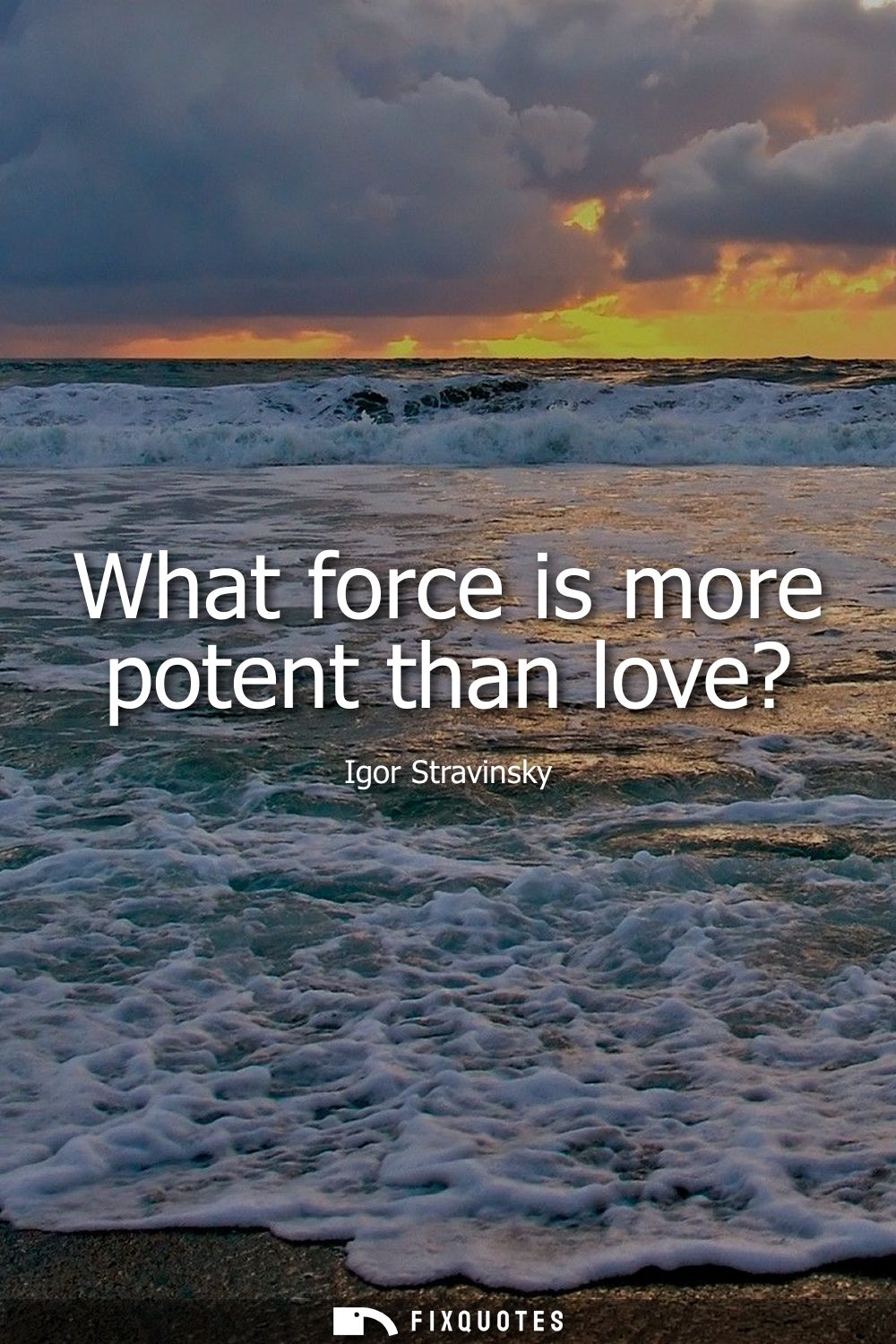
"What force is more potent than love?"
About this Quote
Stravinsky’s question lands like a provocation because it comes from a man famous for distrusting the very word. He spent much of his career swatting away the Romantic myth that music is a diary of feelings, insisting instead on craft, discipline, and the cool intelligence of form. So when Stravinsky asks, "What force is more potent than love?" it reads less like a Valentine and more like a composer's dare: name the rival, if you can.
The line works because it’s a rhetorical question that refuses sentimentality while still acknowledging love’s brute power. Stravinsky doesn’t describe love as tender or moral; he frames it as force. That’s telling. In the early 20th century, he watched Europe implode, ideologies harden, bodies marched and sacrificed in the name of nation, class, and purity. Against that backdrop, "love" isn’t a soft alternative; it’s a competing energy with the capacity to reorder lives, loyalties, and even entire cultures. The subtext is almost political: if power is what moves masses, love belongs on the shortlist.
It also fits Stravinsky’s musical world, where tension and release, attraction and refusal, are structural principles. Love, in that sense, isn’t just an emotion but a kind of gravity - the thing that pulls disparate elements into relation, makes collision meaningful, makes commitment possible. Coming from an artist who prized control, the admission is sly: even the strictest architectures are built around an irresistible pull.
The line works because it’s a rhetorical question that refuses sentimentality while still acknowledging love’s brute power. Stravinsky doesn’t describe love as tender or moral; he frames it as force. That’s telling. In the early 20th century, he watched Europe implode, ideologies harden, bodies marched and sacrificed in the name of nation, class, and purity. Against that backdrop, "love" isn’t a soft alternative; it’s a competing energy with the capacity to reorder lives, loyalties, and even entire cultures. The subtext is almost political: if power is what moves masses, love belongs on the shortlist.
It also fits Stravinsky’s musical world, where tension and release, attraction and refusal, are structural principles. Love, in that sense, isn’t just an emotion but a kind of gravity - the thing that pulls disparate elements into relation, makes collision meaningful, makes commitment possible. Coming from an artist who prized control, the admission is sly: even the strictest architectures are built around an irresistible pull.
Quote Details
| Topic | Love |
|---|---|
| Source | Help us find the source |
| Cite |
Citation Formats
APA Style (7th ed.)
Stravinsky, Igor. (2026, January 15). What force is more potent than love? FixQuotes. https://fixquotes.com/quotes/what-force-is-more-potent-than-love-68337/
Chicago Style
Stravinsky, Igor. "What force is more potent than love?" FixQuotes. January 15, 2026. https://fixquotes.com/quotes/what-force-is-more-potent-than-love-68337/.
MLA Style (9th ed.)
"What force is more potent than love?" FixQuotes, 15 Jan. 2026, https://fixquotes.com/quotes/what-force-is-more-potent-than-love-68337/. Accessed 12 Feb. 2026.
More Quotes by Igor
Add to List