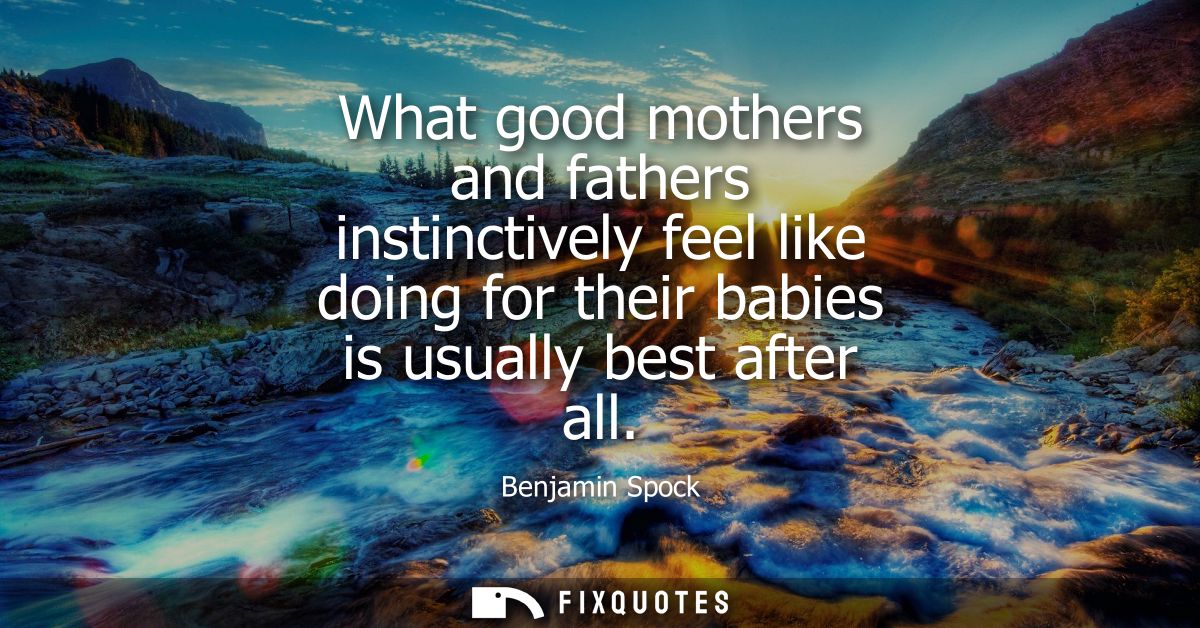
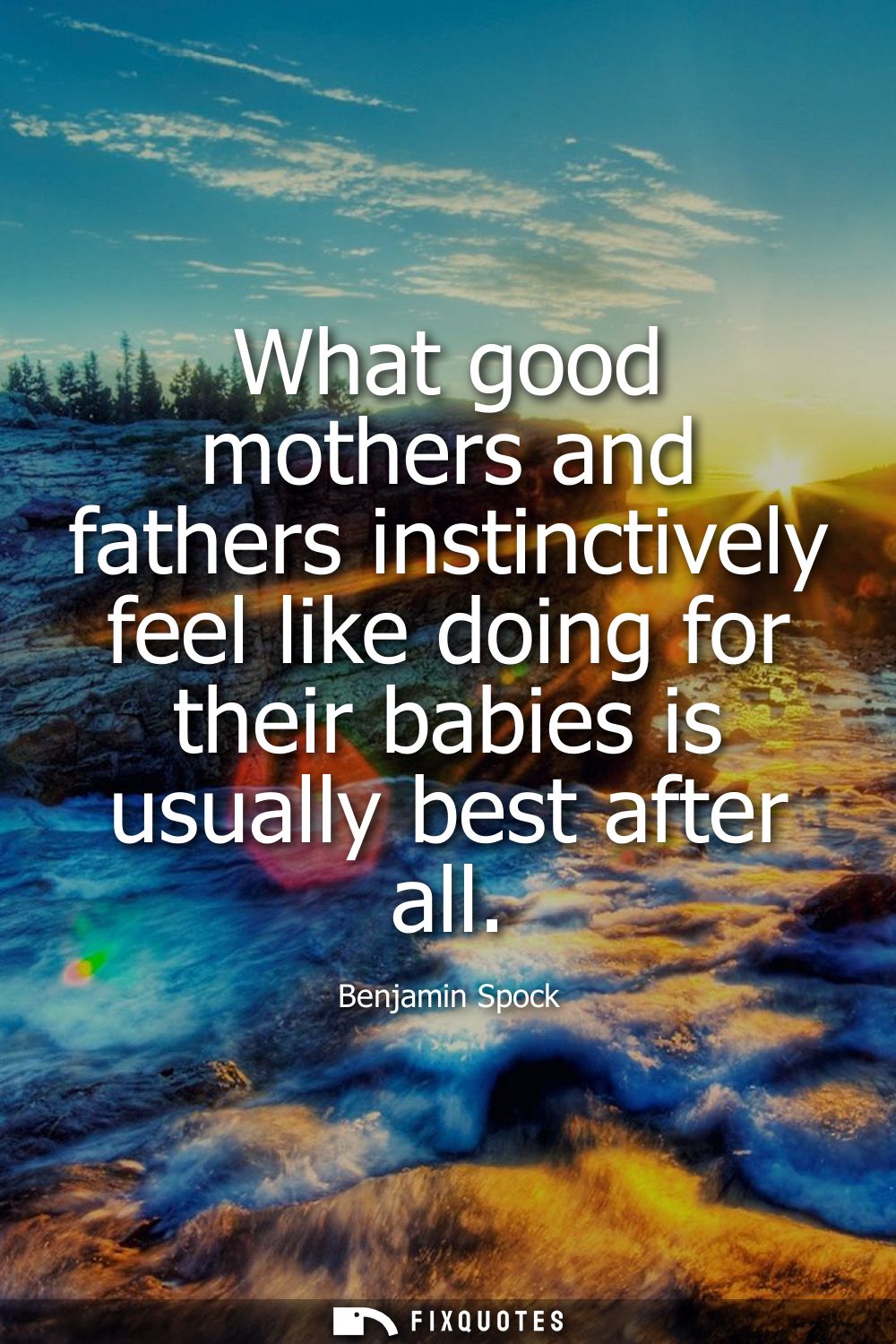
"What good mothers and fathers instinctively feel like doing for their babies is usually best after all"
About this Quote
The subtext is a critique of anxiety economies. Parenting manuals don’t just inform; they produce worry, then sell relief. Spock’s sentence interrupts that loop by suggesting the simplest, least monetizable resource - attunement to your child - is already available. Yet the sentence also reveals its era’s assumptions: “mothers and fathers” as a stable, default unit; “babies” as the focus of intensive care; “instinct” as something reliable and shared. That’s comforting, but it’s also normative, leaving out parents who don’t feel instinctive confidence, or whose circumstances make “what feels right” impossible.
What makes the line endure is its balancing act: it’s anti-authoritarian without being anti-knowledge. Spock isn’t telling parents to ignore medicine; he’s telling them that expertise should serve the relationship, not replace it.
Quote Details
| Topic | Parenting |
|---|---|
| Source | Benjamin Spock — The Common Sense Book of Baby and Child Care (original edition 1946). Quotation appears in his childcare manual commonly cited under this title. |
| Cite |
Citation Formats
APA Style (7th ed.)
Spock, Benjamin. (2026, January 16). What good mothers and fathers instinctively feel like doing for their babies is usually best after all. FixQuotes. https://fixquotes.com/quotes/what-good-mothers-and-fathers-instinctively-feel-138561/
Chicago Style
Spock, Benjamin. "What good mothers and fathers instinctively feel like doing for their babies is usually best after all." FixQuotes. January 16, 2026. https://fixquotes.com/quotes/what-good-mothers-and-fathers-instinctively-feel-138561/.
MLA Style (9th ed.)
"What good mothers and fathers instinctively feel like doing for their babies is usually best after all." FixQuotes, 16 Jan. 2026, https://fixquotes.com/quotes/what-good-mothers-and-fathers-instinctively-feel-138561/. Accessed 12 Feb. 2026.