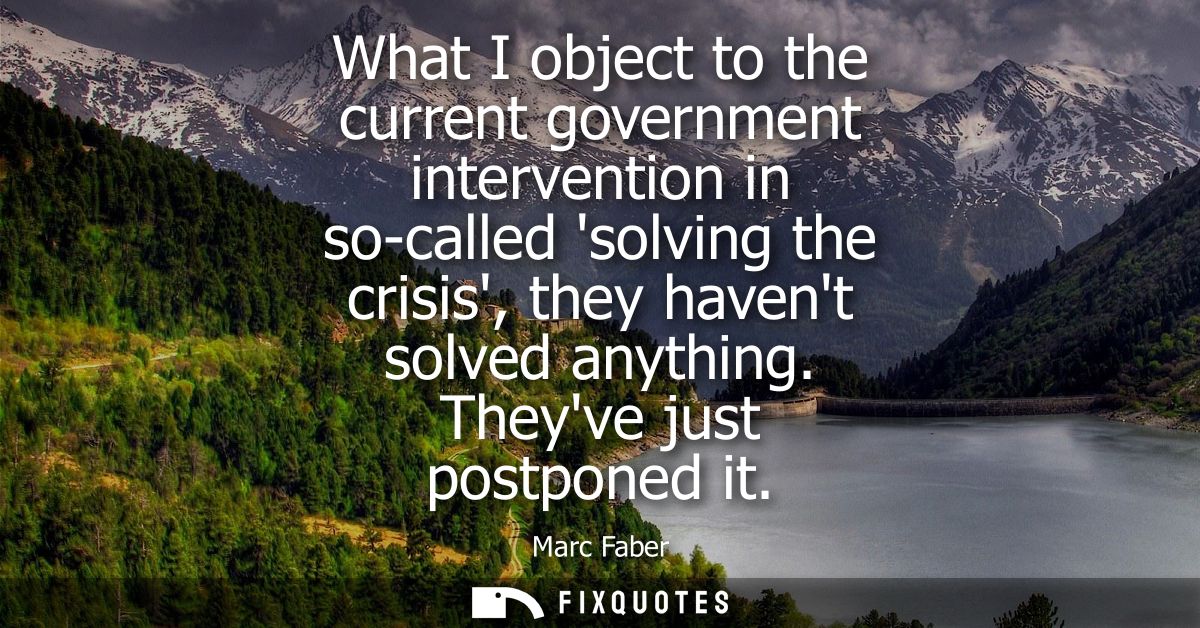
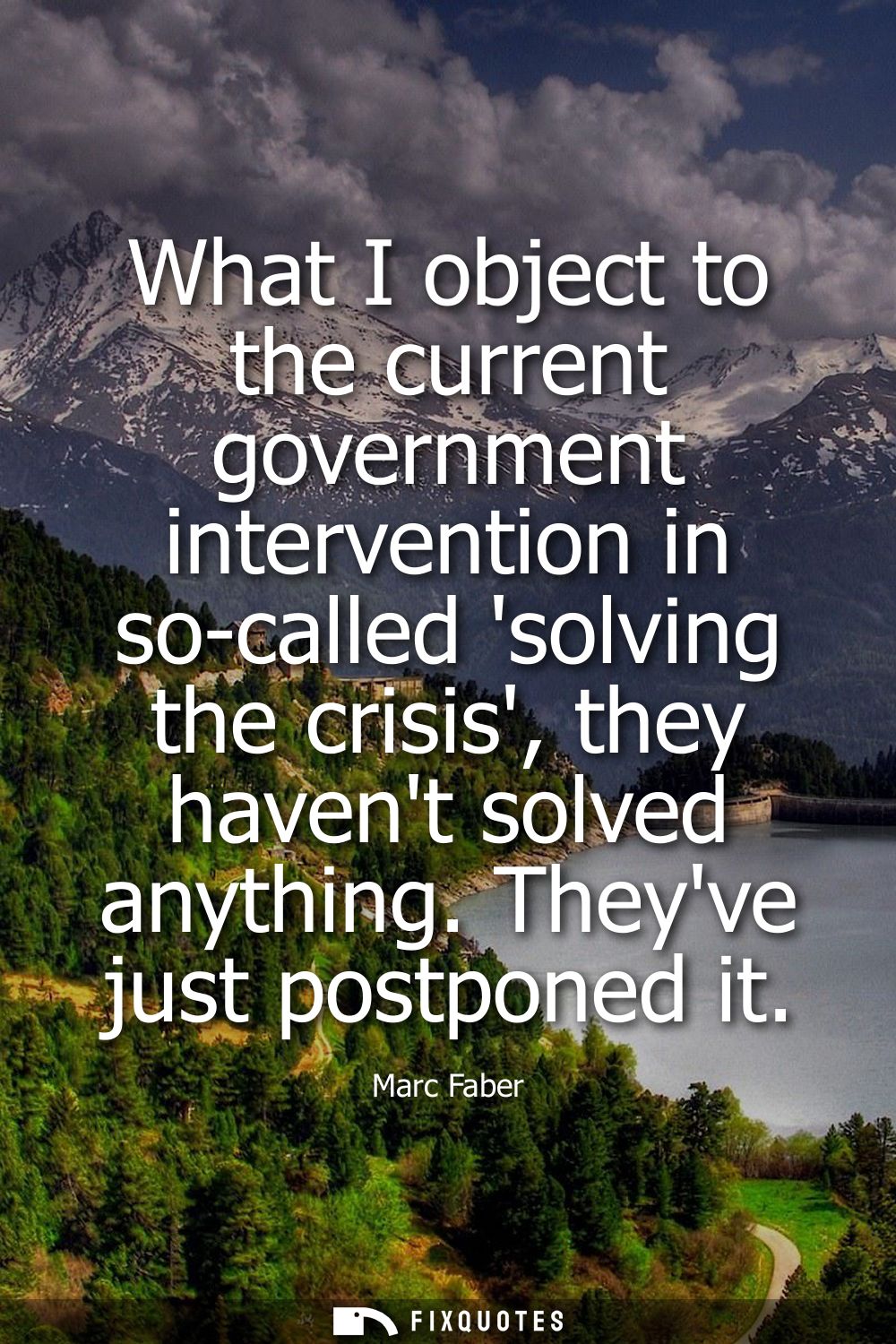
"What I object to the current government intervention in so-called 'solving the crisis', they haven't solved anything. They've just postponed it"
About this Quote
The intent is less to propose an alternative than to delegitimize the logic of intervention. “Government intervention” is treated as a reflex, not a considered tool, and the scare quotes around “solving” imply a category error: you can’t bureaucrat your way out of structural rot. The subtext is moral as much as economic. Postponement becomes a kind of dishonesty, shifting costs onto someone else: future taxpayers, future asset holders, future administrations. It’s also a shot at incentives. Politicians get rewarded for keeping the music playing; central banks get judged on calm, not catharsis. That bias toward postponement is the real “solution” being delivered.
Context matters: Faber’s public persona is the perma-bear with a megaphone, shaped by the long arc of bailout-era finance where liquidity can anesthetize symptoms without touching causes. The quote works because it offers a clean, cynical contrast: a crisis isn’t fixed, it’s rescheduled. That’s a terrifyingly legible story in a world where “stability” often means “not today.”
Quote Details
| Topic | Money |
|---|---|
| Source | Help us find the source |
| Cite |
Citation Formats
APA Style (7th ed.)
Faber, Marc. (2026, January 16). What I object to the current government intervention in so-called 'solving the crisis', they haven't solved anything. They've just postponed it. FixQuotes. https://fixquotes.com/quotes/what-i-object-to-the-current-government-118349/
Chicago Style
Faber, Marc. "What I object to the current government intervention in so-called 'solving the crisis', they haven't solved anything. They've just postponed it." FixQuotes. January 16, 2026. https://fixquotes.com/quotes/what-i-object-to-the-current-government-118349/.
MLA Style (9th ed.)
"What I object to the current government intervention in so-called 'solving the crisis', they haven't solved anything. They've just postponed it." FixQuotes, 16 Jan. 2026, https://fixquotes.com/quotes/what-i-object-to-the-current-government-118349/. Accessed 12 Feb. 2026.