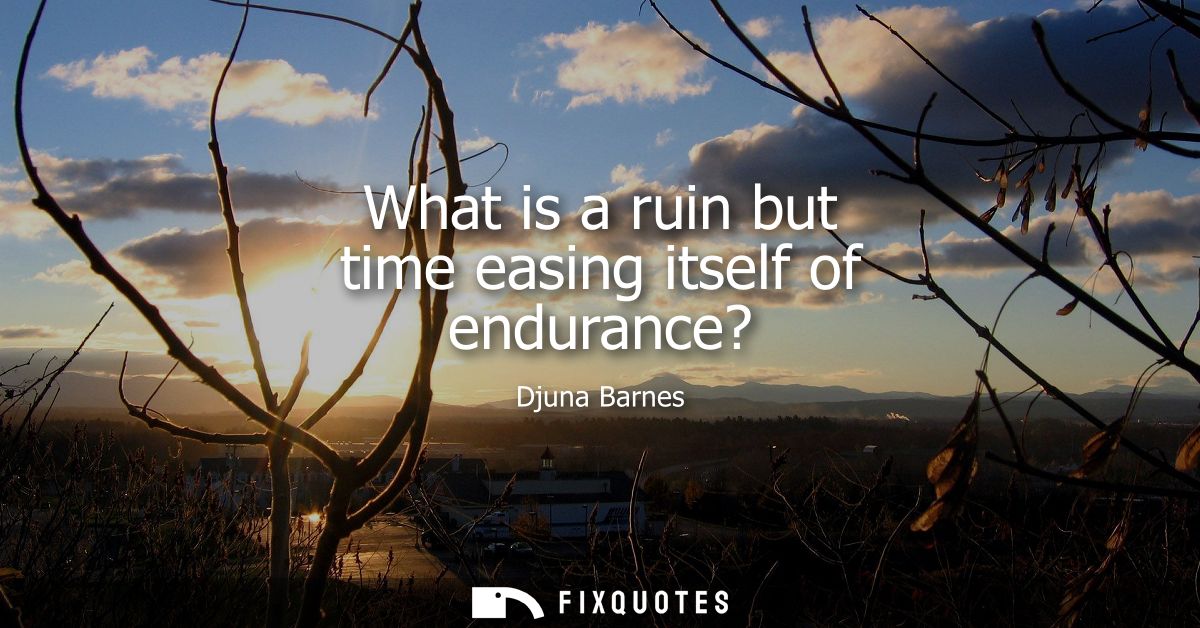
"What is a ruin but time easing itself of endurance?"
About this Quote
A ruin, in Barnes's framing, isn't a romantic object or a tourist stop; it's time caught mid-exhale. The line reverses the usual story we tell about decay. We think endurance fails, structures collapse, history breaks. Barnes suggests something colder and more elegant: endurance is what weighs on time, and a ruin is time shrugging off that burden. The syntax does the work. "What is... but" has the air of a riddle with a trapdoor, an invitation that immediately narrows the answer into inevitability. You're not asked to admire the ruin; you're asked to accept its logic.
"Easing itself" gives time a body, even a conscience. This isn't time as a neutral measure but time as an agent with preferences, capable of relief. That personification is slyly cruel: if time feels relief, then human efforts to make things last start to look like unpaid labor in a universe that would prefer less of it. Barnes was a modernist steeped in the aftermath of empires and the slow-motion wreckage of old certainties. Her work often treats identity, love, and social order as things that look solid until they don't. Here, architecture becomes a stand-in for any performed permanence: reputations, marriages, nations, even the self.
The subtext is a rebuke to nostalgia. Ruins don't "hold memory"; they demonstrate the cost of holding anything at all. Endurance isn't noble by default. It's strain. Time, Barnes implies, is patient enough to let our monuments pretend - then gently, almost politely, lets go.
"Easing itself" gives time a body, even a conscience. This isn't time as a neutral measure but time as an agent with preferences, capable of relief. That personification is slyly cruel: if time feels relief, then human efforts to make things last start to look like unpaid labor in a universe that would prefer less of it. Barnes was a modernist steeped in the aftermath of empires and the slow-motion wreckage of old certainties. Her work often treats identity, love, and social order as things that look solid until they don't. Here, architecture becomes a stand-in for any performed permanence: reputations, marriages, nations, even the self.
The subtext is a rebuke to nostalgia. Ruins don't "hold memory"; they demonstrate the cost of holding anything at all. Endurance isn't noble by default. It's strain. Time, Barnes implies, is patient enough to let our monuments pretend - then gently, almost politely, lets go.
Quote Details
| Topic | Time |
|---|---|
| Source | Help us find the source |
| Cite |
Citation Formats
APA Style (7th ed.)
Barnes, Djuna. (2026, January 15). What is a ruin but time easing itself of endurance? FixQuotes. https://fixquotes.com/quotes/what-is-a-ruin-but-time-easing-itself-of-endurance-144726/
Chicago Style
Barnes, Djuna. "What is a ruin but time easing itself of endurance?" FixQuotes. January 15, 2026. https://fixquotes.com/quotes/what-is-a-ruin-but-time-easing-itself-of-endurance-144726/.
MLA Style (9th ed.)
"What is a ruin but time easing itself of endurance?" FixQuotes, 15 Jan. 2026, https://fixquotes.com/quotes/what-is-a-ruin-but-time-easing-itself-of-endurance-144726/. Accessed 12 Feb. 2026.
More Quotes by Djuna
Add to List