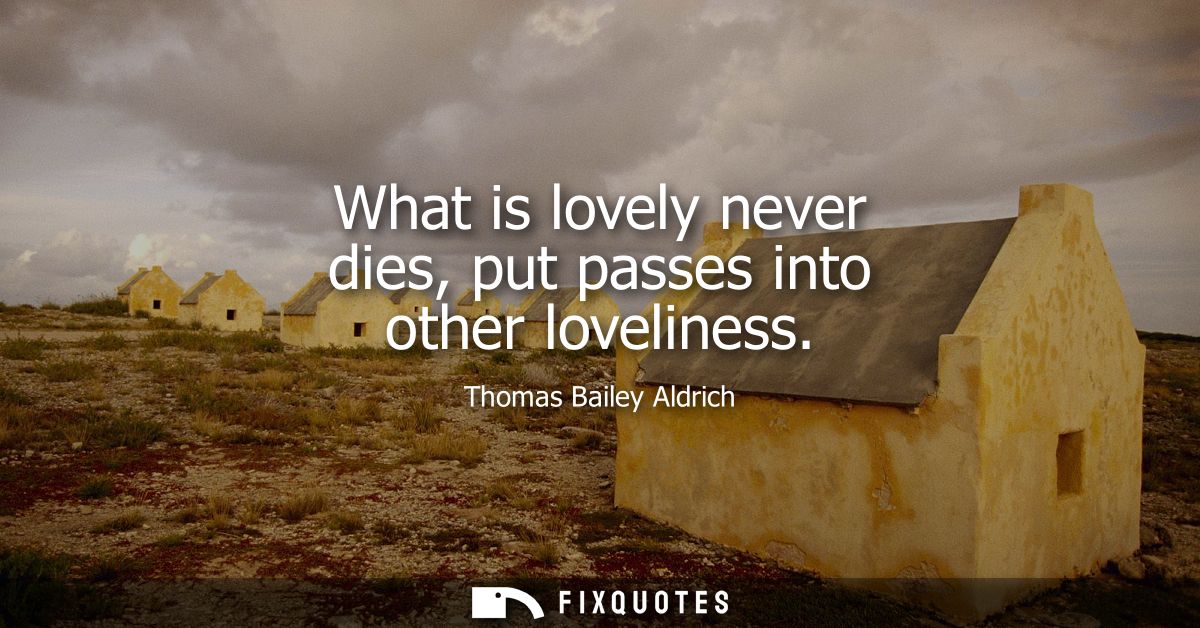
"What is lovely never dies, put passes into other loveliness"
About this Quote
Aldrich’s line is a small act of defiance dressed up as tenderness: beauty doesn’t end, it migrates. The power is in the grammatical sleight of hand. “Never dies” gives you the blunt comfort you want, then the sentence refuses the cheap victory of denial. Instead of saying loss isn’t real, it reroutes loss into a physics of feeling: what’s “lovely” doesn’t vanish; it changes state. The (almost certainly accidental, but telling) stumble of “put passes” even reads like a throat catching mid-eulogy, the mind rushing ahead of the mouth as it tries to make grief behave.
The subtext is Victorian and modern at once: a culture steeped in mourning rituals, but also a literary moment trying to reconcile sentiment with an emerging sobriety about time, decay, and memory. Aldrich, writing in an era that prized polish and lyric consolation, offers an idea that flatters both art and the mourner. If loveliness can be conserved, then remembrance isn’t just nostalgia; it’s stewardship. Beauty becomes transferable property: it “passes” into “other loveliness,” implying a chain of substitutions - a child inheriting a gesture, a landscape holding the color of a vanished afternoon, a poem keeping a voice audible after the body is gone.
It works because it doesn’t argue; it charms. Aldrich sidesteps theology and certainty, choosing the language of metamorphosis. The consolation isn’t that death is defeated, but that perception can be trained to keep finding the beloved in new forms - a discipline of attention as much as a balm.
The subtext is Victorian and modern at once: a culture steeped in mourning rituals, but also a literary moment trying to reconcile sentiment with an emerging sobriety about time, decay, and memory. Aldrich, writing in an era that prized polish and lyric consolation, offers an idea that flatters both art and the mourner. If loveliness can be conserved, then remembrance isn’t just nostalgia; it’s stewardship. Beauty becomes transferable property: it “passes” into “other loveliness,” implying a chain of substitutions - a child inheriting a gesture, a landscape holding the color of a vanished afternoon, a poem keeping a voice audible after the body is gone.
It works because it doesn’t argue; it charms. Aldrich sidesteps theology and certainty, choosing the language of metamorphosis. The consolation isn’t that death is defeated, but that perception can be trained to keep finding the beloved in new forms - a discipline of attention as much as a balm.
Quote Details
| Topic | Love |
|---|---|
| Source | Help us find the source |
| Cite |
Citation Formats
APA Style (7th ed.)
Aldrich, Thomas Bailey. (2026, January 15). What is lovely never dies, put passes into other loveliness. FixQuotes. https://fixquotes.com/quotes/what-is-lovely-never-dies-put-passes-into-other-116911/
Chicago Style
Aldrich, Thomas Bailey. "What is lovely never dies, put passes into other loveliness." FixQuotes. January 15, 2026. https://fixquotes.com/quotes/what-is-lovely-never-dies-put-passes-into-other-116911/.
MLA Style (9th ed.)
"What is lovely never dies, put passes into other loveliness." FixQuotes, 15 Jan. 2026, https://fixquotes.com/quotes/what-is-lovely-never-dies-put-passes-into-other-116911/. Accessed 3 Apr. 2026.
More Quotes by Thomas
Add to List