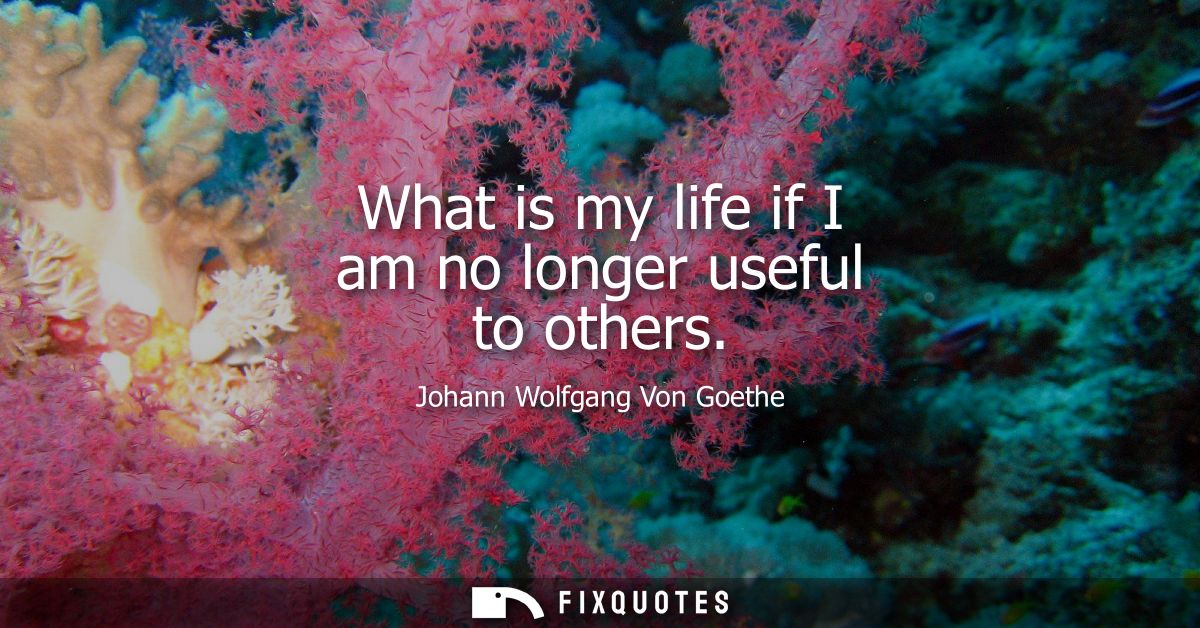
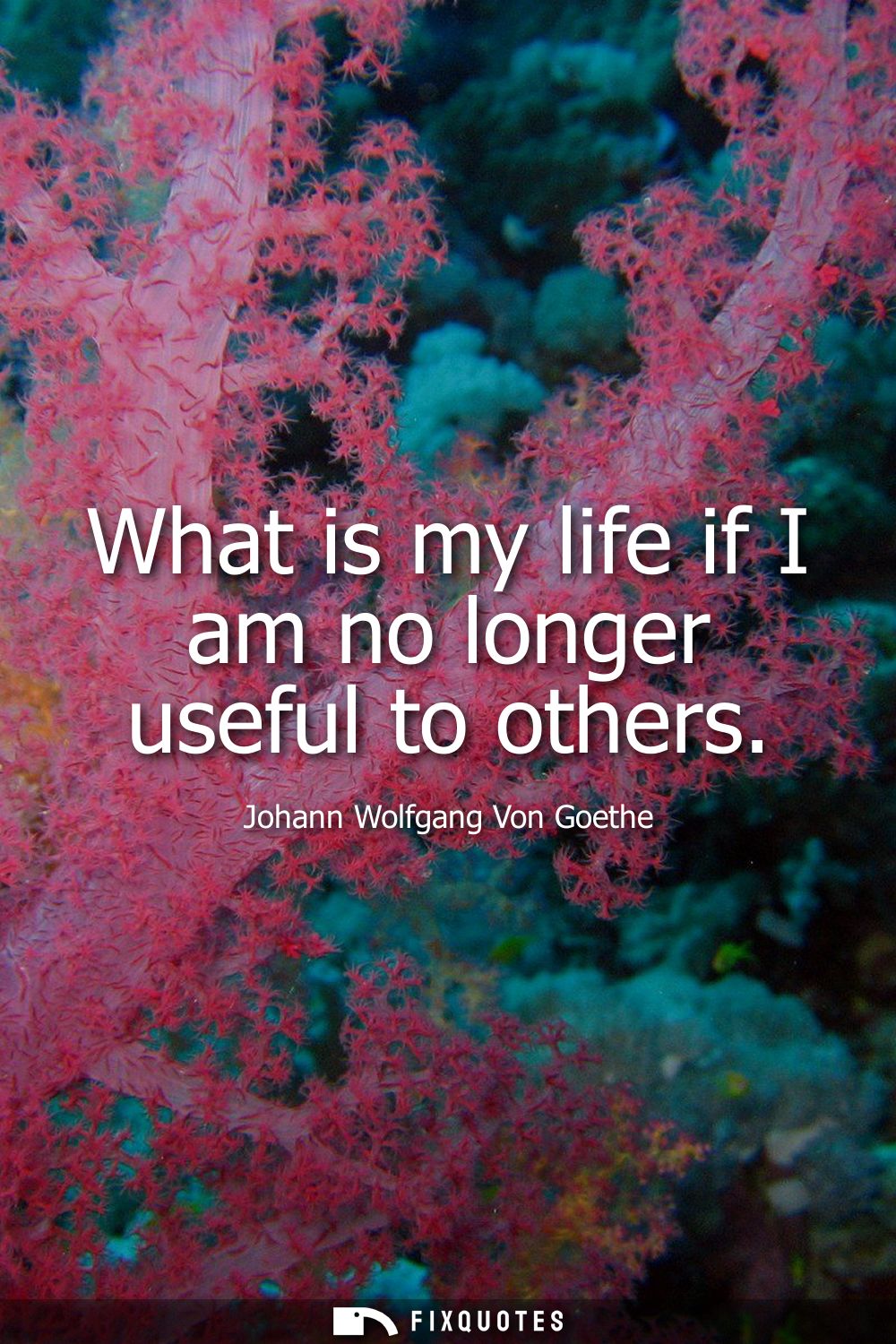
"What is my life if I am no longer useful to others"
About this Quote
Usefulness is the seductive moral shortcut Goethe is poking at: the idea that a life’s worth can be audited in public service, productivity, and the clean receipt of being needed. Coming from a writer who spent decades inside the machinery of court, administration, and cultural prestige, the line doesn’t read as humble selflessness so much as a stark self-interrogation. It’s the Enlightenment and early modern bourgeois ethic distilled into a single anxious question: if you stop contributing, do you stop mattering?
The intent is double-edged. On its face, it’s a credo of social responsibility, the sort of sentence that flatters community-mindedness. Underneath, it’s a confession of dependence: identity outsourced to other people’s demand. Goethe’s phrasing is crucial. “What is my life” doesn’t ask whether life continues, but whether it retains meaning once “useful” is revoked. That word carries the cold clarity of an instrument, not the warmth of love. Useful to others, not connected to others, not cherished by others. The metric is function.
Context sharpens the tension. Goethe lived at the hinge between Romantic inwardness (the self as a vast landscape) and civic rationalism (the self as a worker in the world). The quote dramatizes that collision: the Romantic fear of emptiness meeting the bureaucratic fear of redundancy. Read now, it lands like a critique of modern burnout culture before the factory whistle: when usefulness becomes the only alibi for existence, aging, illness, or simply wanting less starts to feel like a moral failure.
The intent is double-edged. On its face, it’s a credo of social responsibility, the sort of sentence that flatters community-mindedness. Underneath, it’s a confession of dependence: identity outsourced to other people’s demand. Goethe’s phrasing is crucial. “What is my life” doesn’t ask whether life continues, but whether it retains meaning once “useful” is revoked. That word carries the cold clarity of an instrument, not the warmth of love. Useful to others, not connected to others, not cherished by others. The metric is function.
Context sharpens the tension. Goethe lived at the hinge between Romantic inwardness (the self as a vast landscape) and civic rationalism (the self as a worker in the world). The quote dramatizes that collision: the Romantic fear of emptiness meeting the bureaucratic fear of redundancy. Read now, it lands like a critique of modern burnout culture before the factory whistle: when usefulness becomes the only alibi for existence, aging, illness, or simply wanting less starts to feel like a moral failure.
Quote Details
| Topic | Meaning of Life |
|---|---|
| Source | Help us find the source |
| Cite |
Citation Formats
APA Style (7th ed.)
Goethe, Johann Wolfgang Von. (2026, January 15). What is my life if I am no longer useful to others. FixQuotes. https://fixquotes.com/quotes/what-is-my-life-if-i-am-no-longer-useful-to-others-7971/
Chicago Style
Goethe, Johann Wolfgang Von. "What is my life if I am no longer useful to others." FixQuotes. January 15, 2026. https://fixquotes.com/quotes/what-is-my-life-if-i-am-no-longer-useful-to-others-7971/.
MLA Style (9th ed.)
"What is my life if I am no longer useful to others." FixQuotes, 15 Jan. 2026, https://fixquotes.com/quotes/what-is-my-life-if-i-am-no-longer-useful-to-others-7971/. Accessed 12 Feb. 2026.
More Quotes by Johann
Add to List