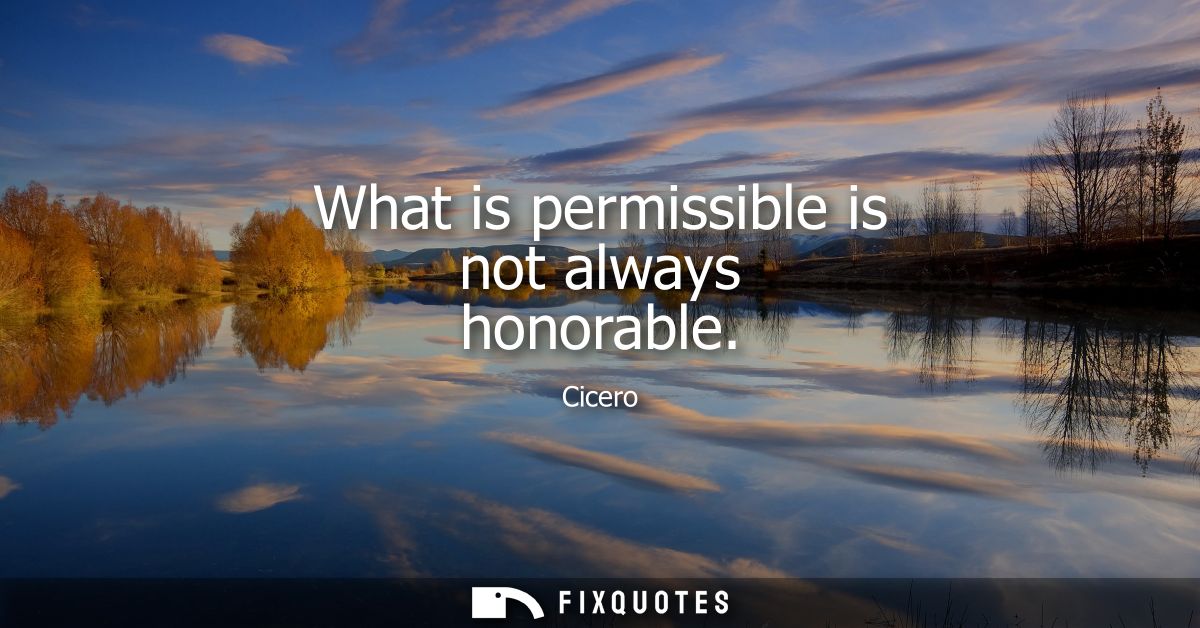
"What is permissible is not always honorable"
About this Quote
Law is a floor, not a halo. Cicero’s line slices through the comforting assumption that if something is allowed, it’s therefore acceptable in any deeper sense. Coming from Rome’s most famous lawyer-orator, the point lands with extra sting: he’s speaking from inside the machinery that turns human conflict into statutes, loopholes, and procedural victories. He knows exactly how easy it is to win on technicalities while losing the moral argument.
The intent is practical, not pious. Cicero is warning a political class trained to confuse legality with legitimacy. Late Republican Rome was a world where ambitious men could use “permissible” acts - bribery dressed up as gifts, violence laundered through proxies, land grabs justified by emergency decrees - to hollow out civic trust while claiming innocence. His subtext: a republic doesn’t collapse only when laws are broken; it collapses when laws are obeyed in bad faith.
Rhetorically, the aphorism works because it sets up a clean, almost courtroom-like distinction: permissible (what the rules let you do) versus honorable (what your character should refuse). The sentence is short enough to feel like common sense, but it’s actually an indictment of moral minimalism - the idea that ethics ends where enforcement ends. Cicero is insisting on a second tribunal, one no judge can run: reputation, conscience, and the fragile consent that makes public life possible. In that gap between “can” and “should,” he locates the true battleground of politics.
The intent is practical, not pious. Cicero is warning a political class trained to confuse legality with legitimacy. Late Republican Rome was a world where ambitious men could use “permissible” acts - bribery dressed up as gifts, violence laundered through proxies, land grabs justified by emergency decrees - to hollow out civic trust while claiming innocence. His subtext: a republic doesn’t collapse only when laws are broken; it collapses when laws are obeyed in bad faith.
Rhetorically, the aphorism works because it sets up a clean, almost courtroom-like distinction: permissible (what the rules let you do) versus honorable (what your character should refuse). The sentence is short enough to feel like common sense, but it’s actually an indictment of moral minimalism - the idea that ethics ends where enforcement ends. Cicero is insisting on a second tribunal, one no judge can run: reputation, conscience, and the fragile consent that makes public life possible. In that gap between “can” and “should,” he locates the true battleground of politics.
Quote Details
| Topic | Ethics & Morality |
|---|---|
| Source | Help us find the source |
| Cite |
Citation Formats
APA Style (7th ed.)
Cicero. (2026, January 15). What is permissible is not always honorable. FixQuotes. https://fixquotes.com/quotes/what-is-permissible-is-not-always-honorable-9064/
Chicago Style
Cicero. "What is permissible is not always honorable." FixQuotes. January 15, 2026. https://fixquotes.com/quotes/what-is-permissible-is-not-always-honorable-9064/.
MLA Style (9th ed.)
"What is permissible is not always honorable." FixQuotes, 15 Jan. 2026, https://fixquotes.com/quotes/what-is-permissible-is-not-always-honorable-9064/. Accessed 28 Mar. 2026.
More Quotes by Cicero
Add to List