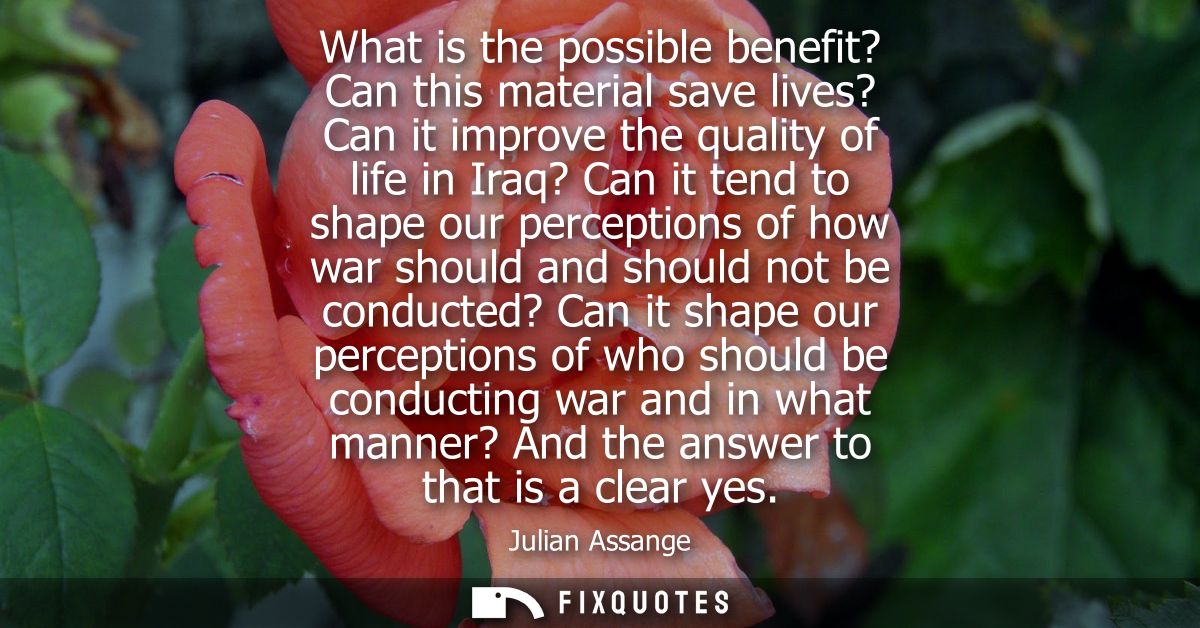
"What is the possible benefit? Can this material save lives? Can it improve the quality of life in Iraq? Can it tend to shape our perceptions of how war should and should not be conducted? Can it shape our perceptions of who should be conducting war and in what manner? And the answer to that is a clear yes!"
About this Quote
The subtext is a defense brief against the perennial critique of leaks: that they’re reckless, voyeuristic, or merely anti-American. By foregrounding Iraq, he centers the people most often treated as background in Western debates about “transparency.” He’s also quietly redefining benefit. It’s not just about immediate tactical outcomes; it’s about “shaping perceptions,” a phrase that concedes the battlefield is cultural as much as geographic. War, he implies, depends on managed visibility - what publics are allowed to see, what soldiers are trained to ignore, what governments can deny.
Context matters: Assange is speaking from the WikiLeaks era when “collateral damage” was both euphemism and policy instrument. His intent is to claim a civic mandate for disclosure by tying it to democratic oversight and moral clarity. The punchline isn’t that information is neutral; it’s that secrecy is active, and it kills.
Quote Details
| Topic | War |
|---|---|
| Source | Help us find the source |
| Cite |
Citation Formats
APA Style (7th ed.)
Assange, Julian. (2026, February 18). What is the possible benefit? Can this material save lives? Can it improve the quality of life in Iraq? Can it tend to shape our perceptions of how war should and should not be conducted? Can it shape our perceptions of who should be conducting war and in what manner? And the answer to that is a clear yes! FixQuotes. https://fixquotes.com/quotes/what-is-the-possible-benefit-can-this-material-60327/
Chicago Style
Assange, Julian. "What is the possible benefit? Can this material save lives? Can it improve the quality of life in Iraq? Can it tend to shape our perceptions of how war should and should not be conducted? Can it shape our perceptions of who should be conducting war and in what manner? And the answer to that is a clear yes!" FixQuotes. February 18, 2026. https://fixquotes.com/quotes/what-is-the-possible-benefit-can-this-material-60327/.
MLA Style (9th ed.)
"What is the possible benefit? Can this material save lives? Can it improve the quality of life in Iraq? Can it tend to shape our perceptions of how war should and should not be conducted? Can it shape our perceptions of who should be conducting war and in what manner? And the answer to that is a clear yes!" FixQuotes, 18 Feb. 2026, https://fixquotes.com/quotes/what-is-the-possible-benefit-can-this-material-60327/. Accessed 24 Mar. 2026.