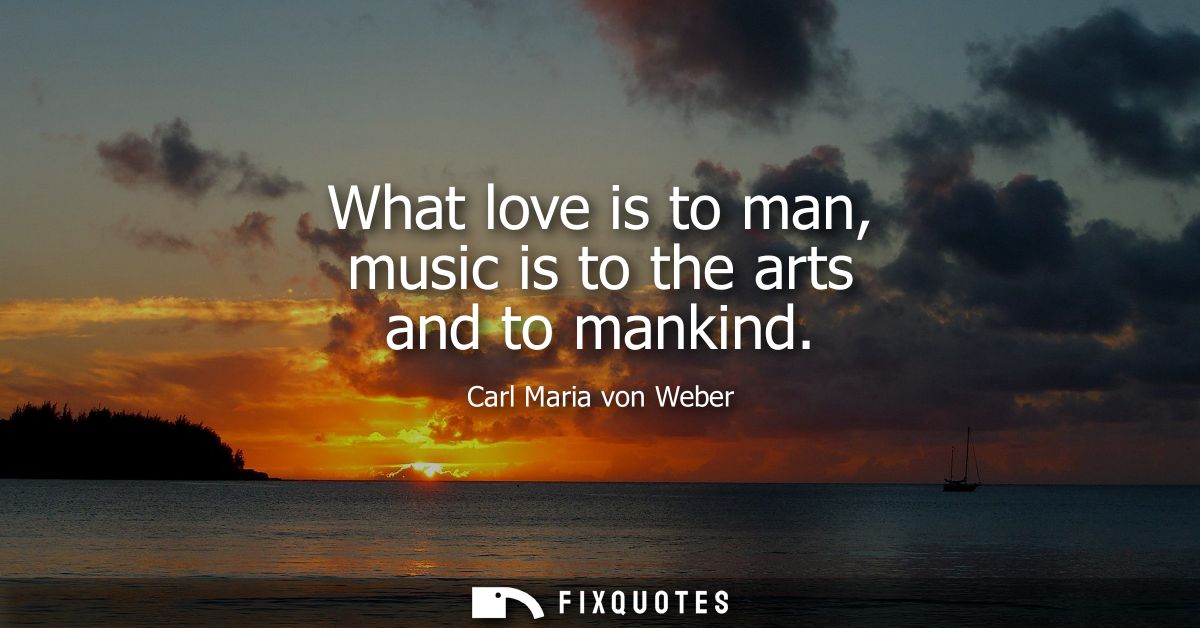
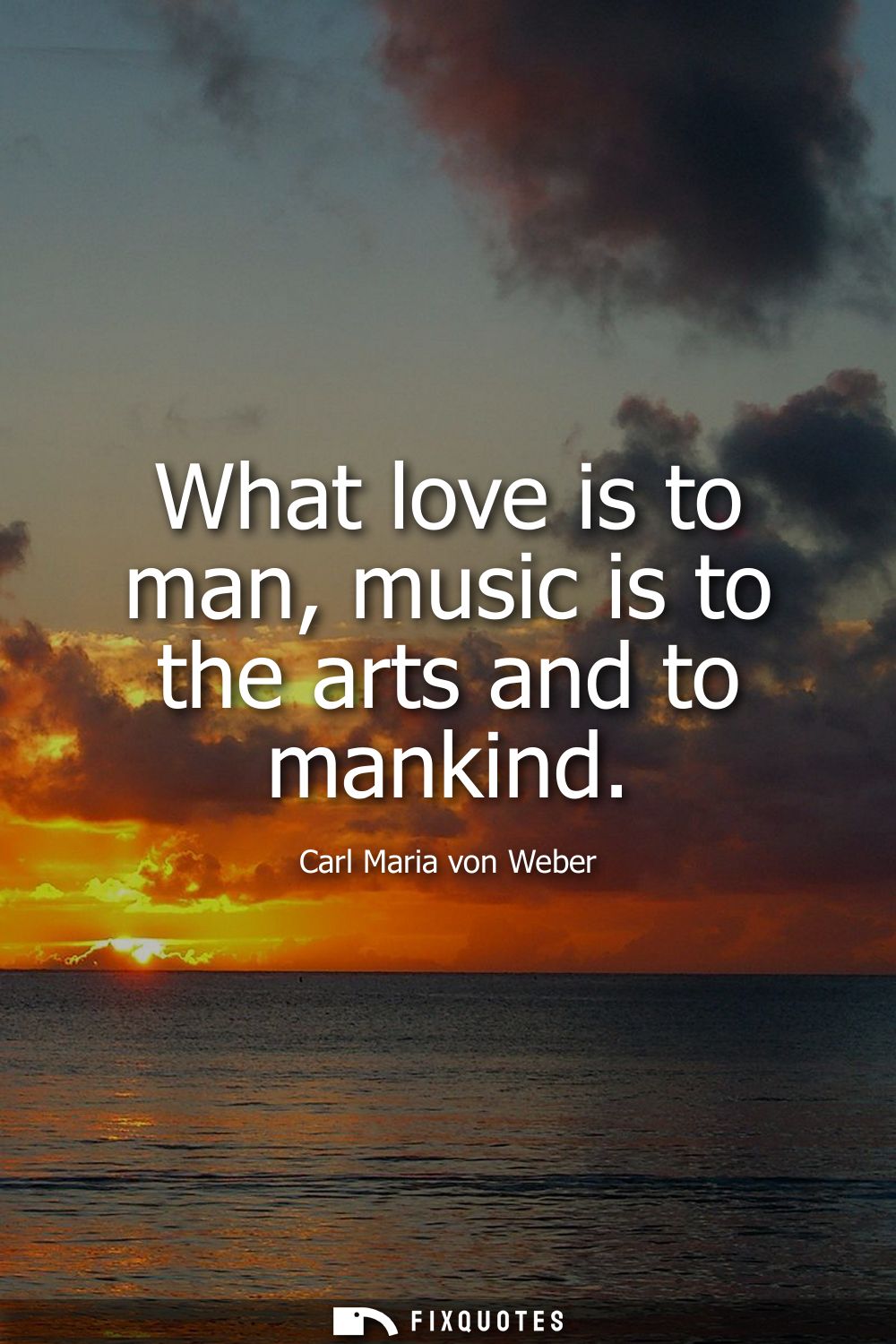
"What love is to man, music is to the arts and to mankind"
About this Quote
Weber doesn’t romanticize music so much as he appoints it: the essential organ of the arts, the thing that keeps the whole body of culture alive. By pairing “love” and “music,” he’s not reaching for a pretty metaphor; he’s building a hierarchy. Love is framed as the force that makes a man fully human - irrational, binding, energizing, sometimes ruinous, but undeniably animating. Music, he argues, plays that same role for every other art form and, more audaciously, for “mankind” itself.
The line works because it smuggles in a claim about what music can do that painting, literature, even philosophy can’t quite manage. Music bypasses explanation. It hits the nervous system first, then the intellect. In an early 19th-century Europe where Romanticism was busy dethroning Enlightenment certainty, that’s a power move: feeling isn’t a distraction from meaning, it’s the delivery system.
There’s also a professional stake hiding in the lyricism. Weber, a key architect of German Romantic opera (and a bridge toward Wagner’s total artwork ambitions), is elevating his medium at a moment when composers were becoming cultural authorities, not courtly employees. Calling music the “love” of the arts implies that without it, the arts can still exist, but they’re emotionally undernourished - technically impressive, spiritually thin. It’s advocacy disguised as philosophy, and it lands because it flatters the listener’s experience: if music moves you, you’re not being manipulated; you’re being made human.
The line works because it smuggles in a claim about what music can do that painting, literature, even philosophy can’t quite manage. Music bypasses explanation. It hits the nervous system first, then the intellect. In an early 19th-century Europe where Romanticism was busy dethroning Enlightenment certainty, that’s a power move: feeling isn’t a distraction from meaning, it’s the delivery system.
There’s also a professional stake hiding in the lyricism. Weber, a key architect of German Romantic opera (and a bridge toward Wagner’s total artwork ambitions), is elevating his medium at a moment when composers were becoming cultural authorities, not courtly employees. Calling music the “love” of the arts implies that without it, the arts can still exist, but they’re emotionally undernourished - technically impressive, spiritually thin. It’s advocacy disguised as philosophy, and it lands because it flatters the listener’s experience: if music moves you, you’re not being manipulated; you’re being made human.
Quote Details
| Topic | Music |
|---|---|
| Source | Help us find the source |
| Cite |
Citation Formats
APA Style (7th ed.)
Weber, Carl Maria von. (2026, January 15). What love is to man, music is to the arts and to mankind. FixQuotes. https://fixquotes.com/quotes/what-love-is-to-man-music-is-to-the-arts-and-to-120018/
Chicago Style
Weber, Carl Maria von. "What love is to man, music is to the arts and to mankind." FixQuotes. January 15, 2026. https://fixquotes.com/quotes/what-love-is-to-man-music-is-to-the-arts-and-to-120018/.
MLA Style (9th ed.)
"What love is to man, music is to the arts and to mankind." FixQuotes, 15 Jan. 2026, https://fixquotes.com/quotes/what-love-is-to-man-music-is-to-the-arts-and-to-120018/. Accessed 12 Feb. 2026.
More Quotes by Carl
Add to List