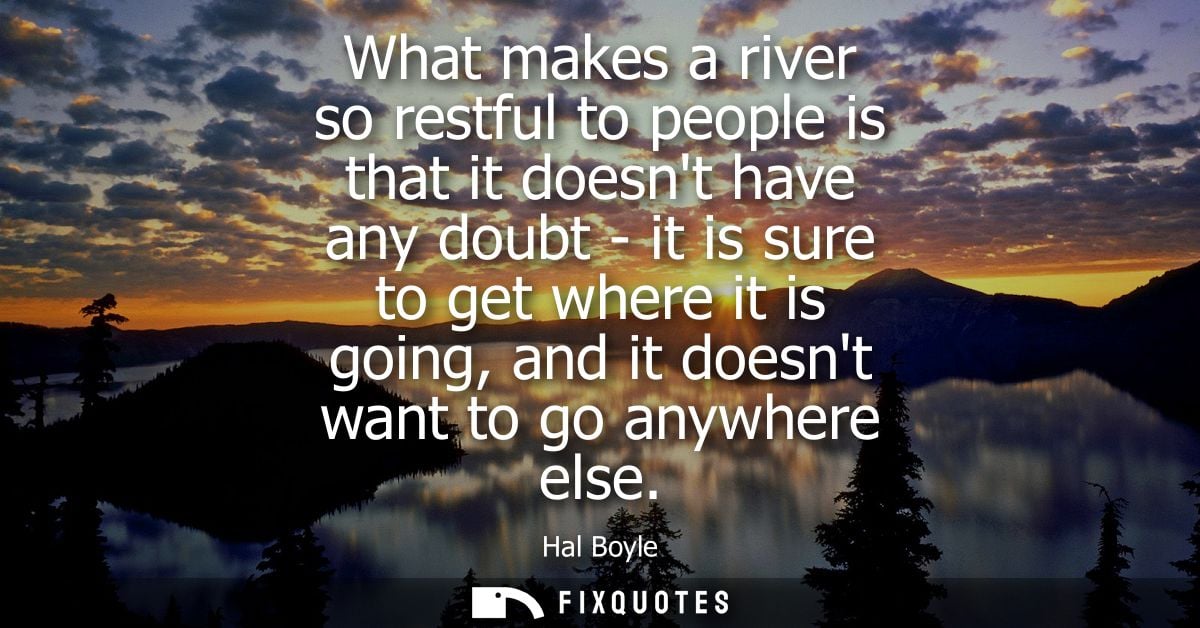
"What makes a river so restful to people is that it doesn't have any doubt - it is sure to get where it is going, and it doesn't want to go anywhere else"
About this Quote
Boyle’s reporter’s eye matters here. Mid-century American journalism lived on deadlines, itineraries, wars, and the industrial churn of getting from one place to the next. In that world, rest isn’t just sleep; it’s relief from contingency. The river becomes a fantasy of certainty in an age of options: it is "sure", not because it’s stubbornly optimistic, but because its physics are destiny. The reassurance comes from watching a system that doesn’t negotiate with itself.
The subtext is slyly moral without preaching. "It doesn’t want to go anywhere else" lands as a critique of status anxiety and the cult of reinvention. Boyle isn’t romanticizing nature so much as diagnosing ambition’s side effects. We admire the river’s single-mindedness because it offers a model of purpose without performance - motion that doesn’t require a justification.
That’s why the sentence feels restful, too: it flows. Boyle builds the thought in clauses that keep moving forward, mirroring the very steadiness he’s praising.
Quote Details
| Topic | Wisdom |
|---|---|
| Source | Help us find the source |
| Cite |
Citation Formats
APA Style (7th ed.)
Boyle, Hal. (2026, January 15). What makes a river so restful to people is that it doesn't have any doubt - it is sure to get where it is going, and it doesn't want to go anywhere else. FixQuotes. https://fixquotes.com/quotes/what-makes-a-river-so-restful-to-people-is-that-163552/
Chicago Style
Boyle, Hal. "What makes a river so restful to people is that it doesn't have any doubt - it is sure to get where it is going, and it doesn't want to go anywhere else." FixQuotes. January 15, 2026. https://fixquotes.com/quotes/what-makes-a-river-so-restful-to-people-is-that-163552/.
MLA Style (9th ed.)
"What makes a river so restful to people is that it doesn't have any doubt - it is sure to get where it is going, and it doesn't want to go anywhere else." FixQuotes, 15 Jan. 2026, https://fixquotes.com/quotes/what-makes-a-river-so-restful-to-people-is-that-163552/. Accessed 30 Mar. 2026.