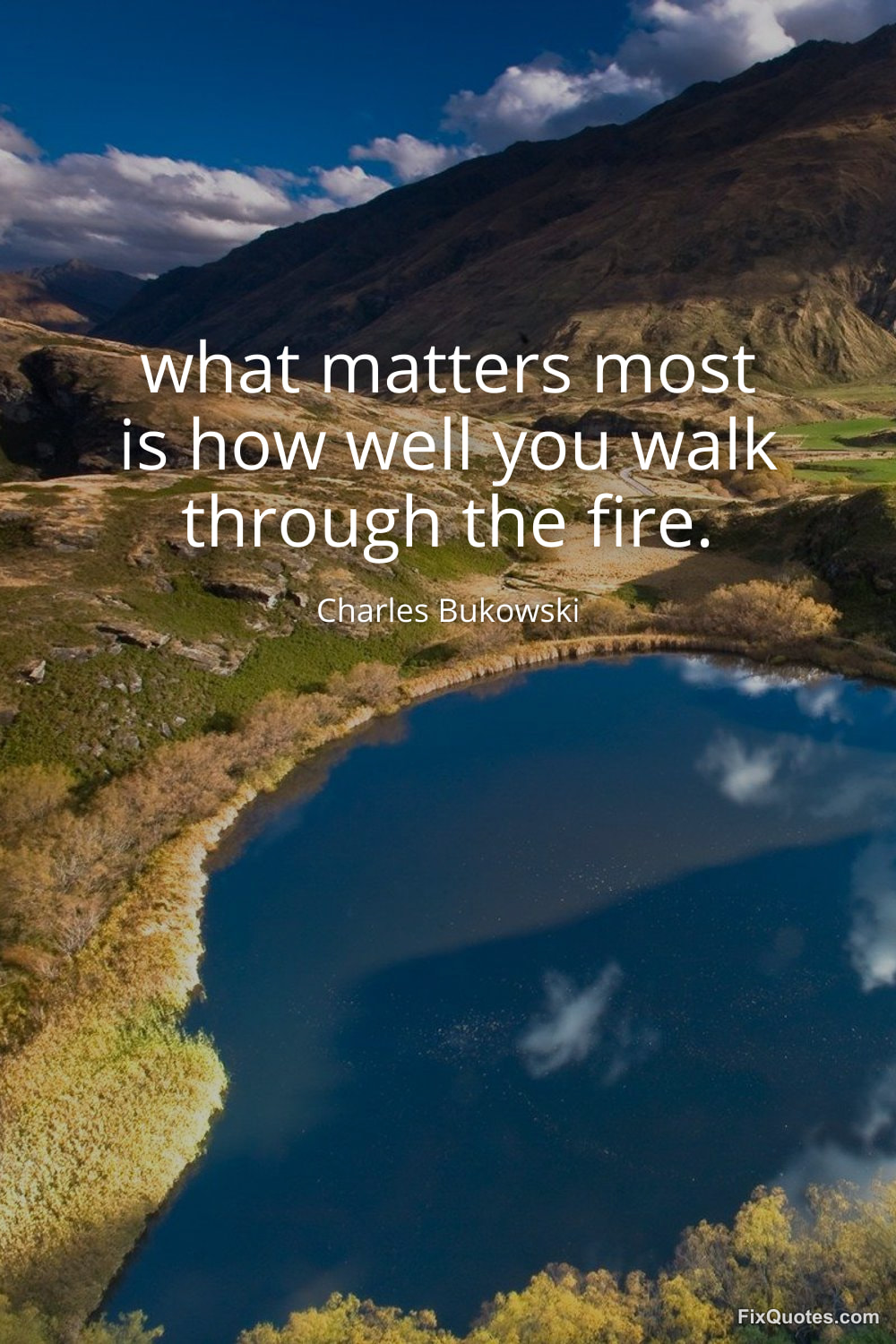
"What matters most is how well you walk through the fire"
About this Quote
Bukowski’s line refuses the luxury of clean triumph. “Walk through the fire” isn’t a motivational poster image of brave self-overcoming; it’s a grimy, street-level metric for survival when life is already burning. The blunt, lowercase cadence carries his signature anti-hero posture: no grand speeches, no moral medals, just the ugly audit of endurance. In Bukowski’s world, the question isn’t whether you get wounded (you will), but whether you can keep moving without turning your pain into performance.
The intent is practical, almost pitiless. By centering “how well”, he shifts value away from outcomes and toward comportment under pressure. That tiny phrase implies an ethic: you don’t control the fire, but you do control your gait. Subtext: suffering is not a special event; it’s the setting. The real scandal, for Bukowski, is people who demand a different universe and then act shocked when they don’t get one. He’s not selling hope so much as scorning self-pity.
Context matters because Bukowski’s persona was built from repetition: dead-end jobs, alcoholism, rejection, and the constant friction between wanting art and needing rent. “Fire” can read as external hardship, but also as inner combustion - addiction, anger, desire, the compulsion to sabotage. “Walk” is crucial: not sprint, not escape, not be rescued. Just the stubborn, unglamorous forward motion. It works because it’s both threat and dare, stripped of sentimentality, aimed at anyone tempted to confuse being burned with being beaten.
The intent is practical, almost pitiless. By centering “how well”, he shifts value away from outcomes and toward comportment under pressure. That tiny phrase implies an ethic: you don’t control the fire, but you do control your gait. Subtext: suffering is not a special event; it’s the setting. The real scandal, for Bukowski, is people who demand a different universe and then act shocked when they don’t get one. He’s not selling hope so much as scorning self-pity.
Context matters because Bukowski’s persona was built from repetition: dead-end jobs, alcoholism, rejection, and the constant friction between wanting art and needing rent. “Fire” can read as external hardship, but also as inner combustion - addiction, anger, desire, the compulsion to sabotage. “Walk” is crucial: not sprint, not escape, not be rescued. Just the stubborn, unglamorous forward motion. It works because it’s both threat and dare, stripped of sentimentality, aimed at anyone tempted to confuse being burned with being beaten.
Quote Details
| Topic | Resilience |
|---|---|
| Source | Charles Bukowski (2012). “The Pleasures of the Damned: Selected Poems 1951-1993”, p.505, Canongate Books |
| Cite |
Citation Formats
APA Style (7th ed.)
Bukowski, Charles. (2026, February 16). What matters most is how well you walk through the fire. FixQuotes. https://fixquotes.com/quotes/what-matters-most-is-how-well-you-walk-through-185122/
Chicago Style
Bukowski, Charles. "What matters most is how well you walk through the fire." FixQuotes. February 16, 2026. https://fixquotes.com/quotes/what-matters-most-is-how-well-you-walk-through-185122/.
MLA Style (9th ed.)
"What matters most is how well you walk through the fire." FixQuotes, 16 Feb. 2026, https://fixquotes.com/quotes/what-matters-most-is-how-well-you-walk-through-185122/. Accessed 27 Mar. 2026.
More Quotes by Charles
Add to List