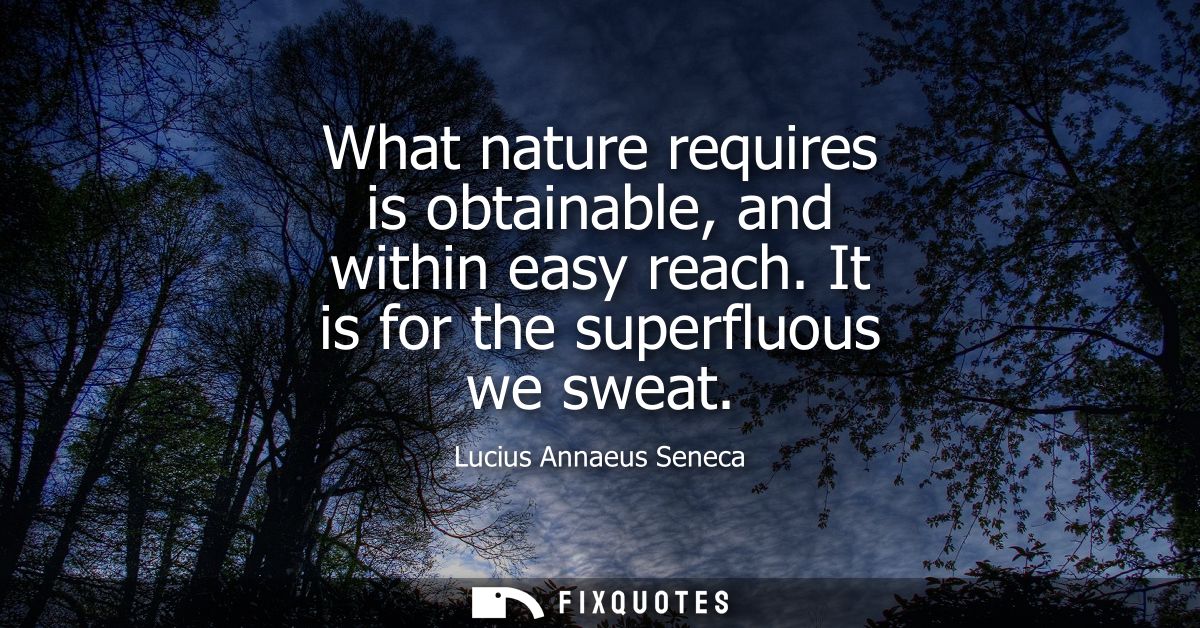
"What nature requires is obtainable, and within easy reach. It is for the superfluous we sweat"
About this Quote
As a Roman statesman steeped in Stoicism, Seneca is writing into an economy of spectacle: elite competition, patronage networks, political precarity, and luxury as a public language. In that world, “superfluous” isn’t just extra stuff; it’s the endless signaling - bigger villas, louder feasts, more influence, more insulation from disgrace. He’s diagnosing an anxiety machine where needs are finite but desires metastasize, and where people mistake the social performance of having enough for the lived experience of being enough.
The subtext is also defensive, even self-implicating. Seneca himself was famously wealthy, which makes this less a scolding from the mountain than a warning from inside the banquet. The quote works because it reframes the problem: nature isn’t the tyrant, appetite is; the hard part isn’t getting what we need, it’s learning to stop calling the unnecessary “necessary.”
Quote Details
| Topic | Wisdom |
|---|---|
| Source | Help us find the source |
| Cite |
Citation Formats
APA Style (7th ed.)
Younger, Seneca the. (2026, January 18). What nature requires is obtainable, and within easy reach. It is for the superfluous we sweat. FixQuotes. https://fixquotes.com/quotes/what-nature-requires-is-obtainable-and-within-8580/
Chicago Style
Younger, Seneca the. "What nature requires is obtainable, and within easy reach. It is for the superfluous we sweat." FixQuotes. January 18, 2026. https://fixquotes.com/quotes/what-nature-requires-is-obtainable-and-within-8580/.
MLA Style (9th ed.)
"What nature requires is obtainable, and within easy reach. It is for the superfluous we sweat." FixQuotes, 18 Jan. 2026, https://fixquotes.com/quotes/what-nature-requires-is-obtainable-and-within-8580/. Accessed 13 Feb. 2026.