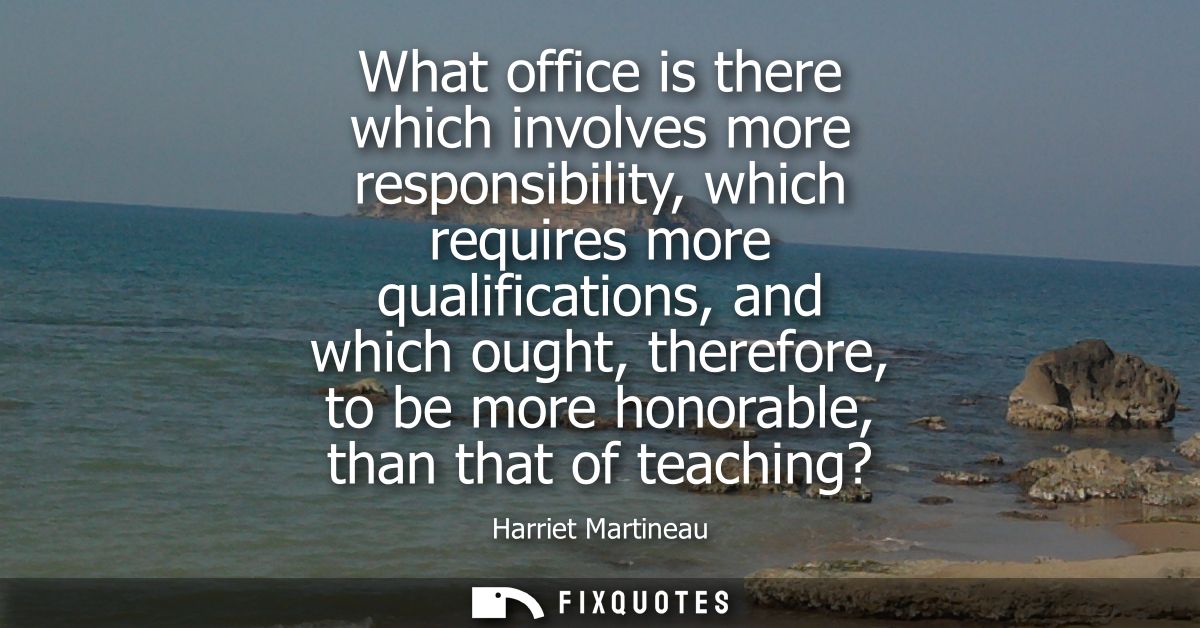
"What office is there which involves more responsibility, which requires more qualifications, and which ought, therefore, to be more honorable, than that of teaching?"
About this Quote
Her trio of escalating clauses is doing political work. “More responsibility” points to consequence: teachers shape citizens, not just students. “More qualifications” pushes back against the patronizing idea that anyone who knows a subject can teach it, a convenient myth for underpaying the labor. “More honorable” is the moral lever - honor as a currency societies claim to prize even when they won’t spend actual money.
The context matters: Martineau wrote in a century obsessed with reform, literacy, and the manufacturing of “respectable” social order, while also limiting women’s professional legitimacy. Elevating teaching reads as both progressive and strategic: one of the few acceptable public roles for women becomes, in her hands, a benchmark for what a serious profession looks like. The subtext is clear-eyed: a nation that mouths reverence for education while treating teachers as expendable is confessing its priorities.
Quote Details
| Topic | Teacher Appreciation |
|---|---|
| Source | Help us find the source |
| Cite |
Citation Formats
APA Style (7th ed.)
Martineau, Harriet. (2026, January 17). What office is there which involves more responsibility, which requires more qualifications, and which ought, therefore, to be more honorable, than that of teaching? FixQuotes. https://fixquotes.com/quotes/what-office-is-there-which-involves-more-54342/
Chicago Style
Martineau, Harriet. "What office is there which involves more responsibility, which requires more qualifications, and which ought, therefore, to be more honorable, than that of teaching?" FixQuotes. January 17, 2026. https://fixquotes.com/quotes/what-office-is-there-which-involves-more-54342/.
MLA Style (9th ed.)
"What office is there which involves more responsibility, which requires more qualifications, and which ought, therefore, to be more honorable, than that of teaching?" FixQuotes, 17 Jan. 2026, https://fixquotes.com/quotes/what-office-is-there-which-involves-more-54342/. Accessed 12 Feb. 2026.