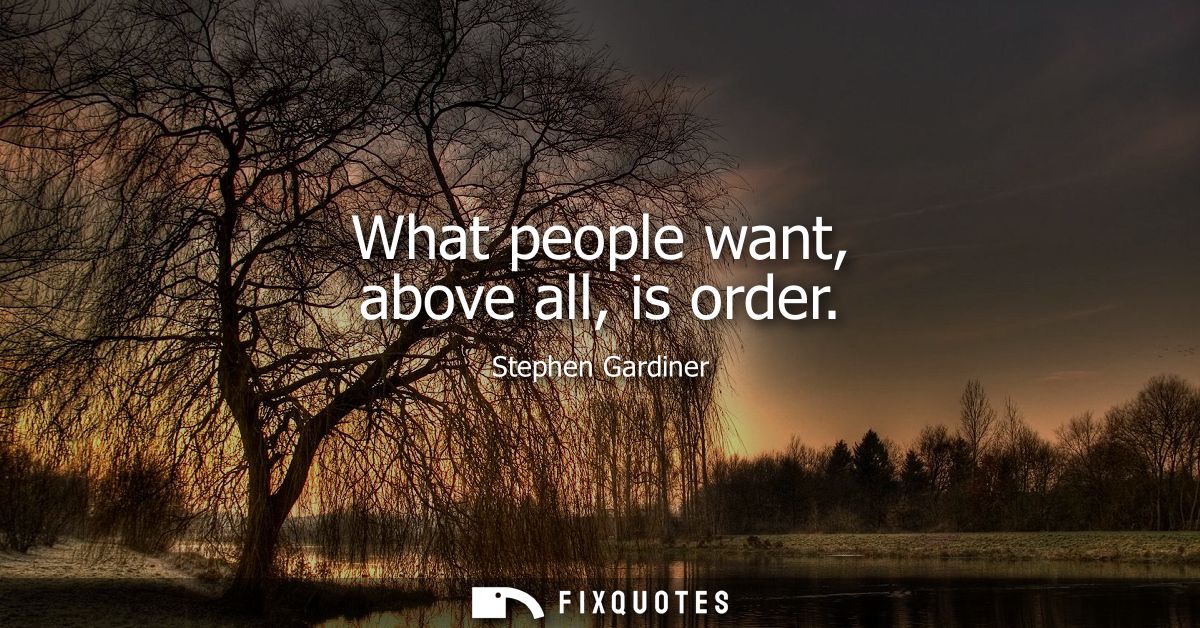
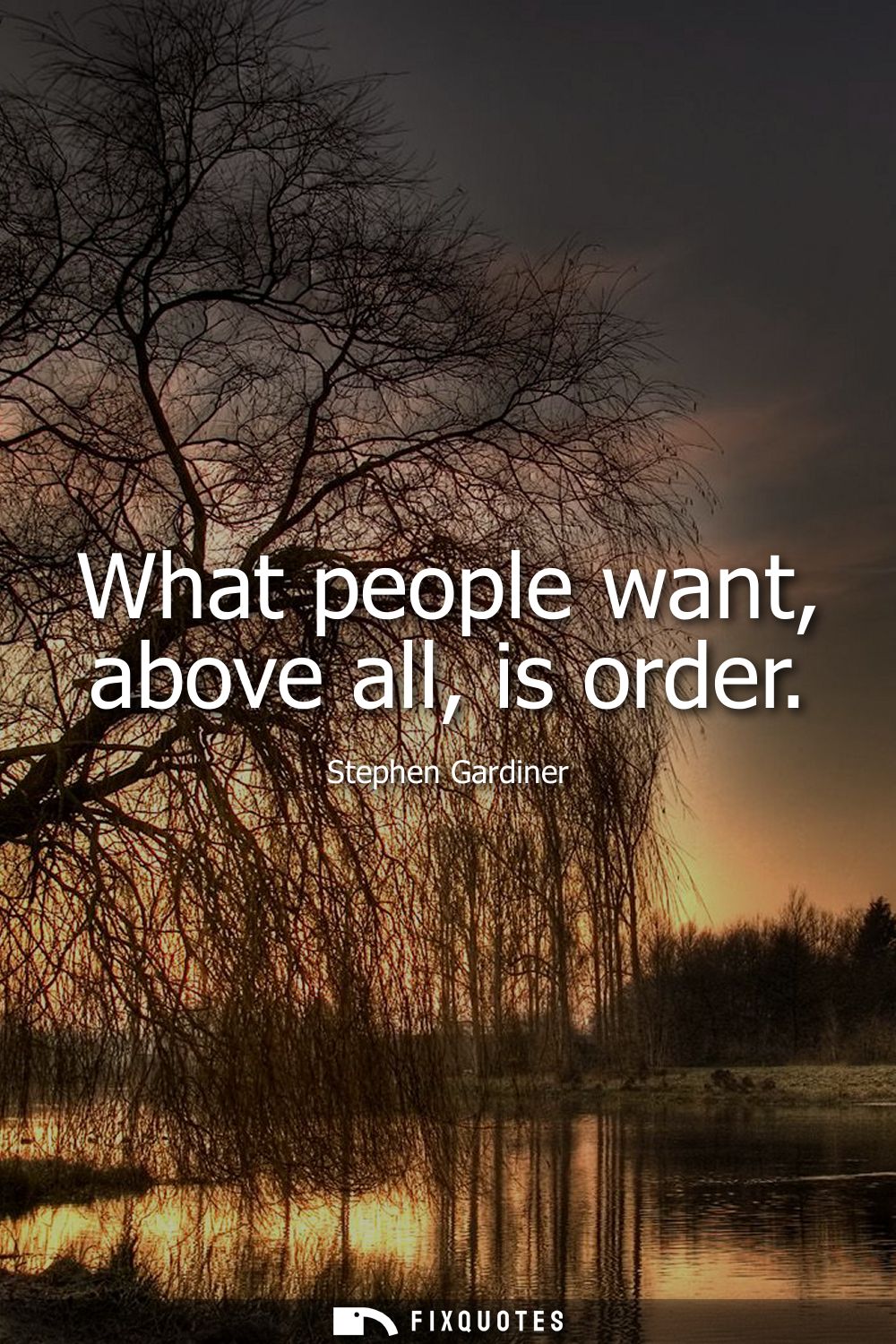
"What people want, above all, is order"
About this Quote
Order is an architect’s dirty secret and enduring sales pitch: people rarely ask for beauty first, but they reliably crave a world that behaves. Stephen Gardiner’s line reads like a cool diagnosis of human nature, yet it’s also a brief for the profession itself. Architecture doesn’t just make spaces; it makes rules you can walk through. Circulation, hierarchy, thresholds, sightlines, even where light lands at noon - these are forms of discipline disguised as comfort.
The intent is pragmatic, almost paternal. Gardiner is defending the built environment as a stabilizing technology: when life is messy, the room shouldn’t be. The subtext is sharper. “Order” isn’t only neatness; it’s legibility and control. A plan you can understand reduces anxiety. A street that “makes sense” tells you where you belong and what you’re allowed to do. That’s why the phrase can feel both reassuring and faintly authoritarian. It flatters the public’s supposed common sense while quietly positioning the designer as the one who supplies it.
Context matters: Gardiner worked in a 20th-century Britain reshaped by reconstruction, planning, and the promises (and failures) of modernism. After wartime dislocation and rapid social change, order was marketed as progress: standardized housing, rational layouts, systems thinking. The irony is that high-modern “order” often produced alienation when it treated people as units rather than neighbors.
The line endures because it names a tension we still live with: we want environments that are coherent enough to calm us, but flexible enough to let us improvise a life.
The intent is pragmatic, almost paternal. Gardiner is defending the built environment as a stabilizing technology: when life is messy, the room shouldn’t be. The subtext is sharper. “Order” isn’t only neatness; it’s legibility and control. A plan you can understand reduces anxiety. A street that “makes sense” tells you where you belong and what you’re allowed to do. That’s why the phrase can feel both reassuring and faintly authoritarian. It flatters the public’s supposed common sense while quietly positioning the designer as the one who supplies it.
Context matters: Gardiner worked in a 20th-century Britain reshaped by reconstruction, planning, and the promises (and failures) of modernism. After wartime dislocation and rapid social change, order was marketed as progress: standardized housing, rational layouts, systems thinking. The irony is that high-modern “order” often produced alienation when it treated people as units rather than neighbors.
The line endures because it names a tension we still live with: we want environments that are coherent enough to calm us, but flexible enough to let us improvise a life.
Quote Details
| Topic | Wisdom |
|---|---|
| Source | Help us find the source |
| Cite |
Citation Formats
APA Style (7th ed.)
Gardiner, Stephen. (2026, January 16). What people want, above all, is order. FixQuotes. https://fixquotes.com/quotes/what-people-want-above-all-is-order-86403/
Chicago Style
Gardiner, Stephen. "What people want, above all, is order." FixQuotes. January 16, 2026. https://fixquotes.com/quotes/what-people-want-above-all-is-order-86403/.
MLA Style (9th ed.)
"What people want, above all, is order." FixQuotes, 16 Jan. 2026, https://fixquotes.com/quotes/what-people-want-above-all-is-order-86403/. Accessed 13 Feb. 2026.
More Quotes by Stephen
Add to List